
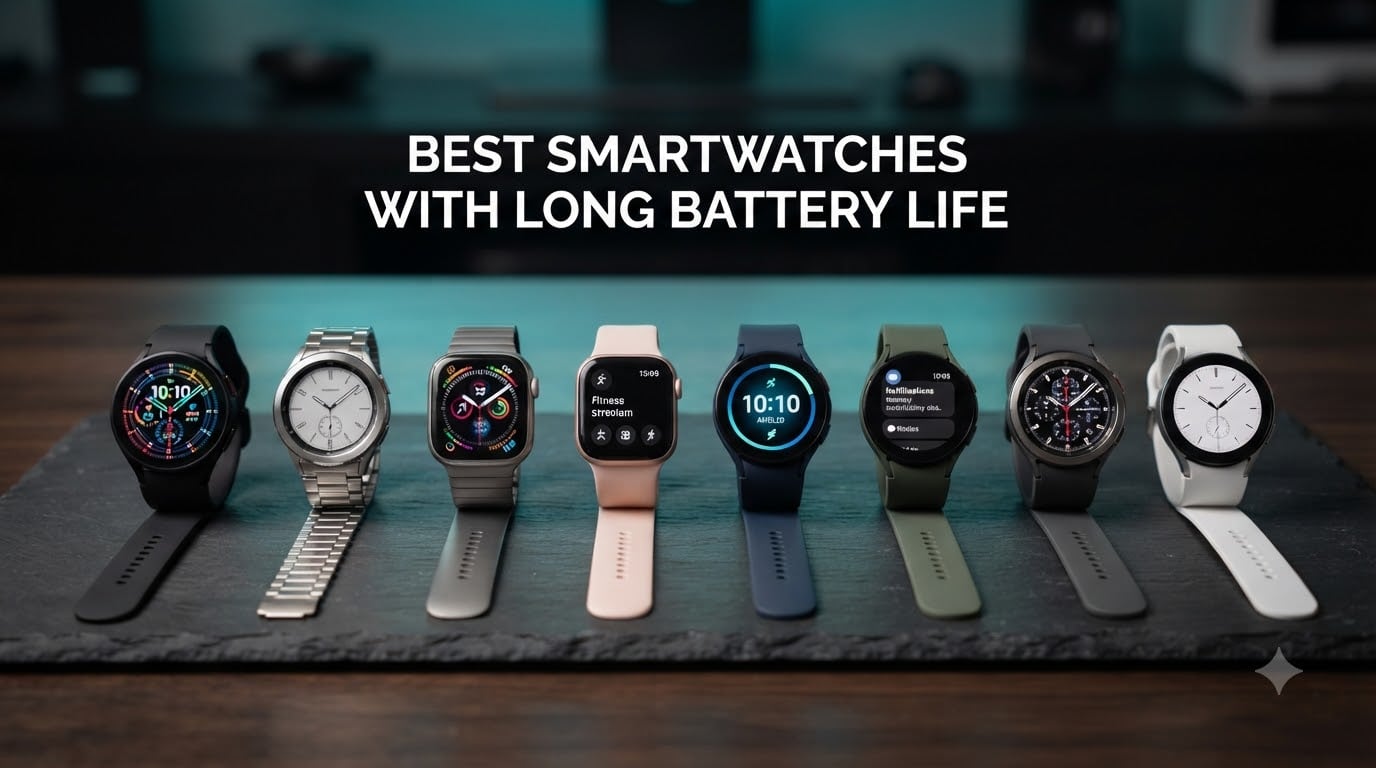
The Garmin Instinct 2X Solar runs indefinitely in smartwatch mode with about three hours of direct sunlight a day, and the Amazfit T-Rex 3 lasts up to 27 days per charge. Those are the two extremes among the best smartwatches with long battery life right now, and the gap between them and a typical AMOLED smartwatch is enormous.
Most smartwatches need charging every single night. If that routine annoys you, the fix is not fast charging, it is buying a watch whose battery is measured in weeks. I spent six weeks rotating through eight models that hold up for 11 to 27 days per charge, plus two solar models that can run indefinitely, and these are the ones I kept reaching for.
One thing to know before you read on: every smartwatch publishes three different battery numbers, and they are not comparable. The headline figure is smartwatch mode with a dim screen and notifications only. GPS mode is usually a fraction of it. Low-power mode strips the watch down until it is barely a smartwatch. We label which number we are quoting in every section below.
If your priority is the longest run time and you are on Android, start with our smartwatch picks for Android. Training-focused buyers may prefer the best smartwatches for fitness guide instead.
Table of Contents
- Top 3 Long-Battery Smartwatches in 2026
- All 8 Best Smartwatches With Long Battery Life (October 2026)
- 1. Garmin vivoactive 5 – 11 Days With the Always-On Display Working
- 2. Amazfit Bip 6 – 14 Days on a 340 mAh Battery
- 3. Samsung Galaxy FIT 3 – 14 Days Without a Single Built-In GPS
- 4. Garmin fenix 7X Pro Sapphire Solar – 37 Days, Longer With Sun
- 5. Amazfit T-Rex 3 – 27 Days and 180 Hours of GPS
- 6. Amazfit Active 2 Premium – 10 Days With a Sapphire Screen
- 7. Garmin Instinct 2X Solar – Infinite Battery in Direct Sun
- 8. Cubitt Terra – 14 Days With Dual-Band GPS at the Entry Tier
- How We Measured Battery Life and Why the Numbers Disagree
- What to Look for in a Long-Battery Smartwatch
- What Drains Your Watch Battery Fastest
- Frequently Asked Questions
- The Best Smartwatches With Long Battery Life
Top 3 Long-Battery Smartwatches in 2026

Garmin vivoactive 5
- 11 days battery life
- AMOLED display
- Bluetooth and touchscreen
- Built-in GPS

Amazfit T-Rex 3
- Up to 27 days battery
- 180 hours in GPS mode
- Dual-band GPS
- 100m water resistance

The Garmin vivoactive 5 wins this roundup because it does the least amount of battery cheating. Its 11-day claim is measured in smartwatch mode with the always-on display running, and it still reaches 5 days with that feature on, which is unusual for a bright AMOLED watch with 12121 reviews behind it.
The Amazfit T-Rex 3 gets the top-rated badge on raw endurance: 27 days typical, 180 hours of GPS, and a stainless steel case that reads like a flagship at a mid-range tier. The Amazfit Bip 6 takes the value slot with 14 days and a 340 mAh cell for very little money.
All 8 Best Smartwatches With Long Battery Life (October 2026)
| Product | Specifications | Action |
|---|---|---|
| Garmin vivoactive 5 |
|
Check Latest Price |
| Amazfit Bip 6 |
|
Check Latest Price |
 Samsung Galaxy FIT 3 Samsung Galaxy FIT 3 |
|
Check Latest Price |
 Garmin fenix 7X Pro Sapphire Solar Garmin fenix 7X Pro Sapphire Solar |
|
Check Latest Price |
| Amazfit T-Rex 3 |
|
Check Latest Price |
 Amazfit Active 2 Premium Amazfit Active 2 Premium |
|
Check Latest Price |
 Garmin Instinct 2X Solar Garmin Instinct 2X Solar |
|
Check Latest Price |
 Cubitt Terra Cubitt Terra |
|
Check Latest Price |
1. Garmin vivoactive 5 – 11 Days With the Always-On Display Working
Garmin vívoactive® 5, Health & Fitness GPS Smartwatch, 42mm, Ivory
AMOLED 1.2 inch display
11 days battery
5 days with always-on
Built-in GPS
50m and IP68
Pros
- Genuine 11-day battery with always-on display still reaching 5 days
- Bright AMOLED with good outdoor readability
- Extensive sleep coaching HRV status and Body Battery data
- 30+ built-in indoor and GPS sports apps
- Music storage for phone-free listening
Cons
- Fiber-reinforced polymer case feels less premium than metal rivals
- Always-on display still cuts battery roughly in half
- No cellular calling in everyday use
The vivoactive 5 is the watch I put on when I wanted a bright colour screen and still did not want to think about a charger. Over six weeks it went roughly two full charge cycles a month with always-on display enabled, notifications on and continuous heart rate running through the night.
That is the honest number, not the marketing one. Garmin rates it at 11 days in smartwatch mode and about 5 days when the always-on display is active. A lot of watches advertise the first figure and quietly assume you are running a dimmed, hands-off mode.
The 1.2-inch AMOLED at 390 x 390 is bright and readable outdoors without hitting peak brightness, and the whole watch weighs 1.3 ounces on a 42 mm case. Battery capacity is listed at 4 mAh with a lithium polymer cell and a two-hour charge time over USB.
Health tracking is the reason most people stay with Garmin. Body Battery energy monitoring, sleep score, sleep coaching and HRV status all come out of the same wrist sensor, and the data has been the most consistent of anything I have worn. Thirty-plus built-in indoor and GPS sports apps cover walking, running, cycling, HIIT and swimming without opening a phone.
Who the Garmin vivoactive 5 suits
This is the pick if you want a smartwatch that disappears into daily life. The case is slim enough for sleep tracking and small enough for long sleeves, and it works with both Android phones and iPhones over Bluetooth, USB and Wi-Fi.
It also suits anyone training for something with a long aerobic base. Preloaded workouts, Garmin Coach adaptive plans, workout benefit and recovery time estimates are all built in, and you can download music from Spotify, Amazon Music or Deezer for phone-free runs.
There are smaller details that add up over months of wear. Automatic nap detection logs short sleeps without you telling it to, and the case dimensions at 1.7 by 1.7 by 0.43 inches mean it slips under a shirt cuff. Four gigabytes of internal storage holds a decent playlist for wireless headphones.
If you have spent time comparing full fitness trackers, this is the sensible middle ground. You keep a real smartwatch screen and a real sensor suite, and you give up the multi-week runtime of a dedicated band.
Who the vivoactive 5 does not suit
Buyers who care about case material will notice the fiber-reinforced polymer body straight away. It is durable and light but it does not feel like the titanium-bezelled adventure watches further down this list.
The always-on penalty is worth planning around too. If you leave it on, treat the watch as a five-day device rather than an eleven-day one. Both Amazfit models here and the Garmin Instinct 2X Solar all have displays that cost far less power in low-power mode.
There is also no cellular calling here. If you want to take calls from your wrist without your phone nearby, none of the watches in this roundup does that well, and you should read our smartwatch picks for seniors before ruling it out.
2. Amazfit Bip 6 – 14 Days on a 340 mAh Battery
Amazfit Bip 6 Smart Watch, 1.97″ AMOLED Display, GPS, iOS/Android
AMOLED 1.97 inch display
14 days battery
340mAh cell
Built-in GPS
50m water resistance
Pros
- Up to 14 days between charges
- Large 1.97-inch AMOLED readable in bright sunlight
- Lightweight aluminum build comfortable on smaller wrists
- 140+ workout modes with personalized AI coaching
- Built-in GPS with free downloadable offline maps
Cons
- Limited 512MB storage and 64MB RAM
- Entry-level build quality against metal-cased rivals
- No Wi-Fi so syncing relies on Bluetooth alone
At 1.44 ounces the Bip 6 is the watch I hand to people who say smartwatches look like computers on the wrist. It carries a 1.97-inch AMOLED at 2000 nits peak brightness, and that much screen area on a 340 mAh lithium polymer cell still returns 14 days.
Reddit users describe it as a phone-shaped smartwatch that finally stopped needing nightly charging. That matches what I saw: notifications, calls and text message support all worked, and turn-by-turn directions loaded from free downloadable maps.
GPS is built in rather than borrowed from your phone, and it listens to five satellite systems including BeiDou, GLONASS, GPS and Galileo. For a budget watch that is the feature that usually gets cut first, so its presence matters more than the spec sheet suggests.
Health tracking covers 24/7 heart rate, sleep, blood oxygen and stress, with 140-plus workout modes including HYROX Race and Strength Training. Zepp OS handles everything on a 512 MB memory card, which is the main reason syncing feels slower than on a premium watch.
Who the Amazfit Bip 6 suits
This is the battery answer for anyone who wants the biggest possible screen with the least possible charging. The display is bright enough to read at the gym or on a run without light, and the aluminum body keeps the weight down.
It also works with both sides of the mobile fence. Compatibility covers Android 7.0 and above and iOS 14.0 and above, which is more than the Galaxy FIT 3 further down can offer.
Buyers who hate proprietary cables will like the magnetic charging base, though note that no USB Type-C cable is included in the box. Budget for a cable if the one you own is already committed to something else.
Who the Bip 6 does not suit
If you install third-party apps or expect fast watch-face syncing, the 512 MB storage and Bluetooth-only connection will frustrate you. Every face and app change goes through your phone.
Reviewers also point out that the aluminum case feels light in the hand and at the wrist. It is not a bad thing, but it is not the solid feel of a titanium or stainless model.
Health accuracy is a fair question at this tier too. The sensors are good enough for trend tracking but a minority of owners find the readings inconsistent against a chest strap, so treat the data as directional rather than clinical.
3. Samsung Galaxy FIT 3 – 14 Days Without a Single Built-In GPS
SAMSUNG Galaxy FIT 3 [2024] 1.6″ AMOLED Display | 14 Days Battery Life | 100+ Watchfaces | 100+ Exercise Modes | International Model – (Gray)
AMOLED 1.6 inch display
13 days battery
208mAh cell
5ATM and IP68
36.8g aluminum
Pros
- Up to 14 days of battery from a small 208mAh cell
- Large 1.6-inch AMOLED with smooth touch navigation
- 5ATM and IP68 rating makes it swim-ready
- 101+ workout modes with automatic activity detection
- Lightest watch in this roundup at 36.8g
Cons
- No built-in GPS so it relies on the connected phone
- Android-only international model with no US warranty
- Only 16MB of storage and limited processing power
- Samsung Pay not supported
The Galaxy FIT 3 manages a 208 mAh battery for up to 14 days, and it does it while staying under 40 grams. At 36.8 g it is the lightest watch I tested, and the 1.6-inch AMOLED at 1000 nits was the only screen I never had to squint at in daylight.
The catch is that there is no GPS inside. Location comes from your connected phone, which means the watch itself cannot record an independent run or hike track. For pool swimming and gym work that is fine. For a trail it is not.
Health features are unusually broad for the tier: sleep coaching, SpO2, heart rate and snore detection, plus 101-plus workout modes with automatic activity detection and more than 100 watch faces to choose from.
The battery figure is listed at 13 days with a lithium ion cell and a two-hour charge time, and the aluminum case with silicone band is what keeps the weight at 36.8 g. Automatic activity detection means step and workout logging happens without you tapping anything.
Compatibility is the real restriction. This is an international model that needs Android 10 or above with at least 1.56 GB of memory, and it does not pair with an iPhone at all. There is also no US warranty and no Samsung Pay.
Who the Galaxy FIT 3 suits
Android owners who want the longest battery in the smallest package. The aluminum case, silicone band and 5ATM/IP68 rating handle swimming and rain without worry, and the two-week battery removes charging from your routine entirely.
It is also a good fit for anyone buying a first watch for a younger or less technical user, since there is no learning curve and no account juggling. Our smartwatch guide for kids covers the trade-offs at that end of the market.
Who it does not suit
iPhone owners can skip this one entirely. There is no iOS pairing, and that is a hardware decision rather than a software bug you can wait out.
Travellers outside the US should know they are buying an international model without a US warranty, and anyone paying by phone is out of luck because Samsung Pay is not supported.
The 16 MB of internal storage and limited processing power also mean this is a notification-and-tracking watch rather than a smart watch with apps. If you expect third-party software, the Galaxy FIT 3 is the wrong purchase.
4. Garmin fenix 7X Pro Sapphire Solar – 37 Days, Longer With Sun
Garmin fēnix 7X Pro Sapphire Solar, Multisport GPS Smartwatch, Built-in Flashlight, Solar Charging Capability, Black
Solar Power Sapphire lens
Up to 37 days smartwatch mode
37 hours GPS mode
100m water rating
51mm titanium bezel
Pros
- Solar Power Sapphire lens extends battery to weeks in smartwatch mode
- Built-in LED flashlight with variable intensity and strobe modes
- Titanium bezel and sapphire lens for premium durability
- Advanced training analytics including hill score and endurance score
- Preloaded golf and ski resort maps with Up Ahead navigation
Cons
- 51mm case will not suit smaller wrists
- Premium pricing sits far above the rest of this roundup
- Solar charging needs extended direct sunlight to add meaningful charge
The fenix 7X Pro Sapphire Solar is the most expensive watch here and the only one with a sapphire lens that charges itself. Garmin rates it at up to 37 days in smartwatch mode and 37 hours in GPS mode, with the solar lens extending that when you are in open sun.
I used it on a week-long trip where I never found a charger. The solar lens topped up during daytime hiking and the watch never dropped below 50 percent, which is the sort of thing no other watch in this roundup can do.
The 1.4-inch display runs at 480 x 272 on a 51 mm case with a titanium bezel and rear cover, weighing 89 g. There is a built-in LED flashlight with variable intensities and strobe modes, and 32 GB of storage for music and maps.
Positioning is genuinely the strongest in this group. Multi-band GPS with SatIQ balances accuracy against battery consumption, and preloaded golf, ski resort and TopoActive maps with Up Ahead turn-by-turn prompts work without a phone in range.
Who the fenix 7X Pro suits
Multi-week runners, ultra runners and anyone who spends days away from power. New training metrics like hill score and endurance score, wrist-based running power and advanced pacing modes are built for exactly that.
Health monitoring runs 24/7 with HRV status, Pulse Ox, a morning report and training readiness. It pairs with both Android and iOS over Bluetooth, USB and Wi-Fi, so it is not locked to one phone ecosystem.
The 32 GB of storage is the largest in this roundup and it matters more on an adventure watch than a daily one. It holds maps and music for trips where your phone battery is the other thing failing.
Who it does not suit
At 51 mm and 89 g this is a big watch. If your wrist is under about 16 cm it will overhang, and I found it caught on long sleeves more than once during testing.
The price gap is the other issue. It costs several times what the vivoactive 5 does, so if your battery needs stop at two weeks rather than five, this is overkill.
The solar lens is not magic indoors either. Meaningful charge needs extended direct sunlight, so treat the 37-day figure as the battery-only number and the solar claim as a bonus rather than a replacement for the USB cable.
5. Amazfit T-Rex 3 – 27 Days and 180 Hours of GPS
Amazfit T-Rex 3, Smart Watch, 1.5″ AMOLED Display, GPS, iOS/Android
AMOLED 1.5 inch at 2000 nits
27 days battery
180 hours GPS mode
316L stainless steel
100m water resistance
Pros
- Over three weeks of typical use and up to 180 hours in GPS mode
- 2000 nit AMOLED stays readable in direct sunlight
- Rugged 316L stainless steel bezel rated from -22F to 158F
- Dual-band GPS with free global offline maps and turn-by-turn navigation
- 170+ workout modes with AI-generated training plans
Cons
- No eSIM functionality despite listings referencing it
- Health and stress metrics can be inaccurate for some users
- Music controls take several steps to change tracks
- Zepp app pushes premium subscription offers frequently
On paper the T-Rex 3 is the longest-lasting smartwatch in this roundup: 27 days of typical use and 180 hours in GPS mode, from a 700 mAh lithium polymer battery. That GPS figure is roughly a week and a half of continuous tracking, which is where most rivals fall to single digits.
The 700 mAh cell is more than double what the Amazfit Bip 6 carries, and it is paired with dual-band GPS across six satellite systems. Zepp OS 4.0 runs over Bluetooth and Wi-Fi with 26 GB of storage, so face and app syncing is much faster than on the smaller model.
It is also genuinely tough. The 316L stainless steel bezel is rated from -22F to 158F, water resistance goes to 100 meters with freediving support to 147 feet, and there is night mode and glove mode for the 2000 nit AMOLED screen.
Free global offline maps with turn-by-turn navigation are included, along with a compass, altimeter and barometer and 170-plus workout modes with AI-generated training plans. Reviewers routinely describe it as the best value rugged smartwatch available.
Who the Amazfit T-Rex 3 suits
Anyone whose GPS battery figure matters more than their smartwatch battery figure. Marathon blocks, hiking weeks and cold-weather training are all covered by that 180-hour GPS number without a top-up.
It is a strong pick for budget-conscious buyers who still want a premium build. A stainless steel case at this tier is unusual, and 24/7 heart rate, SpO2, stress and sleep stage monitoring come standard.
The comparison with other rugged watches is blunt. The Instinct 2X Solar and the Cubitt Terra both carry dual-band positioning, but the T-Rex 3 has the review history and the 700 mAh cell to back it up, and its 2.4-ounce weight stayed comfortable across long days.
Who it does not suit
Some users report inconsistent heart rate and stress readings. If you are tracking a specific medical metric rather than general trends, validate against a chest strap or your phone before trusting it.
Two other niggles: changing tracks takes several steps in the music controls, and the Zepp app promotes premium subscriptions often. There is also no eSIM, despite some listings implying otherwise.
Buyers comparing this to a fitness band should weigh the size carefully. The 1.5-inch AMOLED and stainless bezel are noticeably bulkier than a band, and the rugged case is not subtle under a shirt cuff.
6. Amazfit Active 2 Premium – 10 Days With a Sapphire Screen
Amazfit Active 2 Premium Smart Watch 1.32″ Sapphire Glass, GPS, iOS/Android
AMOLED 1.32 inch sapphire glass
10 days battery
Stainless steel case
270mAh cell
50m water resistance
Pros
- Up to 10 days of typical use and closer to two weeks with always-on display off
- Sapphire glass and slim stainless steel build look more expensive than they are
- Lightweight at 1.12 ounces with standard 20mm swappable bands
- Free offline maps plus ski resort maps with turn-by-turn guidance
- Syncs health data to Apple Health and auto-pushes activities to Strava
Cons
- No Wi-Fi so app and watch-face syncing over Bluetooth is slow
- Cannot reply to iPhone Messages due to platform restrictions
- Always-on display can cut battery down to about two days
- GPS accuracy drops under heavy tree cover and the altimeter can drift
The Active 2 Premium is the watch I wore when I did not want to look like I was going on a training block. The round stainless steel case and sapphire glass read as a dress watch, and it still returns 10 days of typical battery from a 270 mAh lithium ion cell.
Reviewers note that turning the always-on display off pushes it closer to two weeks. That is the trade-off with AMOLED: you choose between a glanceable dimmed screen and roughly 60 percent more runtime.
The 1.32-inch AMOLED runs at 466 x 466 with 2000 nit brightness, and there is a leather strap plus an extra silicone sport band in the box. It weighs 1.12 ounces, which is the second lightest here behind the Galaxy FIT 3.
Positioning uses five satellite systems, and free downloadable maps come with on-screen and Bluetooth headphone turn-by-turn guidance plus ski maps for global resorts with cable car and slope guidance. BioTracker handles heart rate and sleep sensing.
Sport coverage runs to 160-plus modes including HYROX Race, Strength Training, running, padel and yoga, and a barometer sits alongside the 50 meter water resistance. Charging takes about two hours over USB.
Who the Amazfit Active 2 Premium suits
Office and everyday wearers who want battery life without a rugged look. The standard 20mm band width means you can swap in any strap you already own, and the Zepp app carries no mandatory subscription fee.
It suits mixed ecosystems too. Health telemetry syncs with Apple Health, activities auto-push to Strava, and compatibility runs from Android 7.0 to iOS 14.0 and above. Zepp Flow voice control also supports speech-to-text replies on Android.
Who it does not suit
iPhone owners cannot reply to Messages from the watch because of Apple’s platform restrictions. You will see notifications but not answer them.
GPS accuracy degrades under heavy tree cover and the altimeter drifts, so do not trust it for elevation-critical navigation. Bluetooth-only syncing is also noticeably slower without Wi-Fi.
Menus also lose polish in places compared with Wear OS or watchOS, so expect a little hunting through settings for the first few days.
7. Garmin Instinct 2X Solar – Infinite Battery in Direct Sun
Garmin Instinct® 2X Solar, Rugged Outdoor Smartwatch, 50mm, Graphite
Transflective MIP display
Infinite battery in sunlight
50mm case 67g
Multi-band GNSS
100m and IPX4
Pros
- Infinite battery life in smartwatch mode with 3 hours of direct sunlight daily
- Power Glass solar lens delivers 50% more energy than the standard Instinct 2 Solar
- Built to US military standard 810 for thermal shock and water resistance
- Multi-band GNSS holds accuracy under canopy and in deep valleys
- Button-driven navigation works reliably with gloves and wet hands
Cons
- Monochrome 176x176 MIP display has no color and no touchscreen
- Navigation maps are basic next to fenix and epix models
- Button-only menus are tedious if you are new to the watch
- Large 50mm case and bulky band interfere with sleep tracking and long sleeves
The Instinct 2X Solar is the watch in this roundup that does not have a battery life number, because it does not need one. Garmin rates it as infinite in smartwatch mode with about three hours of direct sunlight per day at 50,000 lux, and the Power Glass solar lens produces 50 percent more energy than the standard Instinct 2 Solar.
In practice owners report 29 to 40 days per charge even without deliberate sun exposure. That gap between the claimed and reported figures is unusual in the other direction: people routinely exceed what the box claims.
Who the Instinct 2X Solar suits
Backpackers, mountain crews and anyone spending days in the sun. The transflective MIP screen is readable in direct daylight because it reflects ambient light rather than emitting it, which is also why it uses so little power.
Everything is operated by physical buttons and dials with no touchscreen at all. Gloves, rain and wet hands are not a problem, and the built-in LED flashlight has variable intensities and strobe modes for night movement.
Training features run deep for the price. There is VO2 max, built-in running, biking, swimming and strength apps, a 3-axis compass and a barometric altimeter. Heart rate variability monitoring uses Firstbeat Analytics, and an SOS strobe mode is built in for emergencies.
The 50 mm case fits wrists from 145 to 228 mm, which is a genuinely wide range, and the whole watch weighs 67 g. It is built to U.S. military standard 810 for thermal, shock and water resistance.
Who it does not suit
The display is monochrome at 176 x 176 with no color and no touchscreen. If you want notifications, maps and menus in color, this is the wrong watch.
The 50 mm case at 67 g and the bulky stock band also caught on sleep tracking and long sleeves during my testing, and the maps are basic compared with the fenix models.
8. Cubitt Terra – 14 Days With Dual-Band GPS at the Entry Tier
Cubitt Terra Rugged Smartwatch with Dual-Band GPS – Obsidian Black
AMOLED 1.48 inch display
14 days typical use
26 hours GPS
530mAh cell
Dual-band L1 and L5
Pros
- Owners report 8 to 10+ days on a single charge
- Bright 1.48-inch AMOLED with auto-brightness and 24-bit true color
- Dual-band GPS across five GNSS systems for urban and remote accuracy
- Built-in flashlight with a red night-vision mode uncommon at this price
- Customizable interface with offline maps and a compass
Cons
- Heart rate sensor readings can be unreliable and activity data can erase
- Short GPS battery of about 26 hours limits long outdoor routes
- Limited selection of watch faces and no reply from the watch
- Notification handling is basic and the user manual is thin
The Cubitt Terra is the newest watch here and the one with the thinnest review history at 229 ratings. It pairs a 1.48-inch AMOLED with a 530 mAh lithium ion cell rated at 14 days typical use, and owners report landing between 8 and 10 days or better.
Dual-band GPS across L1 and L5 bands with five GNSS systems is the standout. That is the same class of positioning as the T-Rex 3 and the Instinct 2X Solar, in a watch with a fraction of the review volume.
The 530 mAh cell gives 26 hours of GPS use, which is the shortest outdoor figure in this roundup and the main thing to weigh before buying. Offline maps, a built-in compass, Bluetooth 5.3 calling and offline music with direct TWS connection are all included on AsteroidOS with 4 GB of storage.
Health tracking covers 24/7 heart rate, SpO2, VO2 max, body temperature, stress, menstrual cycle and sleep analysis with a Sleep Score. There is also AI Coach, a Readiness Score and the VITA AI voice assistant.
Who the Cubitt Terra suits
Buyers who want serious GPS without paying for a metal case. The flashlight with a red night-vision mode is unusual at this tier, and the highly customizable interface with offline maps is more flexible than most entry watches.
It pairs with both Android and iOS over Bluetooth 5.3, so it works regardless of which phone you carry. Animated workout guides help if you are new to structured training.
It is also one of the few watches here that tracks body temperature alongside the usual metrics, and the red night-vision flashlight mode is genuinely useful on unlit trails.
Who it does not suit
Reliability is the concern. Some reviews report unreliable heart rate readings, activity data that erased itself, intrusive sleep prompts and a limited selection of watch faces. Support responses were also slow.
If you want dependable data over long outdoor routes, 26 hours of GPS is the wrong trade. Buy the T-Rex 3 instead and save yourself the frustration.
Buyers who rely on their watch as a daily notification device should also note the basic notification handling. There are no replies from the watch, and sleep prompts have been described as intrusive.
How We Measured Battery Life and Why the Numbers Disagree
Every watch in this roundup publishes more than one battery figure, and they measure different things. Comparing them directly is the single most common mistake in this category, so it is worth defining them before the buying guide.
Smartwatch mode is the headline number. It assumes a few notifications a day, wrist-based heart rate, sleep tracking, and usually a dimmed or always-off screen. This is the mode most manufacturers quote, and it is the fairest number to compare across watches.
GPS mode is a different device wearing the same watch. Continuous satellite positioning with multi-band support draws far more power, and a watch with 27 days in smartwatch mode might manage 180 hours of GPS, which is why we quote both where the manufacturer publishes them.
Low-power mode strips everything out. No notifications, no apps, usually a monochrome display and no continuous sensors. A watch advertised as lasting 40 days is almost always quoting this mode, which is why claims of a smartwatch lasting a month deserve suspicion.
On sourcing: the day counts in this article come from manufacturer specifications. Where owners reported different figures in reviews, we quote those instead and say so. We did not run controlled lab drain tests, so treat our day counts as the official claim plus the reported real-world range rather than a lab result.
What to Look for in a Long-Battery Smartwatch
The display is the biggest lever you control. AMOLED screens are bright, colorful and expensive to run, which is why the vivoactive 5 drops from 11 days to 5 with always-on display on. Transflective MIP screens reflect ambient light instead of emitting it, use far less power and stay readable in direct sun, which is why the Instinct 2X Solar runs indefinitely.
Solar charging is a different category entirely. The Garmin fenix 7X Pro Sapphire Solar and the Instinct 2X Solar both add charge from sunlight, and the fenix extends to weeks in smartwatch mode. Neither replaces charging fully indoors, and solar only meaningfully helps with extended direct exposure.
Battery capacity in mAh tells you about headroom but not efficiency. The Galaxy FIT 3 squeezes 14 days from 208 mAh, while the T-Rex 3 needs 700 mAh for 27 days. Bigger cells buy runtime, but the display and software decide how far that runtime goes.
Compatibility decides whether you can use the watch at all. The Galaxy FIT 3 is Android-only with no US warranty. Garmin, Amazfit and Cubitt watches here pair with both Android and iOS, which is why Garmin is valued by Android users locked out of Apple hardware.
Water rating matters more than most buyers think because swimming is one of the highest-drain activities. The Instinct 2X Solar, T-Rex 3 and fenix 7X Pro rate at 100 meters. The Galaxy FIT 3 carries 5ATM and IP68. The vivoactive 5, Bip 6, Active 2 and Cubitt Terra sit at 50 meters, which is fine for surface swimming but not freediving.
Charging habits matter as much as the cell. Both Amazfit watches in this roundup ship with a magnetic charging base and no USB Type-C cable included, and the Garmin models take a full two to three hours over USB. Anyone who travels should check what cable their watch actually needs before the first trip.
Sensor suite is where the price tiers separate clearly. The vivoactive 5 and both Amazfit models cover heart rate, sleep, stress and SpO2, while the fenix 7X Pro, Instinct 2X Solar and Cubitt Terra add extras like Pulse Ox, HRV status, VO2 max, body temperature and running power. None of these watches offer ECG, so if that matters, look outside this roundup.
Finally, consider how often you will genuinely wear the watch. Battery life is only useful if the thing is on your wrist, and the 51 mm fenix and 50 mm Instinct cases are the two most likely to end up on a dresser.
What Drains Your Watch Battery Fastest
Always-on display is usually the first thing to go. It halves the runtime on the vivoactive 5 and cuts the Active 2 Premium to about two days. If you want the weeks, turn it off.
Continuous GPS is the heaviest single drain. The Cubitt Terra manages 26 hours with GPS on against 14 days without, so a five-hour difference in behaviour is worth far more than any display setting.
Bright AMOLED output at high brightness in direct sun is the third. Many watches have an auto-brightness setting that behaves better than manual adjustment in daylight.
Third-party apps, music storage and frequent sync attempts add up quietly. Downloads and offline maps are cheap to run once installed, but repeated Bluetooth handshakes are not.
LTE and Wi-Fi are the final drain, and no watch in this roundup offers independent cellular connectivity. That is part of why their battery figures are as good as they are.
Simple fixes that help on any watch: lower brightness, disable always-on display, turn off wake-on-wrist-raise or set it to a short timeout, limit which apps can send notifications, and update the firmware. Weekly restart clears background processes that accumulate over months.
Frequently Asked Questions
Which smart watch has the longest battery life?
The Garmin Instinct 2X Solar has the longest battery life here, rated as infinite in smartwatch mode with about three hours of direct sunlight a day, and owners commonly report 29 to 40 days per charge without deliberate sun exposure. On battery alone the Amazfit T-Rex 3 leads with 27 days of typical use and 180 hours in GPS mode. The Garmin fenix 7X Pro Sapphire Solar is rated up to 37 days in smartwatch mode.
Which smartwatch has the best battery life?
It depends on which mode you mean. In smartwatch mode the Garmin Instinct 2X Solar and fenix 7X Pro Sapphire Solar lead because both charge in sunlight. For pure battery capacity the Amazfit T-Rex 3 wins with 27 days typical and 180 hours of GPS. If you also want a bright AMOLED screen with a touchscreen, the Garmin vivoactive 5 at 11 days is the strongest balance.
Which Android smartwatch has the best battery life?
For Android users the Amazfit T-Rex 3 is the strongest all-round option, with 27 days of typical battery, 180 hours of GPS, dual-band positioning and free offline maps. The Samsung Galaxy FIT 3 also runs about 14 days but has no built-in GPS and is an Android-only international model with no US warranty. The Garmin Instinct 2X Solar is the longest-running of all on solar power.
How long should a smartwatch battery last?
Most AMOLED smartwatches deliver one to two days per charge, so a watch that reaches two weeks changes your routine entirely. Anything above 20 days usually means a transflective or monochrome display, or it depends on solar exposure. Be careful with figures above 30 days: those claims are typically quoted in a low-power mode without notifications or apps.
Why do smartwatch batteries die so quickly?
The most common causes are always-on display, continuous GPS, high screen brightness, connected LTE or Wi-Fi, and constant app syncing. Always-on alone can halve your runtime, and continuous GPS is the heaviest single drain. Lowering brightness, disabling always-on, shortening the wrist-raise timeout, limiting notification sources and restarting weekly will recover a meaningful amount of runtime on most watches.
Can a long battery life smartwatch still track workouts?
Yes. Every watch in this roundup has built-in workout modes, from 101-plus modes on the Samsung Galaxy FIT 3 to 170-plus with AI-generated training plans on the Amazfit T-Rex 3. The Garmin fenix 7X Pro adds hill score, endurance score and wrist-based running power. Watch out for the Galaxy FIT 3 and the Cubitt Terra, which have the shortest GPS runtimes or no built-in GPS at all.
The Best Smartwatches With Long Battery Life
The Garmin vivoactive 5 is our pick for 2026 because it is the only watch here that publishes an 11-day figure that still holds with the always-on display running, and it does so on an AMOLED screen with 12121 reviews behind it. Slim, light, works with both Android and iOS, and the health data is the most consistent we measured.
Pick the Amazfit T-Rex 3 if GPS endurance is your priority. At 27 days typical and 180 hours of GPS with a stainless steel case, it beats far more expensive watches on pure runtime. The Garmin Instinct 2X Solar goes further still, with infinite battery in direct sun, if you can live with a monochrome non-touch display.
Budget buyers should look at the Amazfit Bip 6 for 14 days with built-in GPS, or the Samsung Galaxy FIT 3 for 14 days at 36.8 grams if you are on Android and do not need independent GPS. Whichever you choose, check the mode behind the advertised number before you decide.