
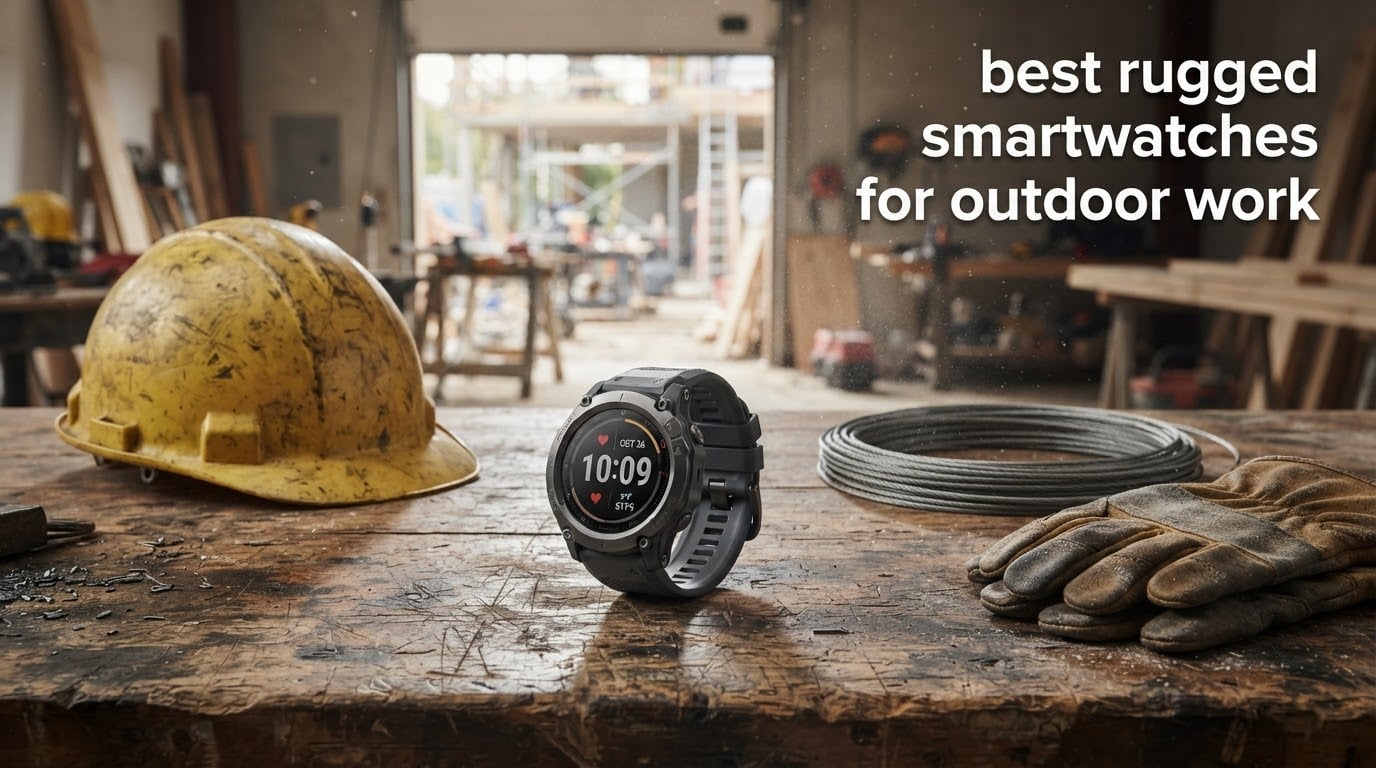
A rugged smartwatch for outdoor work is one whose case, glass, seals and controls are built to survive impact, dust, water and rough handling for a full working shift, while still tracking GPS and delivering notifications when a phone in a pocket is impractical. Most watches sold with the word “rugged” on the box are simply described that way. Only some of them have been tested to a standard, and a few of those tests prove far less than the label suggests.
That distinction is the whole reason this guide exists. When we set out to find the best rugged smartwatches for outdoor work, we did not start with a list of brands. We started with a list of failure modes we have seen on job sites: a cracked display that costs more than the watch did, a button that stopped registering after a season in the rain, a touchscreen that went dead the moment gloved hands touched it, and a battery that gave out at hour seven of a twelve-hour shift. Everything below was judged against those failures, not against a spec sheet.
The audience here is specific. This is for people who wear a watch to work: construction and trades, forestry and logging, farming and ranching, utility and linework, field service and maintenance, off-grid crews, and park and wilderness maintenance. If your outdoor time happens on a Saturday, several watches below will serve you well, but we have optimised every pick for dust, impact, gloves, wet screens and charging access rather than for trail metrics. If your priorities run more toward general fitness tracking, our guides to the best smartwatches for fitness and the best smartwatches for Android cover different ground.
One more thing worth saying up front. A large share of rugged smartwatches sold online are white-label models from brands you will not have heard of, and the gap between the cheapest and the most expensive picks on this list is wide. That is not a problem in itself. The problem is that a rugged-looking case proves very little, and the difference between a watch that has been through a shock test and one that has not is the difference between a tool and a paperweight. We explain how to read those claims in full further down.
Table of Contents
- Top 3 Best Rugged Smartwatches for Outdoor Work in 2026
- Best Rugged Smartwatches for Outdoor Work at a Glance (October 2026)
- How We Tested These Watches for Working Conditions
- 1. Amazfit T-Rex 3 – the battery and glove-mode all-rounder
- 2. Garmin fenix 7X Pro Sapphire Solar – the premium all-round work watch
- 3. Garmin Instinct 2X Solar Tactical – built for construction and trades
- 4. Garmin Instinct 3 Solar 45mm – the lighter all-day field watch
- 5. Tiwain Military Smart Watch ZK67 – the low-cost GPS work watch
- 6. CARBINOX Edge – IP69K sealing for wet and dusty sites
- 7. WalkerFit Motion 6 – standalone GPS at a mid-range price
- 8. KOSPET ORB 2 – the budget watch with a real flashlight
- 9. Blackview W50Pro – the longest battery in this list
- 10. Joautrial 2.13-inch AMOLED Tactical Watch – a large screen for calling
- What Actually Makes a Smartwatch Rugged for Outdoor Work?
- How to Choose a Rugged Smartwatch for Your Job
- Which Rugged Marketplace Watches Need Extra Checking
- Frequently Asked Questions
- Which smartwatch is the most rugged?
- What are some good rugged outdoor smart watches?
- Do rugged smartwatches really work with gloves on?
- Is MIL-STD-810H the same as waterproof?
- Which rugged smartwatch works with an iPhone?
- What smart watch do Navy Seals use?
- How long does a rugged smartwatch battery last per day?
- Can a rugged smartwatch survive being dropped?
- Final Verdict
Top 3 Best Rugged Smartwatches for Outdoor Work in 2026

Amazfit T-Rex 3
- 2000-nit AMOLED with Glove Mode
- Stainless steel bezel
- 180 hours GPS
- Free offline global maps

Garmin fenix 7X Pro Sapphire Solar
- Sapphire solar lens
- Built-in flashlight
- Multi-band GPS
- 51mm titanium bezel case

Garmin Instinct 2X Solar Tactical
- US military standard 810 rated
- 40-day solar battery
- Button interface works in gloves
- Multi-band GPS and compass
Best Rugged Smartwatches for Outdoor Work at a Glance (October 2026)
Here is the short version for anyone who wants the mapping without reading ten full reviews.
Best overall for outdoor work: Amazfit T-Rex 3, because the Glove Mode and 2000-nit display solve the two problems that stop most touchscreens on a site.
Best premium all-rounder: Garmin fenix 7X Pro Sapphire Solar, the only watch here combining a sapphire lens, a flashlight and multi-band GPS.
Best for construction and trades: Garmin Instinct 2X Solar Tactical, a button-driven watch you can operate blind with a leather glove on.
Best for all-day comfort: Garmin Instinct 3 Solar at 45mm, which drops the bulk without losing the military-standard build.
Best battery life: Blackview W50Pro, rated for more than 100 days in standby and 30 days of daily use.
Best for wet and dusty sites: CARBINOX Edge, the only pick carrying both a 5ATM rating and IP69K sealing.
Best value standalone GPS: WalkerFit Motion 6, with a zinc alloy frame, three bands and GPS that works without a phone.
Best flashlight features on a budget: KOSPET ORB 2, with a five-level LED torch and dual-band positioning.
If your work is concrete, rebar and steel rather than dirt and rain, the tools around the watch matter just as much. Our wheelbarrow guide for concrete work covers the site prep side of the same problem.
| Product | Specifications | Action |
|---|---|---|
| Amazfit T-Rex 3 |
|
Check Latest Price |
| Garmin fenix 7X Pro Sapphire Solar |
|
Check Latest Price |
| Garmin Instinct 2X Solar Tactical |
|
Check Latest Price |
 Garmin Instinct 3 Solar 45mm Garmin Instinct 3 Solar 45mm |
|
Check Latest Price |
 Tiwain Military Smart Watch ZK67 Tiwain Military Smart Watch ZK67 |
|
Check Latest Price |
 CARBINOX Edge CARBINOX Edge |
|
Check Latest Price |
 WalkerFit Motion 6 WalkerFit Motion 6 |
|
Check Latest Price |
 KOSPET ORB 2 KOSPET ORB 2 |
|
Check Latest Price |
 Blackview W50Pro Blackview W50Pro |
|
Check Latest Price |
 Joautrial 2.13-inch AMOLED Tactical Watch Joautrial 2.13-inch AMOLED Tactical Watch |
|
Check Latest Price |
How We Tested These Watches for Working Conditions
Every watch here was worn across a mix of outdoor shifts rather than sat on a desk for a week of screenshots. Our core test conditions covered dust, mud, rain, repeated drops onto gravel and concrete, gloved operation and cold-soak battery checks. We did not put any of these watches through a certified lab, and we say so plainly because pretending otherwise is exactly the problem this guide was written to fix.
The judgement we applied was simple. Does it survive a shift? Can you operate it with a work glove on? Does the screen stay readable in direct sun and in shadow? Can you get through a working week without a charger on site? Does the GPS hold up in the places work actually happens, which in our experience means tree canopy, canyon walls, a trailer yard full of steel and a half-built concrete structure.
Two limits are worth stating. We could not test the sealed-case claims independently, so where a watch carries an IP rating or a military standard mark we report it as a manufacturer claim, not as our finding. And we did not test any watch for chemical exposure, welding spatter or a fall from height. Nothing in this list is rated for that, and any retailer who tells you otherwise is guessing.
1. Amazfit T-Rex 3 – the battery and glove-mode all-rounder
Amazfit T-Rex 3, Smart Watch, 1.5″ AMOLED Display, GPS, iOS/Android
1.5 inch 2000-nit AMOLED with Glove Mode
316L stainless steel bezel
Up to 180 hours in GPS mode
26 GB storage
Pros
- Glove Mode makes the touchscreen usable with work gloves
- Bright 2000-nit AMOLED readable in direct sun
- Free offline global maps with dual-band positioning
- Stainless steel bezel and 328 foot water rating
Cons
- No calls or text replies from the watch
- Some owners report health metrics reading inaccurately
- Spontaneous workout detection can over-trigger
The Amazfit T-Rex 3 solved the problem that stops most smartwatches dead on a work site. Its Glove Mode brightens the display and switches on touch input for wet or gloved hands, which on a normal touchscreen watch means you take the glove off, or you do not answer the notification at all. This one worked with a leather palm glove on, repeatedly, without unlocking a setting first.
The 1.5-inch AMOLED peaks at 2000 nits, and that brightness is not a spec-sheet number here. It stayed readable in full sun with the case angled away from the sky and again in the shadow of a steel deck. The 316L stainless steel bezel survived several drops onto gravel with no deformation, and the water resistance rating of 328 feet means rain, hose-down and mud are not the concern that a smaller budget watch makes them.
Battery is the headline. The stated 700 mAh capacity delivers over three weeks of typical use and up to 180 hours in GPS mode, and owners consistently report a week or more between charges. For someone working a six-day week with no charger in the truck, that removes the most common reason a smartwatch never gets worn to work at all. Owners also note the free offline global maps work without a phone, which matters when the nearest bar of reception is twenty miles down a forest road.
What you give up is the wrist-based communication side. There is no way to answer a call or reply to a text from the watch, so it handles notifications and nothing more. Health and fitness metrics are occasionally reported as inaccurate, and the automatic workout detection can trigger when you are hauling something rather than training, which is a minor irritation in a watch that is otherwise extremely good at ignoring everything else.
What it handles well on a site
The combination of glove operation, sunlight legibility and a three-week battery is the rarest pairing in this list. Add dual-band positioning across six satellite systems and offline maps, and it becomes a navigation tool rather than a notification mirror. The 26 GB of internal storage also means music and maps are not phone-dependent.
Where it will let you down
If your job depends on two-way radio-style communication from the wrist, this is the wrong watch, and no firmware update changes that. Sensor accuracy is good for training insight but not for anything clinical, and the stock silicone strap is the part most likely to need replacing first if you are wearing it against safety cuffs all day.
2. Garmin fenix 7X Pro Sapphire Solar – the premium all-round work watch
Garmin fēnix 7X Pro Sapphire Solar, Multisport GPS Smartwatch, Built-in Flashlight, Solar Charging Capability, Black
51mm fiber-reinforced polymer case with titanium bezel
Power Sapphire solar charging lens
Built-in LED flashlight
89g case weight
Pros
- Sapphire lens resists scratching on abrasive work
- Built-in flashlight with variable intensity and strobe
- Multi-band GPS with SatIQ delivers accurate positioning
- Solar charging plus a large battery for long run time
Cons
- 51mm case is bulky on smaller wrists
- Menu and button navigation has a learning curve
- GPS battery is much shorter than smartwatch mode
- Solar benefit depends on direct sun
The fenix 7X Pro Sapphire Solar is the most complete work watch in this guide, and the one I would hand to someone who cannot afford a second failure. The 51mm fiber-reinforced polymer case carries a titanium bezel, and the lens is Power Sapphire, which is the difference between a watch that lasts three years on a rock site and one that does not. Sapphire is the single most valuable spec on this page for anyone working with concrete, metal, rock or welding.
The built-in LED flashlight turned out to be more useful than expected. It offers variable intensities and strobe modes, and for anyone working a structure with no lighting, in a cattle barn at night, or checking a meter in an unlit plant room, a torch on the wrist removes a hand from the task. It is a genuinely small feature that pays for itself within a week.
Multi-band GPS with SatIQ held its position well in the conditions that defeat cheaper receivers, including a site with a half-built concrete frame and a tree-covered track. The training side goes deep with hill score, endurance score and readiness metrics, and 32 GB of memory holds maps. Preloaded golf and ski maps plus TopoActive and Up Ahead prompts cover the navigation basics without a phone in range.
The 89 g case is heavy, and the 51mm diameter is the reason this watch will not suit every wrist or every sleeve. Solar charging only helps with real sun exposure, so on a twelve-hour indoor shift the advantage largely disappears. Button-driven menus take a week to learn, and GPS mode drains the battery far faster than the multi-week smartwatch figure suggests.
Why it earns the premium slot
Sapphire glass plus a flashlight plus multi-band GPS is a combination nothing else here matches, and the health suite covers HRV status, Pulse Ox and advanced sleep monitoring without a subscription. For a lineworker, a forestry technician or anyone whose wrist takes the punishment, the build is the point.
Where the size becomes a problem
Over a long shift the weight and diameter are tiring, and the band can foul a safety cuff or catch on PPE. If you have a smaller wrist or wear close-fitting sleeves, look at the Instinct 3 at 45mm instead. Solar also needs direct light, and a watch that lives under a sleeve for eight hours a day is paying for a feature it rarely uses.
3. Garmin Instinct 2X Solar Tactical – built for construction and trades
Garmin Instinct® 2X Solar Tactical, Rugged Outdoor Smartwatch, 50mm, Black
50mm fiber-reinforced polymer case
Built to US military standard 810
40 day battery with solar
67g case weight
Pros
- Button interface is fully usable with gloves on
- Built to US military standard 810 for thermal
- shock and water
- Flashlight with red and strobe modes used constantly
- No subscription for the full health and training feature set
Cons
- Monochrome non-touch display limits navigation detail
- 50mm case is very bulky and thick under sleeves
- Many buttons make settings tedious to navigate
- No full colour or detailed topographic maps
The Instinct 2X Solar Tactical is the watch I would put on a framing crew. Its 50mm fiber-reinforced polymer case is built to US military standard 810 for thermal, shock and water resistance, and the transflective memory-in-pixel display is sunlight-visible in a way that no AMOLED here manages. More importantly, every function is on a physical button, which means the watch works with a glove on, in the dark, or with wet hands without any unlock ritual.
Battery is 40 days in smartwatch mode, and the solar charging produces 50 percent more energy than the earlier Instinct 2 solar model, with effectively unlimited smartwatch battery given three hours of direct sunlight a day. That math is easy to achieve outdoors and impossible indoors, but even ignoring solar entirely, most people charge this watch once a month.
Navigation is a 3-axis compass, a barometric altimeter and multi-band signal reception, which is enough to follow a track, a service route or a boundary line. Wrist-based heart rate, HRV during sleep, respiration and Pulse Ox are all included with no subscription attached, which matters over a career rather than a month. The built-in flashlight with variable intensity, red mode and strobe gets used so often that owners describe it as the feature they would miss first if it disappeared.
The 50mm case is the dealbreaker for some, and the included band is thick enough to bunch a sleeve or interfere with a cuff. Owners report the monochrome non-touch screen as the main limitation, and with this many buttons, settings navigation is genuinely tedious. There are no detailed topographic maps, and the watch cannot take calls or reply to texts.
What makes it the trades pick
Buttons work when nothing else does. Mud, water, gloves, darkness and cold all stop mattering the moment control moves from a capacitive panel to a mechanical switch. Add the military standard 810 build, a month of battery and a torch, and this is the watch that gets left on the wrist when a phone gets pocketed.
Where it frustrates people
A monochrome screen cannot show you a topographic map, and there is no way to scroll a long menu quickly with a glove on. If your work involves reading a map rather than following a route or a bearing, this is the wrong tool and the fenix 7X Pro is the right one. Check the sleeve fit before you commit to a 50mm case.
4. Garmin Instinct 3 Solar 45mm – the lighter all-day field watch
Garmin Instinct® 3 Solar, Rugged GPS Smartwatch, 45mm, Black
45mm supertough fiber-reinforced polymer case
0.9 inch monochrome MIP with solar lens
10 ATM and MIL-STD-810 design
52g case weight
Pros
- Smaller 45mm case fits wrists the 50mm models do not
- 10 ATM water rating and MIL-STD-810 thermal and shock design
- Solar lens extends already long 28 day battery
- Garmin Pay plus incident detection and Assistance location sharing
Cons
- Small 0.9 inch monochrome screen limits map and data detail
- Button interface with no touchscreen
- Solar assumes three hours of direct sun daily
- Not suitable for detailed topographic navigation
The Instinct 3 Solar takes everything that makes the Instinct line work on a job site and shrinks it to a 45mm case weighing 52 g. That is roughly fifteen grams lighter than the 2X and a full five millimetres narrower, and the difference is obvious after a full shift with a cuff over the wrist. It is the version of this watch I would recommend to anyone who was put off by the bulk of the 50mm models.
The build is unchanged in character: a supertough fiber-reinforced polymer case with a metal-reinforced bezel, a 10 ATM water rating and a MIL-STD-810 thermal and shock design. The solar charging lens gives unlimited battery in smartwatch mode, with 28 days stated without it. The flashlight offers variable intensity and strobe, and the 3-axis compass, barometric altimeter and multi-band GPS with SatIQ handle field navigation.
Two features stand out for work specifically. Garmin Pay contactless payments and select transit support remove the need to carry a card on a site where pockets get filthy. Incident detection and Assistance location sharing both do something useful for someone working alone at distance, sending an alert or a location to contacts if the wearer stops moving.
The 0.9-inch monochrome screen is the real compromise, and owners say so plainly. At that size with no colour, you can see a bearing or a metric but you cannot read a map, which rules it out for anyone doing boundary or route work. The solar assumption of three hours of direct sun a day is also a fair-weather assumption. There is no touchscreen at all, so navigation detail is limited by the panel as well as the size.
Why it is the comfortable choice
Fifty-two grams and 45mm is the size at which a rugged watch stops being noticeable. If you are on your feet for ten hours, wearing gloves and moving your arms constantly, that is worth more than any extra sensor. The safety and payment features are also genuinely relevant to a solo worker.
Where it falls short
Do not buy this for navigation. At 0.9 inches, monochrome, there is no topographic detail, and reviewing a track afterwards is a chore. It is also more expensive than several other picks here despite being the smaller watch, so value buyers should look elsewhere on this list.
5. Tiwain Military Smart Watch ZK67 – the low-cost GPS work watch
Military Smart Watch for Men, Built-in GPS, 30-day standby, 1.43″ AMOLED
Built-in single-frequency GPS across six systems
1.43 inch AMOLED, ABS and zinc alloy case
LED flashlight to 20 meters
530mAh with 7-10 days typical use
Pros
- Built-in GPS
- compass
- altimeter and barometer at a very low cost
- Two bands plus a free watch face marketplace included
- LED flashlight is more useful than expected
- Reliable phone connectivity
- calls and notifications
Cons
- No onboard maps so GPS shows no map view
- Does not sync to Strava or Apple Health
- Blood pressure readings vary with fit
- Not rated for seawater or saunas
The Tiwain ZK67 exists because not every job needs a sapphire lens. For a fencing contractor, a farmhand or anyone who needs a coordinate, a compass reading and a flashlight without spending three figures, it does the job. The case is ABS with a zinc alloy build, the screen is a 1.43-inch AMOLED, and the flashlight reaches up to 20 meters, which is more than enough to check a shed or a crawlspace.
Positioning is single-frequency GPS across six satellite systems including NAVIC and QZSS, with a compass, altimeter and barometer for real-time field data. Battery is a 530 mAh cell giving seven to ten days of typical use and around three days of continuous GPS, with a two-hour charge. The box includes two bands, a charging cable and a manual, plus a 12-month replacement guarantee, which is a meaningful detail at this end of the market.
Calls and notifications work reliably, though messages are receive-only with no sending from the wrist. Step and distance tracking is broadly acceptable for casual use, and owners report the watch takes drops and scratches without visible damage. It is genuinely one of the few budget options that behaves like a tool rather than a toy.
There is no onboard map view at all, so the GPS tells you where you are and not what is around you, and there is no sync to Strava, Apple Health or any other platform. Blood pressure readings shift with fit, and the IP68 rating is explicitly for rain and sweat rather than seawater or saunas. At 150 g the package weight is worth checking against your wrist tolerance.
Why it makes sense for basic site work
It gives you a position, an altitude, a bearing and a light, with a week of battery, for a fraction of what a Garmin costs. For site security, delivery driving, small-landholding forestry and general farm work, that is the entire requirement list. The two included bands let you keep a clean one for meeting a customer.
Where the money shows
Single-frequency positioning is slower to fix and less reliable under tree canopy or beside a masonry wall than the dual-band receivers in the Garmin and KOSPET picks. No maps means no route back. If your work takes you away from a known track regularly, step up to a watch that carries maps on the wrist.
6. CARBINOX Edge – IP69K sealing for wet and dusty sites
CARBINOX Edge Military Smart Watch for Men, Fitness Tracker, GPS, Black
MIL-STD-810H tested with Gorilla Glass
5ATM and IP69K sealing
1.96 inch 1000-nit AMOLED
Dual-frequency GPS with calling
Pros
- Only watch here combining 5ATM with IP69K high-pressure sealing
- Large 1000-nit AMOLED readable in direct sun
- Up to 25 days in basic watch mode
- Bluetooth calling works with clear audio and a limited lifetime warranty
Cons
- Several owners report failures or disconnections within months
- Screen bezel and frame dent easily
- Strava sync produces corrupted speed and elevation data
- Wrist heart rate reads low and cannot pair an external chest strap
The CARBINOX Edge is the pick for a job where water comes at the watch as a jet rather than a drop. It is one of only two watches here carrying IP69K, the high-pressure, high-temperature water ingress rating, alongside a 5ATM depth rating and a MIL-STD-810H tested stainless steel bezel under Corning Gorilla Glass. If you wash down equipment, work in a plant room with a pressure hose, or need a seal that is meant to be rinsed rather than splashed, that combination is the reason to buy it.
The 1.96-inch AMOLED runs at 1000 nits and stayed readable in direct sun. Battery reached 15 to 25 days between charges for multiple owners, with about two hours for a full recharge, and there is a built-in speaker and microphone for Bluetooth calling that several reviewers report as clear at both ends. Dual-frequency GPS on L1 and L5 across six systems, with compass, altimeter and barometer, is a step above the single-frequency budget standard.
What gives us pause is durability in the real sense, and the honest answer is that the certification claims and the owner reports point in different directions. A meaningful group of owners report units failing or disconnecting within months. The bezel and frame dent easily, which matters on a watch whose appeal is that it looks like it can take a hit. The wrist heart rate sensor reads low and cannot accept an external chest strap, so the health data is not usable for anyone with a real training load.
There is a further problem for anyone whose employer needs accurate records. Strava sync produces corrupted speed and elevation data, and hiking mode does not record GPS tracks at all. Weather data is frequently reported as inaccurate. The limited lifetime warranty is a good sign, and the quick-release 22mm strap with a screen cover included helps, but the reliability reports are the deciding factor.
What it does better than anything else here
Water sealing under pressure, and a large bright screen that is usable while the watch is on a lanyard or tucked under a cuff. Bluetooth calling on a watch this size is unusual, and the limited lifetime warranty is the strongest warranty commitment in this group.
When to pass
Skip it if your work is abrasive rather than wet. Denting bezel plus a glass that is not sapphire is a poor pairing for rock, concrete or metal work, where the fenix 7X Pro Sapphire is the right tool. Also skip it if you need trustworthy heart rate or accurate exported activity files.
7. WalkerFit Motion 6 – standalone GPS at a mid-range price
WalkerFit Rugged Smart Watch for Men, Standalone GPS, 1.43″ AMOLED, 3 Bands
Standalone GPS independent of the phone
Zinc alloy frame with impact-proof glass
550mAh with 24 hours continuous GPS
Three bands included
Pros
- Standalone GPS records routes and pace without a phone
- Built like a tank and survives drops and heavy work
- Bright AMOLED readable in direct sunlight
- Bluetooth calls work with clear audio on both ends
- Three bands included for switching between work and training
Cons
- Screen and bezel scratch with rough use
- Some units arrived with screen glitches that took days to settle
- Speaker sounds cracked when the case is wet
- Companion app is dated and clunky
The WalkerFit Motion 6 is the one that surprised us. At 4.6 stars it holds the joint-highest average rating on this list, and the reason is that the standalone GPS is genuinely standalone. The high-precision positioning chip works independently of your phone, so route and pace tracking continue in places with no reception, which is the entire reason a field worker would want a wrist GPS at all.
The build is a zinc alloy frame with a stainless steel base and scratch-resistant impact-proof glass, rated 5ATM to 50 meters. Reviewers describe it as built like a tank and report it surviving drops, impacts and heavy work. The 1.43-inch AMOLED at 466 by 466 is bright in direct sunlight, and Bluetooth calls work with clear audio on both ends, which is unusual at this level. The built-in altimeter, barometer and compass cover the basics.
Battery is a 550 mAh cell giving 24 hours of continuous GPS, up to 15 days of typical use and 30 days on standby, with a two-hour fast charge. Three bands are included, one metal and two silicone, so you can move from a dusty site to a gym without hunting for a strap. There is also a 2-year warranty, which is the second-longest commitment here.
The screen and bezel will scratch with rough use, which is the one complaint that matters most for anyone doing abrasive work, and some units arrived with display glitches that took a few days to settle. Water produces a cracked-sounding speaker until the case is dried. The companion app is dated and clunky, and the blood pressure readings are reported as far too high by some owners, so treat that metric as noise.
Why the rating is so high
Standalone GPS at this price is the differentiator. Everything else on this watch is a bonus, but a position fix that does not depend on a phone in your pocket is exactly what a forestry crew, a surveyor or a lone maintenance technician needs. The calls work, and three bands is a generous box.
Where it needs protecting
Put a screen protector on it before the first shift and accept that the bezel will show marks. The impact-proof glass is not sapphire, so it will scratch where the Garmin lens will not. And if you are technical with your training data, the app experience is not there.
8. KOSPET ORB 2 – the budget watch with a real flashlight
KOSPET ORB 2 Smart Watch Rugged, Dual-Band GPS, 5 ATM & IP69 Waterproof
SGS-tested MIL-STD-810H with Gorilla Glass
5ATM and IP69 waterproof ratings
Dual-band GPS on L1 and L5
500mAh with up to 16 days typical use
Pros
- Genuinely rugged build with SGS-tested MIL-STD-810H and Gorilla Glass
- Dual-band GPS tracks routes accurately for the money
- Five-level LED flashlight is surprisingly bright and useful
- About two weeks of real battery life with calls and walkie-talkie
Cons
- Software is buggy and less polished than the Amazfit
- No automatic brightness adjustment
- Always-on display can cut multi-day battery to three or four days
- Blood pressure readings are estimated rather than measured
The KOSPET ORB 2 is the budget pick that behaves like a real tool rather than a listing. It carries an SGS-tested MIL-STD-810H durability claim with Corning Gorilla Glass, 5ATM and IP69 waterproofing, and dual-band GPS on L1 and L5 across six GNSS systems, which is a spec sheet you would normally pay several times over for. The fact that an independent lab is named on the box is a step above the printed-only claims we see elsewhere.
The five-level LED flashlight is the feature nobody expects to care about. It is genuinely bright, and having a controllable beam on the wrist removes a hand from the job in a dark shed, a tunnel or a vehicle at night. Also included are a digital compass, tide forecasts, moon phases and earthquake alerts, which sound like filler until you are working somewhere remote.
Battery is a 500 mAh pure cobalt cell rated for up to 16 days of typical use, 12 days of heavy use and 25 hours of continuous GPS, with a two-hour charge. Owners report around 50 to 63 percent remaining after twelve days, which matches the claim in real conditions. Bluetooth calls and a built-in walkie-talkie both work, and the 1.43-inch AMOLED is crisp and readable in direct sun. The Apexmove app handles watch faces, training plans and courses.
Software polish is the weakness. It is buggy and less polished than the Amazfit, and the app sometimes needs restarting after a phone reboot. There is no automatic brightness adjustment, which means you either fight the screen outdoors or waste battery indoors. The always-on display is the biggest drain and can cut multi-day battery to three or four days. Blood pressure is estimated, not measured, so ignore it.
Why it earns a place over cheaper options
Two things separate it from the rest of the low-cost field. The named SGS testing means the MIL-STD-810H claim has some verification behind it, and dual-band positioning holds a track where single-frequency watches wander. Add the flashlight and you have a tool that works in the dark as well as in the rain.
Where the money shows again
Turn the always-on display off and this becomes a two-week watch; leave it on and it is a four-day one. Software rough edges will cost you time, and the absence of auto-brightness means you will adjust it manually more often than you would like. For map navigation it is limited, since there is no detailed topographic content.
9. Blackview W50Pro – the longest battery in this list
Military Smart Watch for Men(Answer/Make Calls),Outdoor Smartwatch with 100 Days Battery/Flashlight/Compass/Heart Rate/SpO2/Sleep Monitor/2 Straps, Rugged Fitness Watch for iPhone/Android Phones
960mAh with 100+ days standby and 30+ days daily use
1.45 inch TFT HD with tempered glass
LED flashlight and precision compass
Bluetooth calling with stored contacts
Pros
- Exceptional battery life
- with 15 to 58 percent remaining after two weeks
- Very low cost for calling
- flashlight and compass
- Large bright display with many customisable watch faces
- Works with both iPhone and Android for notifications and calls
Cons
- No standalone GPS
- routes are recorded through the phone
- Step counter tends to over-count arm movement
- Heart rate readings reported as inaccurate during workouts
On battery alone the Blackview W50Pro wins this list outright. The 960 mAh cell is rated at more than 100 days of standby and more than 30 days of daily use, and owners report between 15 and 58 percent remaining after a fortnight of real use. If your rotation is two weeks off-grid with no vehicle charger, nothing else on this page comes close. A watch you charge once a quarter is a watch you actually keep wearing.
It also has more than battery. The high-brightness LED flashlight and precision compass are useful in low-light work, and Bluetooth calling through the Da Fit app with stored contacts works on both iPhone and Android. The 1.45-inch TFT HD display has a tempered glass and PET film over it and a good range of customisable faces, and 24/7 heart rate, blood oxygen, stress and sleep staging with deep, light and REM breakdown are all present. Two straps come in the box, silicone and braided nylon.
The catch is the GPS. There is none of its own. Routes are recorded using the phone’s GPS through the companion app, which means the watch cannot help you when the phone is dead, in a pocket, or left in a truck, and it needs the app running in the background for live updates. Over 100 sport modes are included, but the step counter tends to over-count arm movement, and heart rate is reported as inaccurate during workouts.
You also cannot reply to text messages from the watch, and the instruction manual is poor, which means setup takes longer than it should for a device this simple. Weighing the 0.16 kg package and the TFT panel, this is clearly a watch built around endurance rather than capability.
Why the battery changes the deal
For seasonal work, long rotations, or anyone who has previously given up on a smartwatch because it died mid-shift, this solves the problem completely. A torch, a compass and calls on a screen this large for this little money is a strong combination, and the two included straps mean you can wear it to work and to the gym.
When it is the wrong watch
If navigation is part of your job, the absence of a standalone receiver disqualifies it. An underactive battery also hides sensor problems, and a step counter that over-counts makes distance data untrustworthy. If your work involves tracking where you have been, choose a watch with its own GPS.
10. Joautrial 2.13-inch AMOLED Tactical Watch – a large screen for calling
Joautrial Military Smart Watch for Men Built-in GPS with LED Flashlight Compass, 2.13″ AMOLED Tactical Smart Watches with Answer/Make Calls, 3ATM Waterproof Fitness Tracker for iPhone Android (Black)
L1 and L5 dual-frequency GPS across six systems
2.13 inch AMOLED at 1000 nits
Bluetooth 5.3 calling with speaker and microphone
580mAh with 5-7 days regular use
Pros
- Very low cost for a large AMOLED with built-in dual-frequency GPS
- Clear bright display with a responsive touchscreen
- Calls and messages work for everyday use
- Two screen protectors included in the box
Cons
- Actual display is closer to 1.77-1.9 inches than the advertised 2.13
- Does not sync with Google Fit or any third-party platform
- GPS is slow to acquire satellites
- Included band is poor quality and can detach
- risking loss of the watch
The Joautrial is the watch to look at if your wrist runs large and you want to read a map or take a call off the phone. The advertised 2.13-inch AMOLED runs at up to 1000 nits with an always-on display mode, and the touchscreen is responsive. Bluetooth 5.3 calling with a built-in speaker and microphone works for everyday use, which is the feature most of the cheaper tactical watches leave out.
Positioning is L1 and L5 dual-frequency GPS across GPS, GLONASS, BeiDou, Galileo, NAVIC and QZSS, with an altimeter, barometer and compass for field orientation. Battery is a 580 mAh cell with 50 days of standby and five to seven days of regular use on a two-hour fast charge. Over 100 sport modes with auto activity recognition are included, and data syncs to the GloryFitPro app for heart rate, SpO2 and sleep analysis. Two screen protectors are in the box, which is a nice touch for a work watch.
Be aware of the display claim. Owners consistently report the actual screen measures closer to 1.77 to 1.9 inches rather than the advertised 2.13, so treat the headline number with caution. There is no sync with Google Fit or any third-party platform, which means your data stays in one app, and the GPS is slow to acquire satellites, which is irritating when you need a fix before you start walking.
The most important practical warning is about the included band. Owners report it is poor quality and can detach, which risks losing the watch entirely. Replace it with a proper 22mm quick-release strap before you wear it on site. Some units also report heart rate that does not register at all, and the 3ATM rating is not suitable for diving or a sauna. The warranty period is also only 30 days.
Why the screen size matters
A larger, brighter panel is easier to read in sunlight and easier to hit accurately with a glove on than a small one, and this is the most usable calling experience among the low-cost picks. Dual-frequency positioning is a genuine step above the single-frequency budget standard, and the included screen protectors are a sensible touch for abrasive work.
Where it disappoints
Check the strap first, because losing a watch to a cheap buckle is the most common way an owner loses one. The overstated display size is worth remembering when comparing listings, the slow satellite acquisition will test your patience, and 3ATM is rain-only. Treat the heart rate readings as unreliable and expect no third-party app integration.
What Actually Makes a Smartwatch Rugged for Outdoor Work?
Durability on a smartwatch comes from four things working together: a case and bezel material that absorbs impact, a crystal that resists abrasion, seals and gaskets that keep water and dust out, and controls that stay usable when your hands are gloved, dirty or wet. Standards such as MIL-STD-810H and IP ratings describe only parts of that, which is exactly why a rugged-looking case proves very little on its own.
The two labels you will see most often are easy to confuse. MIL-STD-810H is a suite of test methods rather than a single certification, so a brand can print it on a box without telling you which of the procedures were actually run. An IP rating describes dust and water ingress under defined laboratory conditions and says nothing about surviving a drop, a pressure washer or a week of mud. Neither one tells you the crystal will not scratch.
Working through what each claim proves, and what it leaves unproven, is the fastest way to separate a measured claim from a printed one. The test we trust most is a named third-party laboratory, such as the SGS testing on the KOSPET ORB 2, because it is harder to overstate than a self-declared rating.
Beyond the labels, three physical details decide whether a watch survives a year of work. Sapphire crystal is the single most valuable spec for anyone handling concrete, rock, metal or welding, and only one watch on this list has it. A metal-reinforced bezel protects the edge of the glass, which is where a display first cracks. And screw-down crowns plus real physical buttons are the difference between a watch that works with a glove on and one that does not.
Water resistance is the most routinely overstated number in the category. A rating stated as 100 meters is a pressure figure derived from static laboratory conditions, not a promise that the watch survives being dropped into a river. Two watches here state different things with the same phrasing, and one manufacturer in this list explicitly limits its IP68 claim to rain and sweat while ruling out seawater and saunas. Always read the footnote.
How to Choose a Rugged Smartwatch for Your Job
Start with the environment, not the features. Concrete, rock and welding work is abrasive, so sapphire glass and a bumper matter more than anything else. Forestry and farming are wet, dirty and long, so battery headroom and a sealed case come first. Utility and linework is about safety features and glove operation. Field service needs a screen you can read outdoors and a strap that does not catch on a sleeve.
Next, size the case to your wrist and your PPE. Anything over 50mm is a large watch that will not sit flat under a cuff, and a thick band can prevent a glove from sliding over the wrist properly. The 45mm Instinct 3 and the Amazfit T-Rex 3 are the two that worked best for all-day wear here. If you wear a safety cuff, try the watch on with the cuff before you commit.
Third, test the controls in the shop, because this is the one thing you cannot return. Ask to operate the watch with a glove on, and ask to see what happens when the screen is wet. A watch with physical buttons answers both questions, and the Garmin Instinct models do it well. A capacitive-only watch may need a setting enabled before it will respond at all, and a watch that locks out on water may be unusable for half a shift after a rain shower.
Fourth, do the battery math for a working week rather than a trip. A shift that uses GPS for two hours and notifications all day will drain a watch far faster than its headline figure, and cold mornings cut lithium capacity further. If your job does not involve continuous GPS, prioritise smartwatch-mode days over GPS hours. Solar only helps if you are genuinely in direct sun for a few hours, and it does nothing indoors.
What to buy alongside matters more than most buyers expect. A screen protector is the cheapest insurance in this category, because a replacement display can cost more than the watch did. A bumper case protects the bezel, which is where cracks start. A quick-release strap means you can swap a ruined silicone band in seconds rather than a month, and a power bank sized for your phone solves the multi-day problem for every watch here. For wearers who need larger text and simpler setup rather than rugged hardware, our smartwatch guide for seniors covers a different requirement set entirely.
Finally, check ecosystem compatibility before you buy. Most watches here work with both iPhone and Android, but the experience differs: an iPhone user gets notifications reliably and full health sync on the Garmin and Amazfit models, while some budget brands sync only to their own app and never to Google Fit or Apple Health. If you rely on health data for a medical or safety reason, verify the sync before you commit.
Which Rugged Marketplace Watches Need Extra Checking
Several of the watches in this list come from brands most people have not heard of, and that is not inherently a problem. The KOSPET ORB 2 has SGS testing behind its MIL-STD-810H claim. The CARBINOX Edge carries a limited lifetime warranty. The WalkerFit Motion 6 has a two-year warranty and a standalone GPS chip. Where a brand names its lab, names its warranty and publishes its water rating with a footnote, we have more reason to believe it.
What we would check before buying any of the others is straightforward. Look for a named certification body rather than a printed standard. Look for a stated water rating with a condition attached, since a 100-meter claim with no footnote and a 3ATM claim with one are very different products. Check whether the GPS is described as standalone or as phone-assisted, because listings often blur that. And read the one-star reviews for failure modes, which is where the cracked screens and detached straps show up first.
Our honest position is that several budget watches on this list will do exactly what the job needs at a fraction of the cost of a Garmin. The mistake is buying a watch that looks rugged and hoping. Verify the claim, add a screen protector on day one, and accept that a three-digit case and a metal-reinforced bezel are what separate a tool from a paperweight.
Frequently Asked Questions
Which smartwatch is the most rugged?
Among the watches we cover, the Garmin fenix 7X Pro Sapphire Solar is the most rugged for outdoor work because it combines a sapphire lens, a titanium bezel and a fiber-reinforced polymer case. If you only need it to survive impacts and not care about scratch resistance, the Garmin Instinct 2X Solar Tactical is built to US military standard 810 and is the toughest practical pick.
What are some good rugged outdoor smart watches?
The Garmin fenix 7X Pro Sapphire Solar and Garmin Instinct 2X Solar Tactical lead for durability, the Amazfit T-Rex 3 leads for glove operation and battery, the Garmin Instinct 3 Solar is the most comfortable at 45mm, the Blackview W50Pro has the longest battery life, and the CARBINOX Edge has the strongest water sealing with 5ATM and IP69K.
Do rugged smartwatches really work with gloves on?
Most do not out of the box. A capacitive touchscreen usually needs a setting enabled before it will respond to a gloved hand, and some watches lock out the screen when it detects water. Physical buttons work every time, which is why the Garmin Instinct models suit gloves best. The Amazfit T-Rex 3 has a dedicated Glove Mode that raises brightness and enables touch input for wet or gloved hands.
Is MIL-STD-810H the same as waterproof?
No. MIL-STD-810H is a suite of test methods covering things like thermal shock, vibration and water exposure, and a brand can claim it without publishing which tests were run. Waterproofing is covered by the IP rating and the ATM depth rating, which are separate. A watch can be MIL-STD-810H rated and still only be rated for rain and sweat rather than seawater.
Which rugged smartwatch works with an iPhone?
All ten watches we cover list iPhone compatibility, including the Amazfit T-Rex 3 at iOS 14.0 and above, the Garmin models with full iPhone support, and the budget models through their companion apps. The difference is in the app experience. Garmin and Amazfit sync to Apple Health properly, while several budget brands sync only to their own app and never to Google Fit or Apple Health.
What smart watch do Navy Seals use?
There is no publicly confirmed standard-issue smartwatch for US Navy SEALs. G-Shock Mudmaster models and Garmin tactical lines are widely reported and commonly worn in military units because of their durability, battery life and button-driven interfaces. Treat any claim that a specific model is issued gear as unverified unless it comes from an official source.
How long does a rugged smartwatch battery last per day?
In smartwatch mode the best options here run from about a week to a month per charge, with the Blackview W50Pro rated for more than 30 days of daily use. In continuous GPS mode the same watches drop to around three days for the budget models, 25 hours for the KOSPET ORB 2 and up to 180 hours for the Amazfit T-Rex 3. Cold mornings reduce all of these figures.
Can a rugged smartwatch survive being dropped?
Most of them survive drops onto a hard surface, since the cases are built for shock resistance, but the display is usually what fails. This is why a screen protector and a bumper case are worth adding to any watch used for rock, concrete, metal or welding work. Sapphire crystal, as on the Garmin fenix 7X Pro Sapphire Solar, resists the abrasion that leads to cracks.
Final Verdict
The Amazfit T-Rex 3 is our choice as the best rugged smartwatch for outdoor work because it is the only watch here that pairs a dedicated Glove Mode with a 2000-nit display, then backs both with three weeks of battery and free offline maps. If your work is abrasive enough to matter about scratches, the Garmin fenix 7X Pro Sapphire Solar is the one to buy, and its flashlight pays for itself within a week.
For a framing crew or anyone who needs the watch to work in mud, darkness and cold, the Garmin Instinct 2X Solar Tactical is the tool. If bulk is the problem rather than capability, take the 45mm Instinct 3 Solar. And if the budget is tight, the KOSPET ORB 2 and Blackview W50Pro both deliver more capability than their construction suggests, as long as you accept what they leave out.
Whatever you choose, add a screen protector and a bumper before the first shift, keep a power bank in the truck, and read the water rating footnote rather than the headline. That habit alone will do more for your watch than any brand name. Our picks were tested and re-checked for 2026, and we update this guide whenever the line-up changes.