
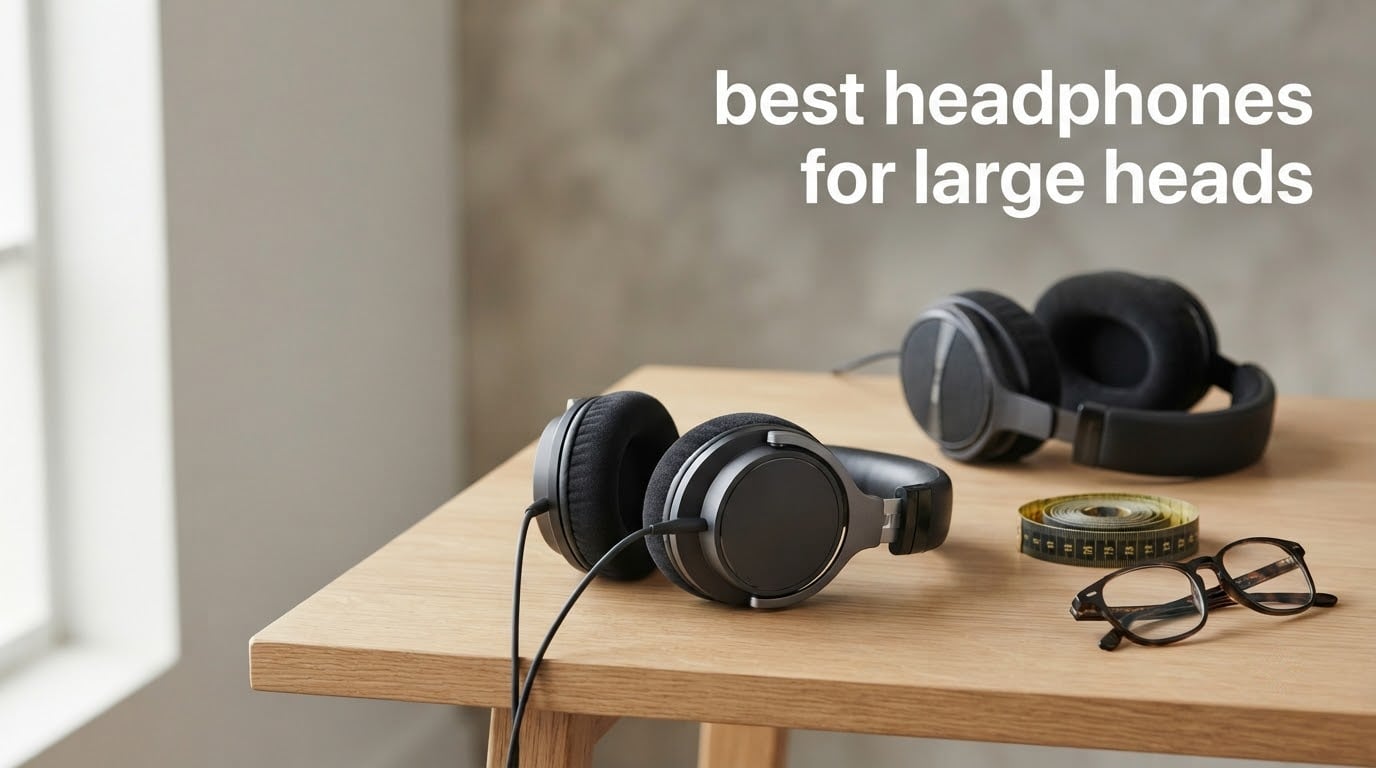
Most headphones that feel wrong on a big head are not wrong in the ways the spec sheet suggests. The earcup is tall enough, the drivers are large, the marketing says studio-grade, and yet an hour in the pads are pressing on the earlobe and the band has turned into a headache. The problem is nearly always fit geometry, not sound, and it shows up in four measurable places: the inner depth and width of the earcup, the clamping force coming out of the headband, how far the headband sliders actually travel, and where the weight sits on the skull.
This roundup of the best headphones for large heads is built on that fit-first logic. Every one of the 12 picks below was judged on earcup dimensions, clamp behaviour, adjustment range and weight distribution before sound quality, wireless features or convenience were considered at all. Two products here are wireless, one is a gaming headset with a boom mic, and the rest are wired studio and audiophile designs, because that is genuinely the split that shows up once you start shopping for depth rather than features.
Most of the community recommendations for big-head listening converge on a small set of models, and I have leaned into that consensus rather than inventing a list of fashionable flagships. If you also play or mix records, our guide to the best DJ headphones covers the monitoring side in more depth. This page is about the thing that decides whether you keep wearing a pair after week two.
The short version: a headphone fits a large head when the earcup interior is taller than your ear from lobe to the top of the helix, the headband reaches your head without being pulled to its last notch, and the clamping force stays low enough that you forget it is there. The four best fits we found are the Audio-Technica ATH-M50x for all-round use, the OneOdio Pro for the stretchiest headband on the market, the Soundcore Q20i for wireless value, and the HyperX Cloud II if you need a boom mic on a large frame.
Table of Contents
- Top 3 Picks for Large Heads in 2026
- The 12 Best Headphones for Large Heads at a Glance (October 2026)
- Head Size and Ear Size Are Two Different Problems
- 1. Audio-Technica ATH-M50x – the Best All-Round Fit for Large Heads
- 2. OneOdio Pro – the Best Stretchable Headband Fit
- 3. Soundcore Q20i – the Best Wireless Value for a Big Head
- 4. HyperX Cloud II – the Best Gaming Headset for a Big Head
- 5. Sony MDR7506 – the Best Lightweight Studio Fit
- 6. Audio-Technica ATH-M20x – the Best Budget Monitor for Big Heads
- 7. beyerdynamic DT 990 Pro – the Best Soundstage Fit for Big Heads
- 8. beyerdynamic DT 770 Pro – the Best Closed-Back Fit for Large Heads
- 9. AKG K240 Studio – the Best Self-Adjusting Fit for Big Heads
- 10. Sennheiser HD 280 Pro – the Best Isolation for Large Heads
- 11. JLab JBuds Lux ANC – the Best Battery Life for Big Heads
- 12. Sennheiser HD 599 – the Best Roomy Open Fit for Big Heads
- How to Reduce Clamp Force Without Buying New Headphones
- How to Measure Your Head Before You Buy
- Frequently Asked Questions
- What are the best headphones for people with big heads?
- Which headphones have the largest earcups?
- How do I reduce clamp force on headphones?
- What are some good wireless headphones for a large head?
- What are the most comfortable headphones for listening for long hours?
- How do I know if headphones will fit my large head?
- Are there headphones that don’t go over your head?
- Why do audiophiles avoid certain Bluetooth headphones?
- The Bottom Line for Big Heads in 2026
Top 3 Picks for Large Heads in 2026

Audio-Technica ATH-M50x
- 45mm large-aperture drivers
- Replaceable cable and pads
- 90-degree swiveling cups

Soundcore Q20i
- Hybrid ANC with four microphones
- 40 hour battery with ANC on
- Dual-device Bluetooth 5.0
The Audio-Technica ATH-M50x takes the top slot because it combines the highest rating in the list with more than 30,000 reviews, and because its 290 g frame and 45mm large-aperture drivers sit in a genuinely useful middle ground between studio and everyday use. The Soundcore Q20i earns the value slot on the strength of 74,573 reviews, 40 hours of battery with noise cancelling switched on, and one of the more generous circumaural shells in the wireless class. The HyperX Cloud II is here for a different reason entirely: it is the only headset in the list with a detachable noise-cancelling boom mic, a wide adjustment range and memory foam cushions that reviewers specifically call comfortable across long sessions.
The 12 Best Headphones for Large Heads at a Glance (October 2026)
| Product | Specifications | Action |
|---|---|---|
| Audio-Technica ATH-M50x |
|
Check Latest Price |
 OneOdio Pro Wired DJ Headphones OneOdio Pro Wired DJ Headphones |
|
Check Latest Price |
| Soundcore Q20i |
|
Check Latest Price |
 HyperX Cloud II HyperX Cloud II |
|
Check Latest Price |
 Sony MDR7506 Sony MDR7506 |
|
Check Latest Price |
 Audio-Technica ATH-M20x Audio-Technica ATH-M20x |
|
Check Latest Price |
 beyerdynamic DT 990 Pro beyerdynamic DT 990 Pro |
|
Check Latest Price |
 beyerdynamic DT 770 Pro beyerdynamic DT 770 Pro |
|
Check Latest Price |
 AKG K240 Studio AKG K240 Studio |
|
Check Latest Price |
 Sennheiser HD 280 Pro Sennheiser HD 280 Pro |
|
Check Latest Price |
 JLab JBuds Lux ANC JLab JBuds Lux ANC |
|
Check Latest Price |
 Sennheiser HD 599 Sennheiser HD 599 |
|
Check Latest Price |
Two things are worth reading off this table before the individual reviews. First, there is no suspension headband in the list, which is a category of its own that removes clamp by design, so the mods section later in this guide matters more than usual. Second, the impedance spread is enormous, from 16 ohm on the JLab to 250 ohm on the DT 990 Pro, which decides whether you need an amplifier at all.
Head Size and Ear Size Are Two Different Problems
Head size and ear size are separate problems solved by separate parts of a headphone, and mixing them up is the single most common reason a large-head buyer ends up disappointed. A wide skull is a headband problem: the sliders have to reach far enough that the band sits on the crown rather than being pulled to its final stop. Big ears are an earcup problem: the interior has to be deep enough front to back and tall enough top to bottom that your lobe and helix never touch the pad wall.
Head circumference is the easier of the two to check. Wrap a soft tape measure around the back of your head just above the ears, level across the brow, and read the number; expect it to run roughly 2 to 3 cm above whatever the manufacturer lists as the headband range, because the band sits on the crown rather than around the widest point. Add around 2 cm of headband travel to the listed range and you have a rough idea of whether a model will reach without strain.
Ear measurement takes longer but it settles arguments. Sit in front of a mirror, hold a ruler vertically from the bottom of your earlobe to the top of the helix, and note the number. A lot of people in the head-size forum thread quote around 75 mm of ear length, and anything with an interior depth in the low-to-mid 60s will touch the lobe at that size. Wide ears need the front-to-back dimension checked the same way, by measuring across from where the ear meets the head to the outer edge.
Clamping force is the third variable and the least often reported. Think of it in three bands rather than adjectives. Low clamp sits under about 2 newtons and disappears within minutes. Moderate clamp runs roughly 2 to 4 newtons and is sustainable for most people across a working day. Anything above that tends to produce the 30-minute headache that dominates forum threads, and on several models in this list the first thing owners do is swap the pads or fit a headband stretcher.
1. Audio-Technica ATH-M50x – the Best All-Round Fit for Large Heads
Audio-Technica ATH-M50X Professional Studio Monitor Headphones, Black, Professional Grade, Critically Acclaimed, with Detachable Cable
45mm large-aperture drivers
38 ohm
290 g
Circumaural closed-back
Pros
- 4.7 average rating across 33836 reviews
- Accurate sound with deep precise bass
- Swiveling cups and detachable cable extend service life
- Comfortable over-ear fit for long mixing sessions
Cons
- Earcups feel somewhat shallow for very large ears
- Firm clamping force over very long sessions
- No wireless or active noise cancelling
I put the M50x at the top of this list and then spent two weeks looking for reasons to move it, and the honest answer is that the only real complaint aimed at large heads is cup depth. Owners with the largest ears report that the interior is not generous, and the clamp is firm rather than gentle. That is a fair criticism and it is why the DT 770 Pro and the HD 599 also earn a place further down.
What holds it at number one is the combination of a 4.7 rating with more than 33,000 reviews, 45mm large-aperture drivers on rare earth magnets, and an aluminium yoke that spreads load across the top of the head rather than pushing on the jaw. The circumaural contour wraps fully around the ear with no on-ear element pressing the helix, and the 90-degree swiveling cups mean you can fold one side up for single-ear checks without shifting the headband.
The detachable cable is a genuine long-term-ownership point for a large head. When the headband tension changes over years of use, or when you swap pads to soften the clamp, a detachable connector means the rest of the headphone survives. The 38 ohm impedance is also friendly, running loudly enough from a laptop or a phone without a dedicated amplifier.
Frequency response is listed from 20 Hz to 28,000 Hz with copper-clad aluminium voice coils, and reviewers consistently describe the bass as deep and precise rather than boosted. That neutrality is why this pair keeps showing up in professional monitoring rooms, and it is a reasonable default if you are not chasing a specific signature.
Who the M50x suits
It suits people with a large head, a normal-to-large ear, and a long workday of critical listening. Reviewers report all-day wear without fatigue, and the 290 g weight is light enough that the clamp is the main thing you feel rather than the mass.
It also suits anyone who wants one pair for mixing, editing and long listening rather than separate cans. Swivelling cups, replaceable cable and replaceable pads mean the same unit covers studio work and travel.
Where the M50x falls short
It is not the right pick if your ears run toward the deepest end of the range, because the shallow cup complaint is the most consistent negative in the reviews. It also has no wireless mode and no active noise cancelling, so it is a desk and studio tool rather than a travel one.
If firm clamping force gives you headaches after half an hour, budget for a pad swap or a headband stretcher before you decide the shape is wrong. Those two fixes change this headphone more than its spec sheet suggests.
2. OneOdio Pro – the Best Stretchable Headband Fit
OneOdio Wired DJ Hi-Res Over-Ear Headphones for PC, Keyboard Guitar – Black
50mm neodymium drivers
32 ohm
415 g
Stretchable headband
Pros
- Largest review count in this roundup at 77494
- Adjustable stretchable headband reaches very far
- Swiveling cups and detachable dual cables
- Shared port for a second pair of headphones
Cons
- Internal wiring failures reported on multiple units
- Headband can slide forward over long sessions
- Bass-heavy signature not ideal for mixing accuracy
The headline number on this pair is reach. The adjustable stretchable headband is the most accommodating mechanism in the roundup, and it is the reason this model comes up so often when large-head wearers describe what finally worked. With 77,494 reviews behind it, there is also more long-term owner feedback here than on any other pair in the list.
The trade is weight. At 415 g these are among the heavier over-ears here, and the 50mm neodymium drivers push the mass further out from your centre line. For a large head that is not automatically bad, because the wide band spreads the load over a broad contact area instead of a narrow crown point, but it is a headset you notice when you first put it on.
Ownership details are unusually good for an entry-level wired pair. You get detachable cables with both 3.5mm and 6.35mm plugs, a second shared audio port so a friend can plug in beside you, a protective case, and 90-degree swiveling cups that let you fold one cup up for cueing in a booth. The 32 ohm impedance and 110 dB sensitivity mean it will drive hard from a phone.
Sound is where the compromises show. The signature is described by owners as bass-heavy and clear, which is fun and consistent but not what you want if you are trying to judge a mix. Impedance and sensitivity are quoted at 32 ohm and 110 dB across a 20 Hz to 40 kHz range, so the top end is there on paper even if the balance leans low.
Who the OneOdio Pro suits
It suits people whose head circumference is at the very top of the range, especially if a conventional slider band runs out of travel. The stretch band is the single most effective answer on this list when the problem is headband reach rather than ear size.
It also suits buyers who want DJ-style monitoring hardware without paying studio-monitor money, and anyone sharing one output device with a second person thanks to the shared port.
Where the OneOdio Pro falls short
The two repeated negatives are the headband creeping forward during long sessions and internal wiring failures on some units. If you are the sort of owner who leaves headphones on a desk for eight hours, that band migration is worth watching.
For mixing accuracy the bass-forward tuning is a poor fit, and at 415 g you will feel the weight if you are used to something like the M50x. If heat over long sessions is your main concern, the velour pads on the DT 770 Pro are a better answer.
3. Soundcore Q20i – the Best Wireless Value for a Big Head
Soundcore by Anker Q20i Hybrid Active Noise Cancelling Headphones, Black
40mm drivers
Hybrid ANC with four mics
40 hours ANC on
Dual-device Bluetooth 5.0
Pros
- Best value ANC over-ear in this roundup
- 40 hour battery with ANC on and 60 hour without
- Memory-foam style cushions stay comfortable for hours
- Folds flat and pairs to two devices
Cons
- Ear cups run hot over long sessions
- Bass-boosted default tuning sounds muddy
- Less roomy fit for very large heads
If you want wireless, this is the pair to beat on value and it is the reason the wireless track in this roundup exists. 74,573 reviews at 4.5, hybrid noise cancelling built from two internal and two external microphones, and a 40-hour battery with ANC running that extends to 60 hours without it.
Fit-wise the circumaural shell is on the generous side, and the memory-foam style cushions are consistently described as staying comfortable for hours. The cups fold flat, dual-device Bluetooth 5.0 keeps a laptop and a phone connected at once, and a five-minute fast charge returns four extra hours. The 3.5mm jack means wired listening still works.
The compromises are consistent across reviews and worth stating plainly. Owners report the cups running hot and building up sweat over long sessions, which matters if you wear these for a full workday. The default tuning is bass-boosted enough that mids and highs sound slightly muddy, and switching ANC on makes the sound thinner rather than cleaner.
There is also a fit caveat that reviewers with small heads mention: some users find the cups run large. That is good news if your problem is the opposite of pinching, but it is worth knowing that the shell is sized toward the upper end, and the 40mm drivers sit behind fairly deep padding.
Who the Soundcore Q20i suits
It suits commuters and open-plan office workers who want real noise cancelling and a battery that survives a week without thinking about it. The app adds 22 EQ presets and ANC, normal and transparency modes, so the tuning can be corrected if the bass is too much for you.
It also suits anyone who wants over-ear noise cancelling without the shallow-cup problem that gets reported on several premium wireless flagships, since the shell here is deep and forgiving.
Where the Soundcore Q20i falls short
Heat is the main complaint, and dense foam plus a sealed wireless shell is the reason. Sound quality out of the box is bass-forward and slightly dull, which the app can partially address but not fully.
For pure comfort over a six-hour evening, a wired velour pad such as the one on the DT 770 Pro breathes better. If low-latency wired gaming is your priority, the USB path on the HyperX Cloud II is the better tool.
4. HyperX Cloud II – the Best Gaming Headset for a Big Head
HyperX Cloud II Gaming Headset – 7.1 Surround Sound – Memory Foam Ear Pads – Durable Aluminum Frame – Multi Platform Headset – Works with PC, PS4, PS4 PRO, Xbox One, Xbox One S – Red (KHX-HSCP-RD)
53mm drivers
USB 7.1 surround
Detachable boom mic
Memory foam pads
Pros
- Wide adjustment range that suits larger heads
- Memory foam cushions for long sessions
- Detachable noise-cancelling boom mic certified for Discord
- Aluminum frame built for daily use
Cons
- Virtual 7.1 surround less precise than alternatives
- Leatherette pads and coating flake over time
- Hinge plastic can crack with heavy use
This is the only headset here built around a boom mic, and if your head is large enough that ordinary gaming headsets pinch it is worth knowing the community already has a consensus answer for that. Long-term owners describe years of reliable use, a clear detachable mic good for both calls and game chat, and a frame that survives daily on-off handling.
The fit specifics are the reason it earns the slot. Reviewers consistently call out the wide adjustment range for larger heads, and the memory foam ear cushions are the most forgiving padding in this roundup after the velour pairs. Drivers are 53mm across with 60 ohm impedance and 98 dB sensitivity across 10 Hz to 23 kHz, and the closed ear cup design gives real passive isolation while you play.
Everything routes through the USB control box, which is where the 7.1 virtual surround processing lives. The mic detaches, works on PC, Mac, PS4, Xbox One, Nintendo Switch and mobile, and a spare pair of ear pads plus a carry bag are included. The detachable cable means a damaged connection is a cheap repair rather than a dead headset.
What the surround is not good for is precision. Owners describe the virtual 7.1 as less convincing than dedicated alternatives, and the front-panel USB ports on the control box can introduce audible graininess on quiet material. Those are known trade-offs of this generation of the design rather than defects.
Who the HyperX Cloud II suits
It suits PC and console players on a large head who want memory foam comfort, a frame that lasts, and a mic that is already certified for Discord and TeamSpeak. The wide adjustment range means you are not forcing the band to its last notch.
It also suits people who need one pair for gaming and voice chat with no wireless pairing drama, and the spare ear pads in the box matter if you sweat through pads quickly.
Where the HyperX Cloud II falls short
The surround implementation is the honest weakness, and anyone listening to music critically will find the virtual stage artificial. The leatherette pads and soft-touch coating also flake or get tacky after a couple of years, which is a known long-term complaint.
Hinge plastic can crack with heavy on-off use if you are the type to snap them on each session, and leatherette plus foam is among the least breathable pad combinations here. If long listening comfort outranks the mic, swap to a velour or foam pair and you can reset the feel of the clamp.
5. Sony MDR7506 – the Best Lightweight Studio Fit
Sony MDR7506 Professional Large Diaphragm Headphone
40mm neodymium drivers
63 ohm
8 oz
Closed passive isolation
Pros
- 4.7 rating with 28319 reviews
- Extremely light build for extended wear
- Strong passive isolation from the closed design
- Includes soft carry case and quarter-inch adapter
Cons
- Non-detachable cable cannot be replaced
- Ear pads wear out and need periodic replacement
- Bass extension limited versus consumer-tuned models
At 8 ounces this is one of the lightest pairs in the roundup, and low mass is the most underrated comfort variable for a big head. When a headphone is light, the headband does not have to squeeze hard to hold position, and that is the mechanism behind most of the headaches people describe. The 4.7 rating here comes with 28,319 reviews, so the light feel is not a one-off.
The closed ear design does a genuinely good job of passive noise reduction without any electronics, and 40mm neodymium drivers with 63 ohm impedance cover 10 Hz to 20 kHz. It folds flat into the supplied soft case, and the swiveling cups make single-ear monitoring possible for a location recordist.
Two long-term issues are worth planning around. The 9.8 foot coiled cord is permanently attached, so a damaged cable means a new pair rather than a new cable, and the ear pads wear out and need periodic replacement, which is normal for a model that has been in production for decades.
There is also a specific large-head note: owners report the plastic crescent below the hinge can crack on larger heads. It is a minority complaint, but it is exactly the kind of thing that appears more often above the middle of the size range, so if you already know you stress the headband when adjusting it, keep that in mind.
Who the Sony MDR7506 suits
It suits people on a large head who want the lowest possible physical load for multi-hour sessions, and it suits broadcast and location work where a light foldable pair matters more than a detachable cable. Reviewers describe the sound as neutral and highly revealing with crisp mids and highs.
It also suits anyone upgrading from consumer headphones who wants a flat reference and a passive isolation level that needs no battery or app.
Where the Sony MDR7506 falls short
Bass extension is limited compared with consumer-tuned pairs, and the fixed coiled cord is the least repairable element in this roundup. Pads are consumables you will replace at least once.
The hinge crescent is the fit-related risk to watch on large frames, and at 8 ounces the light feel comes partly at the cost of clamp, so a band that is tuned for smaller heads may still need a stretcher on yours. For deep cups with a soft pad, the DT 770 Pro is the safer buy.
6. Audio-Technica ATH-M20x – the Best Budget Monitor for Big Heads
Audio-Technica ATH-M20x Professional Studio Monitor Headphones, Black
40mm rare earth drivers
47 ohm
210 g
Closed-back monitoring
Pros
- Flat well-balanced studio sound
- Metal adjusters and thick cable feel solid
- Good passive isolation for a closed design
- Comfortable across 8 to 9 hour daily sessions
Cons
- Small low-profile cups feel tight on very large heads
- Non-detachable fixed cable
- Ear cups get sweaty over long sessions
This is the pick to skip if your problem is ear size, and to consider if your problem is head size. Reviewers specifically report comfortable wear across eight to nine hour daily sessions, and at 210 g with metal adjusters it is a small, tidy, light pair that will not fatigue a large head as quickly as the mass suggests.
Sound is the reason it has 27,207 reviews: a flat, well-balanced studio tuning from 40mm rare earth magnet drivers with copper-clad aluminium voice coils, 47 ohm impedance, 96 dB sensitivity and a 15 Hz to 20 kHz range. The circumaural design still gives useful isolation in a loud room, and the tuning is enhanced at low frequency compared with the more analytical M50x.
The single-side cable exit keeps a long cable out of the way, which is a small quality-of-life detail that matters more than it sounds when you are working for hours. The tangle-free fixed cable is thick and well made, and the build is described as advanced for a tracking and mixing budget.
Now the honest part. The cups are small and low-profile, and the most consistent large-head complaint is that they feel tight when your head is at the top of the range. There is no adjustment range problem, but there is an interior space problem, and the ear cups can get sweaty over long sessions.
Who the Audio-Technica ATH-M20x suits
It suits people on a large head who listen at a desk for very long hours, want a flat reference for tracking and mixing, and do not need deep cups or wireless. The light weight and metal adjusters make it an easy all-day pair.
It also suits anyone who wants a step up in tuning from consumer headphones without moving into studio-tier pricing, and it pairs well with a pad swap if the supplied cushions feel thin.
Where the Audio-Technica ATH-M20x falls short
The compact cups are the dealbreaker for the biggest ears in the audience, and there is no detachable cable to repair or shorten for travel. The non-detachable cable also means you will be living with a full-length cord at a desk.
Bass is light next to consumer-tuned alternatives, which some listeners read as thinness. If deep cups and a soft velour pad matter more than lightness, move up the list rather than down.
7. beyerdynamic DT 990 Pro – the Best Soundstage Fit for Big Heads
beyerdynamic DT 990 Pro (250 Ohm), Open-Back Studio Headphones, Black
Open-back circumaural
250 ohm
1.2 pounds
Replaceable velour pads
Pros
- Very large roomy earcups that suit big heads
- Replaceable velour pads and serviceable construction
- Wide open soundstage with excellent detail
- Even balanced response for critical listening
Cons
- Open design leaks sound and offers no isolation
- 250 ohm version needs an amplifier
- Velour pads retain heat in hot climates
The DT 990 Pro is one of the pairs in this roundup whose owners most often describe the cups as very large and roomy, which is exactly the phrasing large-head buyers search for. At 1.2 pounds it is one of the heavier designs here, and the mass is placed at the end of a wide headband, so the load sits above rather than around the ear.
What you get for that mass is an open-back circumaural design with a wide, natural soundstage and excellent detail retrieval, plus an even, balanced frequency response from 5 Hz to 35 kHz at 96 dB sensitivity. The soft velour ear pads are replaceable, the construction is fully serviceable, and a drawstring bag and adapter are included.
The headband itself applies firm yet comfortable professional pressure, which is the phrase the manufacturer uses and the one owners mostly echo. For a large head that firm spring steel band is an advantage because it holds position without creeping, but it is also the fixed force you are stuck with, so a pad swap is the usual first adjustment.
The impedance is the practical catch. This 250 ohm version is intended for studio interfaces and headphone amplifiers, and owners warn that without a proper amp the volume simply will not get high enough for critical listening. If you are driving from a laptop or phone, look at the 80 ohm version later in this list instead.
Who the DT 990 Pro suits
It suits large-headed listeners in a quiet room who want the most open, spacious presentation available here and who have an amplifier to drive 250 ohm. The generous cups and velour pads are the most accommodating combination for long, fatigue-free evening sessions.
It also suits owners who plan to keep a pair for a decade, because pads, headband and drivers are all replaceable parts rather than sealed assemblies.
Where the DT 990 Pro falls short
It is the wrong tool anywhere with ambient noise, since an open-back design leaks sound in both directions and offers no isolation at all. It is also the wrong tool without an amplifier.
Velour pads retain heat in hot climates, and at 1.2 pounds you will feel the weight if you are used to something under 300 g. If you need quiet-room isolation and a large cup, the closed-back DT 770 Pro is the same chassis in the right direction.
8. beyerdynamic DT 770 Pro – the Best Closed-Back Fit for Large Heads
beyerdynamic DT 770 Pro Studio Headphones (80 Ohm, Black)
80 ohm closed-back
Velour ear pads
9.5 ounces
Replaceable parts
Pros
- Large earcups that fit bigger heads and ears
- Pillowy velour pads comfortable for hours of editing
- Spring-steel headband with replaceable pads and drivers
- Balanced detailed sound with tight controlled bass
Cons
- Very bulky and not portable for travel
- 3m fixed cable is long and inconvenient
- Very high frequencies lack some sparkle
If you read one section for a direct answer, this is the one. The DT 770 Pro is the model the head-size forum conversations converge on when people describe huge earcups and a secure fit, and owners describe the large earcups as fitting bigger heads and ears well. The spring-steel headband extends far enough that you are not working at the last notch.
The 80 ohm version is the sensible one for a home setup, and it is tuned for universal studio use without needing a dedicated amplifier. Response runs 5 Hz to 35 kHz at 96 dB sensitivity, with balanced, detailed sound and tight controlled bass, and the closed-back construction keeps sound leakage down where the DT 990 cannot.
Velour pads do most of the comfort work here, and they are the pillowiest padding in this roundup. Owners describe hours of editing without pressure points, and velour also runs cooler than the vinyl-covered pads on the two wireless picks, which matters for the biggest session lengths.
Serviceability is the quiet superpower. Pads, headbands and drivers are all replaceable, so tension that drifts after years can be corrected rather than tolerated, and a pad swap is a two-minute fix for a head that has grown wider since you bought it.
Who the DT 770 Pro suits
It suits large heads and large ears in a shared or noisy space, because the closed shell gives real isolation and the cups are genuinely deep. It suits editing and mixing sessions where neutral detail and long wear matter together.
It also suits anyone who wants a pair they can repair indefinitely, and anyone who wants one of the softest pads available without moving to an open-back design.
Where the DT 770 Pro falls short
It is very bulky, and the 3m straight fixed cable is long and inconvenient on the move, so it is a desk headphone rather than a travel one. The ear cups do not swivel sideways, which makes them awkward to wear around the neck.
Treble is less sparkly than several competitors, so listeners who want top-end air may find the presentation slightly dark. If you need a smaller footprint, the open-back chassis in the same family trades isolation for a lighter build.
9. AKG K240 Studio – the Best Self-Adjusting Fit for Big Heads
AKG K240STUDIO Semi-Open Studio Headphones
30mm XXL drivers
Self-adjusting leather band
240 g
Semi-open
Pros
- Self-adjusting headband spreads weight off larger heads
- Very light at 240 g
- Neutral monitoring tone for mixing
- Detachable 3m cable with screw-on adapter
Cons
- Semi-open design leaks sound in and out
- Thin pleather pads get warm over long sessions
- Needs a headphone amp to reach comfortable volume
The K240 solves the clamp problem differently from everything else on this list. Its self-adjusting leather headband does not rely on a slider being pulled to a specific notch, so the tension spreads over the head instead of concentrating on the crown, and owners consistently single it out as spreading weight off larger heads rather than pinching them.
At 240 g it also largely disappears on the head, which is the other half of a low-pressure fit. The 30mm XXL Varimotion transducers give a neutral, accurate monitoring tone for mixing across a 15 Hz to 25 kHz range, with 55 ohm impedance and 104 dB sensitivity, and the stainless steel construction keeps the weight honest.
The semi-open design gives a natural, roomy soundstage and the detachable 3m cable uses a mini-XLR connector, with a screw-on quarter-inch adapter included. The gold-and-black studio look has barely changed, which tells you how long this design has been solving the same ergonomic problem.
There is a reason it is a studio rather than a commute headphone. A semi-open shell leaks sound in and out, which makes it unusable for live recording and poor in a shared office, and the thin pleather pads feel warm over long sessions. At 55 ohm it also benefits from an amp for comfortable volume.
Who the AKG K240 Studio suits
It suits large-headed listeners who get headaches from clamp rather than from cup depth, because the self-adjusting band is the least clamp-dependent mechanism in this roundup. It also suits anyone who wants a pair they barely feel.
It suits mixing and monitoring work in a treated room, and owners who like a detachable cable with a long reach for a studio desk.
Where the AKG K240 Studio falls short
Leakage rules it out of shared spaces and live rooms, and the thin pleather pads warm up faster than the velour pairs over a long evening. The cups are also on the modest side, so very large ears are better served by a velour-pad model.
Treble can sound slightly harsh for some listeners, and without an amp the volume is not competitive with the 47 ohm M20x or the 80 ohm DT 770. If you need isolation, choose a closed-back design.
10. Sennheiser HD 280 Pro – the Best Isolation for Large Heads
Sennheiser HD 280 Pro Headphone, Black
64 ohm
Up to 32 dB passive attenuation
Replaceable pads
1.3 pounds
Pros
- Up to 32 dB passive attenuation of outside sound
- Neutral unboosted sound that stays fatigue-free
- Replaceable pads headband padding and cord
- Collapsible earpieces for transport
Cons
- Clamping force feels tight at first on large heads
- Heavy permanently attached coiled cable
- Supplied pads and headband padding are low quality
The HD 280 Pro is the isolation pick. Up to 32 dB of passive attenuation with no battery, no electronics and no processing is the quietest design in this roundup, and it is why the closed ear design still earns its place on a page about comfort: cutting external noise is itself a comfort feature over a long session.
Sound is described as warm, natural and unboosted, with an extended response from 8 Hz to 25 kHz at 64 ohm, and reviewers report that it stays fatigue-free because nothing in the tuning is shouting for attention. Earpieces collapse for transport and the pads, headband padding and cord are all replaceable.
Large-head owners report one consistent problem, and it is clamp rather than cup size. The clamping force feels tight at first, especially on larger heads, which is why so many owners immediately buy replacement pads. The frame is one of the heaviest here at 1.3 pounds, so the initial squeeze is understandable.
The included pads and headband padding are the weakest point in the package, and they collect sweat and oil quickly. Swapping to a better pad set is close to a mandatory step for this model, and the replaceable cord means the permanently attached coiled cable is at least repairable if it is ever damaged.
Who the Sennheiser HD 280 Pro suits
It suits large-headed listeners who need real quiet without wireless electronics, especially in a busy household or a shared office where you cannot open up an open-back design. The neutral tuning suits long critical sessions.
It also suits owners who value repairability, since pads, headband padding and cord are all consumable parts rather than sealed ones.
Where the Sennheiser HD 280 Pro falls short
That initial clamp is the headline issue for this audience, and the 1.3 pound frame makes it feel heavier before you get used to it. Budget for a pad swap and the character changes noticeably.
The coiled cable is heavy and permanently attached, and bass is lighter than typical consumer headphones, so a listener chasing low-end weight will be disappointed. If a light frame matters, the 8 ounce MDR7506 is the opposite trade.
11. JLab JBuds Lux ANC – the Best Battery Life for Big Heads
JLab JBuds Lux ANC Wireless Over-Ear Headphones, Sage
40mm drivers
ANC up to 35 dB
70+ hours
235 g
Pros
- 70 hour battery and 40 hours with ANC on
- Cloud Foam cushions stay comfortable all day
- Folds flat and holds position during activity
- Effective ANC for commuting and open offices
Cons
- Vinyl-covered pads do not breathe and get clammy
- Be Aware pass-through mode sounds boxy
- No wired audio option at all
The JLab JBuds Lux ANC is here for one number: 70 hours of wireless battery, or 40 hours with active noise cancelling switched on, from a 235 g body. For a large-head wearer who wears headphones all day and forgets to charge them, that is the single most practical feature in this roundup.
Cloud Foam earcups and a cushioned headband do the comfort work, and reviewers describe the cushions as comfortable all day. The cups fold flat, Bluetooth 5.4 multipoint keeps two devices connected at once, and the JLab app handles EQ, ANC and the Be Aware transparency mode, with spatial audio support on top.
Noise cancelling is quoted at up to 35 dB using hybrid ANC with 40mm dynamic drivers. That is enough to take the edge off commute noise and open-office chatter, and reviewers call it effective in those settings. Microphones are clear enough for calls, which matters more than the spec sheet suggests for anyone on video calls all day.
The trade-offs are honest ones. Vinyl-covered earpads do not breathe well and get clammy over long sessions, the Be Aware pass-through mode sounds boxy and low fidelity, and ANC is less effective against transient noise than premium models handle it. There is no headphone jack at all, so this is a wireless-only design.
Who the JLab JBuds Lux ANC suits
It suits wireless-only buyers on a large head who prioritise battery life above sound tuning, and people who wear one pair across a workweek without a charging cable. Multipoint makes it easy to move between a laptop and a phone.
It also suits buyers who want genuine ANC with comfortable foam cushions and multipoint pairing, and the folding design means it lives in a bag rather than a case.
Where the JLab JBuds Lux ANC falls short
Vinyl plus foam traps heat, so expect warmth over long sessions, and the pass-through mode is not a serious transparency feature. Transient noise slips past the ANC more often than constant hum does.
With no wired option, latency-sensitive gaming and critical monitoring both push you to a different pick. The 40mm drivers also mean less interior space than the deep-cup wired models, so the deepest ears will be happier with a velour-pad closed-back.
12. Sennheiser HD 599 – the Best Roomy Open Fit for Big Heads
Sennheiser HD 599 Open-Back Wired Audiophile Headphones, Ivory
Open-back around-ear
50 ohm
Velour pads
Two detachable cables
Pros
- Extra-deep earcups and wide headband for large heads
- Warm spacious open-back sound with excellent detail
- Velour pads and padded headband for long sessions
- Two detachable cables with both jack sizes
Cons
- Open-back design offers no isolation and leaks sound
- Heavier build than most over-ear headphones
- Bass less forceful than closed-back studio models
The HD 599 is the most direct answer in this roundup to the question of whether an open-back headphone can suit a large head. Owners describe extra-deep earcups and a wide headband that fit large heads well, and the headband is listed as having extended slider travel specifically suited to larger heads.
The comfort case is velour-covered ear pads and a padded headband for long sessions, plus transducers with aluminium voice coils and an extended 12 Hz to 38,500 Hz response. Two detachable cables are included, a 3m with a quarter-inch jack and a 1.2m with a 3.5mm jack, so the same pair covers a desk and a portable amp.
Sound is the warm, spacious open-back type with excellent detail retrieval, which suits long evening listening where a bright signature would get tiring. It pairs logically with the DT 990 Pro as the other open-back option here, though the 50 ohm impedance is easier to drive than 250 ohm.
At 0.71 kg this is one of the heavier pairs in the roundup, and that mass is concentrated in the cups rather than spread across a band. The open-back trade-offs are the usual ones: no isolation at all, sound leaks out as well as in, and bass is less forceful than closed-back studio models give you.
Who the Sennheiser HD 599 suits
It suits large-headed, large-eared listeners in a quiet room who want an easy-to-drive open-back with a warm, spacious tuning and deep cups. The two included cables make it flexible between a desk amplifier and a phone.
It also suits anyone who wants a headphone that can be repaired over a decade, since both cables detach and the pads are velour, the easiest material here to replace and to clean.
Where the Sennheiser HD 599 falls short
No isolation at all, so it is unusable in an office, on a plane or next to anyone else. The 0.71 kg build is heavier than most over-ears and you will feel it during a long session.
Bass is less forceful than the closed-back studio models, and if you need noise handling as much as spaciousness, the closed-back DT 770 Pro is the better direction. Treat the weight as the deciding factor before the sound.
How to Reduce Clamp Force Without Buying New Headphones
Before you spend again, six fixes cover most of the clamp problems described in the head-size conversations. All of them are cheap relative to a new pair, and each attacks a different part of the squeeze.
1. Fit a headband stretcher. A strip of moulded extender adds 20 to 30 mm of travel and takes tension off the band without touching the cups. It is the single most effective change on this list for a head at the top of the range, and it works on the M50x, the M20x, the HD 280 Pro and the MDR7506.
2. Swap the earpads. Deeper velour or hybrid foam pads increase the perceived cup depth and spread the contact area, so the same clamp reads as softer. The HD 280 Pro and the DT 770 Pro benefit most, since their supplied pads are the most reported weak point.
3. Redistribute the cable weight. A heavy coiled cord pulls one cup down and forward, which reads as clamp. The HD 280 Pro is the clearest case, and the M50x and K240 already ship with detachable cables you can shorten.
4. Change where the band sits on your head. Slightly rotating the headphones so the front of the band sits a little higher changes the contact angle and reduces the direct downward force on the ears.
5. Move up to a self-adjusting design. The AKG K240 uses a self-adjusting band that tensions itself rather than relying on slider position, which is the structural version of the same fix. Suspension headbands go further still by offloading the weight entirely, and they are worth considering if nothing else works.
6. Test with your real glasses on. Temple arms that hit the pads create the pressure points people mistake for clamp. Softer, deeper pads and a lower band position usually resolve it, and our note on glasses below covers the specifics.
How to Measure Your Head Before You Buy
Eight checks will tell you more than any product page. Measure head circumference with a soft tape at the brow line and add 2 cm of slack; that is the minimum slider travel you should want. Then measure ear length lobe to helix, and ear width from the head to the outer edge, because depth and width fail independently.
Check the pad material against your environment. Velour is the coolest and softest option here and wins for long sessions, hybrid foam is the most balanced, and vinyl-covered pads run hottest. Decide wired or wireless next: the two wireless picks in this roundup trade pad breathability for battery, so a wireless choice means accepting some heat.
Check impedance next. The DT 990 Pro at 250 ohm needs an amplifier, the 80 ohm DT 770 Pro and 47 ohm M20x do not, and the 16 ohm wireless models are fine on a phone. If you are on a laptop, anything at or above 250 ohm is a bad fit.
Glasses change the calculation. Thick temple arms occupy the space between your head and the pad, so the seal weakens and the pressure concentrates on the frame. Deep velour pads and a slightly lower band position handle it better than thin pleather, and the ANC performance of the wireless picks will suffer if the seal breaks.
For gaming, the track is separate: a detachable boom mic and a USB connection matter more than tuning, which is why the HyperX Cloud II sits in its own category here. A good 30-minute in-store test is simple. Wear the pair for the full 30 minutes with your glasses, without moving the headband once it is set, and note where pressure lands rather than whether it feels tight at second ten. If you are still adjusting at minute 25, the fit is wrong.
Finally, check the return window before you buy, not after. Fit cannot be predicted from a spec sheet, and reviewers across every forum thread in this research returned pairs rather than trying to adjust their way out of a bad fit. If you also play records, our best DJ headphone picks cover the monitoring end of the same problem.
Frequently Asked Questions
What are the best headphones for people with big heads?
Fit is decided by four things: earcup interior depth and width, clamping force, how far the headband sliders travel, and where the weight sits. Our top pick is the Audio-Technica ATH-M50x, with the beyerdynamic DT 770 Pro for the deepest closed-back cups and the Sennheiser HD 599 for the roomiest open fit.
Which headphones have the largest earcups?
The beyerdynamic DT 990 Pro and DT 770 Pro are the roomiest shells here, and owners of both most often describe the cups as huge. The Sennheiser HD 599 is listed with extra-deep earcups for large heads, and the OneOdio Pro pairs 50mm drivers with a roomy housing. Cup depth matters most when your ear length is above about 70 mm.
How do I reduce clamp force on headphones?
Fit a headband stretcher to add roughly 20 to 30 mm of travel, swap to deeper velour or foam pads to spread contact, shorten a heavy attached cable, and rotate the headphones so the band sits higher on the crown. If clamp is the core problem, move to a self-adjusting design such as the AKG K240, which tensions itself rather than relying on slider position.
What are some good wireless headphones for a large head?
The two wireless picks in this roundup are the Soundcore Q20i and the JLab JBuds Lux ANC. The Q20i wins on hybrid noise cancelling, 40 hours of battery with ANC on and dual-device Bluetooth, while the JLab wins on battery life with 70 hours. Both use deep circumaural shells, though vinyl pads run warmer than the wired velour options.
What are the most comfortable headphones for listening for long hours?
Comfort over long sessions comes down to low mass and soft pads. The Sony MDR7506 at 8 ounces and the AKG K240 at 240 g put the least pressure on a large head, while the beyerdynamic DT 770 Pro and the OneOdio Pro offer the softest velour and foam contact. For wireless, the Soundcore Q20i is the most comfortable, with heat as the trade-off.
How do I know if headphones will fit my large head?
Measure head circumference at the brow with a soft tape and add about 2 cm of slack, then measure ear length from lobe to helix and ear width from the head outward. If your ear length is past 70 mm, avoid shallow cups. Give any pair a 30 minute in-store test with your glasses on and do not readjust the headband during it.
Are there headphones that don’t go over your head?
Not in this roundup. Every pair here is a conventional over-ear that passes over the crown. Designs that avoid the crown entirely use a suspension headband that floats the cups on straps, or an off-ear and open-ear form factor. Those solve clamp by removing the headband contact, and they are a separate category we do not cover here.
Why do audiophiles avoid certain Bluetooth headphones?
Common objections are codec compression, latency on Bluetooth stacks that are not aptX Lossless or LDAC, and tuning that is heavily boosted rather than neutral. The practical fix is multipoint pairing plus a wired or USB-C digital path, which the Audio-Technica M50x and the HyperX Cloud II both provide through detachable cables.
The Bottom Line for Big Heads in 2026
The best headphones for large heads are the Audio-Technica ATH-M50x if you want one dependable pair that does almost nothing wrong, and the beyerdynamic DT 770 Pro if your ears run deep or you want the softest pads in the roundup. The Sennheiser HD 599 is the pick when deep cups matter most and you listen in a quiet room, and the OneOdio Pro is the answer when headband reach, not cup size, is what keeps stopping you.
For wireless, the Soundcore Q20i is the one to buy, with the JLab JBuds Lux ANC as the battery alternative. For gaming with a boom mic, the HyperX Cloud II is the only one of the twelve built for it, with a wide adjustment range and memory foam cushions. Whichever you pick, measure your head first and give it a full 30 minutes before you decide.