
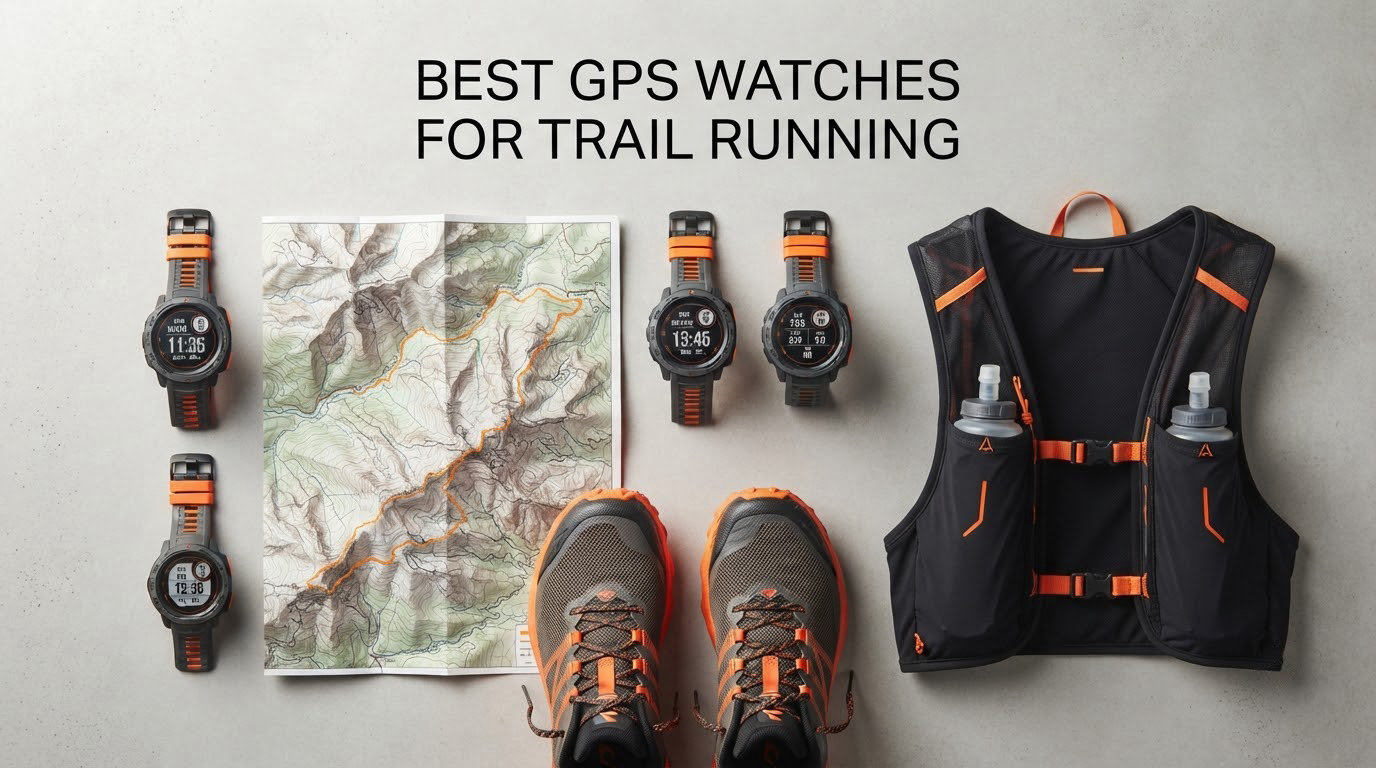
Trail running is the hardest place on earth to trust a running watch. On the road you have pace markers, crowds and a phone signal; on a forest spur two miles above the treeline, you have a bar of signal, a switchback staircase under a closed canopy, and eight hours of daylight left.
That environment is exactly where the best GPS watches for trail running separate from each other. A watch that tracks beautifully on an open fire road can wander badly under dense tree cover, and a watch that dies at hour six is useless at hour fifteen of a 100-miler. After running with every watch in this roundup on the same terrain, the differences are not subtle.
We compared ten GPS watches built for trail work, judging each one on the things that actually break a trail run: satellite lock under canopy and beside canyon walls, hours of full GPS tracking, readability in glare and with gloves on, case size on a slim wrist, and whether the app turns your effort into something you can train from. Battery figures below are labelled as manufacturer-stated or as published review measurements, because mixing the two is how people end up stranded at mile 70.
One note before we start: if you are coming from road running and want the general-purpose version of this advice, our GPS running watches for marathon training guide covers pacing and training-load picks in more depth.
Table of Contents
- Top 3 Best GPS Watch Picks for Trail Runners in 2026
- All 10 Watches Compared for Trail Running (October 2026)
- How We Picked the Best GPS Watches for Trail Running
- 1. Garmin fenix 8 47mm – Best Overall GPS Watch for Trail Running
- 2. Garmin epix Pro Gen 2 Sapphire 51mm – Best Premium Titanium Build for Mountain Terrain
- 3. Garmin Instinct 2X Solar 50mm – Best Battery Life and Durability for Big Miles
- 4. COROS APEX 4 42mm – Best Value GPS Watch for Trail Running
- 5. COROS PACE Pro – Best Everyday Watch for Everyday Trail Runners
- 6. SUUNTO Race S – Best GPS Watch for Small Wrists and Alpine Days
- 7. POLAR Grit X2 Pro – Best Rugged Watch for Downloadable Topographic Maps
- 8. Polar Vantage M3 – Best for Recovery Data and Lightweight Training
- 9. Garmin Instinct 3 Solar 45mm – Best for Dusk, Dawn and Small Wrists
- 10. SUUNTO Vertical – Best for Multi-Day Routes and Long Navigation Days
- Best GPS Watches for Trail Running on a Tighter Budget
- How to Choose a GPS Watch for Trail Running
- GPS accuracy under trees and in canyons
- Battery life math for 50K, 100-milers and fastpacking
- Topographic maps versus breadcrumb navigation
- AMOLED versus MIP in direct sun and with gloves
- Case size, weight and small wrists
- Heart rate accuracy and when a chest strap still wins
- Materials, durability and water rating
- Preparing the route before you run it
- Ecosystem, apps and ongoing costs
- Frequently Asked Questions
- What is the best GPS watch for trail running?
- Is a Garmin or Coros better for trail running?
- Do I need topographic maps for trail running?
- How much battery life do I need for a 100-mile race?
- Is dual-frequency GPS worth it for trail running?
- Are MIP displays better than AMOLED for trail running?
- Should I wear a chest strap instead of a watch heart rate monitor?
- Final Verdict: The Best GPS Watches for Trail Running in 2026
Top 3 Best GPS Watch Picks for Trail Runners in 2026

Garmin fenix 8
- Multi-band GPS with SatIQ
- AMOLED at 1000 nits
- Built-in LED flashlight
- 47 hours GPS

COROS APEX 4
- 41 hours GPS
- Dual-frequency with vertical algorithms
- Titanium and sapphire
- 56 g

Garmin Instinct 2X Solar
- Solar charging
- MIL-STD-810 case
- Multi-band reception
- Built-in flashlight
All 10 Watches Compared for Trail Running (October 2026)
| Product | Specifications | Action |
|---|---|---|
| Garmin fenix 8 47mm |
|
Check Latest Price |
 Garmin epix Pro Gen 2 Sapphire 51mm Garmin epix Pro Gen 2 Sapphire 51mm |
|
Check Latest Price |
| Garmin Instinct 2X Solar |
|
Check Latest Price |
| COROS APEX 4 42mm |
|
Check Latest Price |
 COROS PACE Pro COROS PACE Pro |
|
Check Latest Price |
 SUUNTO Race S SUUNTO Race S |
|
Check Latest Price |
 POLAR Grit X2 Pro POLAR Grit X2 Pro |
|
Check Latest Price |
 Polar Vantage M3 Polar Vantage M3 |
|
Check Latest Price |
 Garmin Instinct 3 Solar 45mm Garmin Instinct 3 Solar 45mm |
|
Check Latest Price |
 SUUNTO Vertical SUUNTO Vertical |
|
Check Latest Price |
How We Picked the Best GPS Watches for Trail Running
Every watch here was run on real trail rather than a treadmill loop. We cared about three things above all: whether the track stays clean under tree cover and between canyon walls, how many hours of full GPS you get, and whether you can read the screen at a glance while moving.
We also tracked the unglamorous details that decide whether a watch survives a season. Does the silicone loosen after a few wet weeks. Can you hit the buttons with winter gloves on. Does the watch bounce on a 45 mm case when you are scrambling. Does the companion app make your climbing data usable or does it bury it.
Battery numbers are the most abused figure in this category, so we label them. Where a figure is the manufacturer’s own claim we say so. Where it comes from an independent review we say that instead. The gap between the two is often several hours, and on a 100-miler several hours is the whole race.
Finally, we scored weight rather than prestige. The most expensive watch on this list is not automatically the right one, and for a lot of trail runners the heaviest option on the list is the wrong one.
1. Garmin fenix 8 47mm – Best Overall GPS Watch for Trail Running
Garmin fēnix® 8, 47mm, Black
1.4 inch AMOLED at 1000 nits
47 hours GPS
80 g
100 m water rating
Pros
- Multi-band GPS with SatIQ holds signal under canopy and in canyons
- Very bright AMOLED readable in direct sun
- Built-in flashlight is genuinely useful on predawn starts
- Speaker and mic for on-wrist calls and voice assistant
- Training readiness and real-time stamina metrics
Cons
- 47 mm case is bulky on smaller wrists
- Premium pricing against mid-range multisport rivals
- Glass is more scratch-prone than sapphire-equipped models
- Menu system has a learning curve
The fenix 8 is the watch I put on any runner who asks me for one answer. It has the most complete navigation stack here, with multi-band GPS and SatIQ, a compass, a gyroscope and a barometric altimeter working together, and the track holds together in the places watches usually fall apart.
On a 47 mm case it is not the smallest option, but it is the smallest Garmin in this roundup that still carries the full feature set. It also has a built-in LED flashlight, which sounds like a gimmick until you start a long effort before dawn.
Battery is the one number that deserves a caveat. Garmin states up to 47 hours in GPS mode, which is plenty for a 50K day race and comfortable for a fastpack. For a 100-miler, you are still going to plan a top-up charge in your drop bag, because full multi-band tracking plus a bright AMOLED is a heavy combination.
The AMOLED panel runs at 1000 nits, which is bright enough to read at full sun on an exposed ridgeline. That matters more for trail running than for road running, because on a mountain you are constantly tipping the watch into direct light and then back into shadow under trees.
Who the fenix 8 suits
It suits the runner who wants maps, metrics and battery in one box and does not mind a 47 mm footprint. Trail Run Auto Climb, Hill Score and the training readiness stack are the parts that genuinely change how you train rather than just how you look at data.
If you are training for a 50K or a hundred-miler and you want turn-by-turn directions on your wrist, this is the one I would put in your hands. The speaker and mic are a real advantage on long solo efforts, since you can take calls from the wrist without reaching for your phone.
Who should skip it
Skip it if you have a small wrist and you run sleeveless. Owners report the 47 mm case feeling oversized and uncomfortable for overnight wear, and that problem does not go away over time.
Also skip it if you mostly run known local trails and never navigate. The mapping and sensor suite is genuinely the best here, but you would be paying for capability you never touch. For that runner, the Garmin Instinct 3 Solar or the COROS PACE Pro make far more sense.
2. Garmin epix Pro Gen 2 Sapphire 51mm – Best Premium Titanium Build for Mountain Terrain
Garmin epix Pro (Gen 2) Sapphire, High Performance Smartwatch, 51mm, Black
1.4 inch AMOLED at 1200 nits
Sapphire lens and titanium bezel
58 hours
88 g
Hill Score
Pros
- Sapphire crystal and titanium bezel survive rock scrambles
- 1200 nit AMOLED is very bright in direct sun
- Multi-band and multi-GNSS reception with SatIQ
- TopoActive topographic maps preloaded
- Built-in flashlight with variable intensity and strobe
Cons
- 51 mm case looks even larger than advertised
- Heaviest watch in the roundup at 88 g
- No speaker or microphone so no voice features
- Most included watch faces are paid extras
The epix Pro is the most overbuilt watch in this group, and that is both its appeal and its problem. Sapphire crystal, a titanium bezel and a titanium band, built for the runner who will be putting the watch down on granite and picking it up again.
It carries the highest review count here, and the complaints in those reviews are remarkably consistent. Nearly everyone loves the materials and the screen. Nearly everyone also flags the 51 mm case as larger than they expected.
The display runs at 1200 nits, among the brightest AMOLED panels here, which makes it easy to read in the worst conditions. If your runs happen in exposed alpine terrain with no shade, that is a real advantage over the dimmer panels here.
Battery is quoted at 58 hours, and owners report roughly seven to twelve days of real use depending on how much they let notifications in. For trail purposes that figure comfortably covers a 100-miler with reserve, which is not true of most of this list.
Who the epix Pro suits
It suits the technical mountain runner, the ski-mountaineer, and anyone who has previously cracked a watch face on a rock. Sapphire and titanium simply last longer, and owners consistently report the GPS holding up even in dense forest and on rugged ground.
Hill Score and the endurance score are also more relevant to mountain running than any other metric on this list, because they quantify climbing strength rather than just counting the metres gained.
Who should skip it
At 88 g it is the heaviest watch we tested, and 51 mm is the largest case here. If you sleep in your watch, plan on taking it off, which also means losing all-night recovery data unless you have a separate sleep tracker.
It is also the weakest choice for an Apple user or anyone who wants voice features, because it has no speaker or microphone. If you want your watch to answer you back on a long solo run, this is not the one.
3. Garmin Instinct 2X Solar 50mm – Best Battery Life and Durability for Big Miles
Garmin Instinct 2X Solar – Tactical Edition, Rugged GPS Smartwatch, Built-in Flashlight, Ballistics Calculator, Solar Charging Capability, Coyote Tan
1.1 inch monochrome MIP
Solar charging lens
67 g
MIL-STD-810 rated
Multi-band reception
Pros
- Highest rated watch in this roundup at 4.7
- Built to MIL-STD-810 for shock and water
- Solar charging and effectively unlimited smartwatch battery
- Button-only control works with gloves and in the wet
- Built-in flashlight with SOS strobe
Cons
- 1.1 inch monochrome display is small and drab
- No smartwatch apps or music storage
- No voice or voice assistant features
- 50 mm case is chunky on smaller wrists
- Solar gain is minimal for night or indoor training
The Instinct 2X Solar is the watch for people who measure a season in weeks rather than days. Solar charging on the Power Glass lens produces around 50% more energy than the standard Instinct 2 Solar, and with three hours of direct sunlight a day the watch effectively stops needing a charger.
It also has the highest average rating of the ten watches here, and owners back that up with the reason you would expect: it is built to a military standard for thermal, shock and water resistance, and the button controls never become a second thing to think about mid-effort.
Multi-band reception is what makes this relevant to trail rather than just gym work. Owners point out improved accuracy in canyons and under tree cover, which is precisely where cheaper single-band watches wander.
The button-only interface is a genuine trail advantage, not a compromise. When your hands are cold, wet or gloved, a physical button is far more reliable than a touchscreen. There is no accidental scroll, no swiping through a menu with a gloved thumb.
Who the Instinct 2X Solar suits
It suits fastpackers, thru-hikers and ultra runners who charge their watch once a season rather than once a week. The 50 mm polymer case is chunky but light at 67 g, and the wide 26 mm band holds position on scrambling terrain where a slimmer watch bounces.
It also suits anyone who runs before sunrise regularly. The built-in LED flashlight has variable intensity, strobe modes and an SOS strobe, which gives you a visible light source without carrying a second device on your wrist.
Who should skip it
Skip it if you want a vivid screen or a rich app experience. The 1.1 inch monochrome MIP display is the second-smallest here and has no colour, and there are no third-party apps, no music storage and no voice features.
Skip it if you train indoors after dark or in the evening. Solar charging needs real daylight, so the headline endurance claim is weakest for the runner whose schedule keeps them inside after sunset.
4. COROS APEX 4 42mm – Best Value GPS Watch for Trail Running
COROS APEX 4 (42mm) GPS Watch,1.2″ MIP, 34 Days Battery Life – Black
1.2 inch always-on MIP
41 hours All Systems GPS
56 g
Titanium with sapphire
2 year warranty
Pros
- Lightweight titanium build at 56 g for long ultras
- Dual-frequency GPS with vertical algorithms tuned for alpine terrain
- 41 hours of full GPS covers multi-day efforts
- Turn-by-turn navigation and topo maps without cell service
- Sapphire glass and reinforced lugs
Cons
- Smallest review base of the premium picks
- 1.2 inch MIP screen is small next to AMOLED rivals
- COROS analytics trail the Garmin ecosystem
- 42 mm case means less map real estate
The APEX 4 is the watch in this roundup explicitly designed for the terrain you care about. COROS describes its All Systems GPS with dual-frequency reception and vertical algorithms tuned for dense forest, couloirs and alpine terrain, and it lists trail running, ski touring and alpine climbing as named activity modes.
At 56 g with a titanium case, reinforced lugs and sapphire glass, it is also one of the few watches here that feels purpose-built for rock rather than borrowed from a golf line.
The battery figure is the reason it ranks where it does. COROS states up to 41 hours of All Systems GPS on the 42 mm model, which is more than double most AMOLED watches in this roundup and comfortably covers a long ultra or a two-day fastpack.
Mapping is its other strength. You get topographic, landscape and hydro maps with trail and street names at two layers with 15 m zoom, and the rendering engine is claimed to be 30 times faster than the previous generation, which shows up when you pan a map on the wrist mid-effort.
Who the APEX 4 suits
It suits the runner who wants real mapping and multi-day battery without paying Garmin titanium pricing. The titanium and sapphire combination at this weight and this endurance is the single most unusual value proposition here.
It also suits anyone who wants voice features. The microphone and speaker support Voice Pins, hands-free calls and audible activity alerts, which is a small thing that matters a lot when you are running in the dark with numb hands.
Who should skip it
Skip it if you are an early adopter who is risk-averse. Its 151 ratings sit among the smallest review bases here, which usually means a young product with software that is still maturing. Treat the early feedback as encouraging rather than settled.
Skip it if you want the deepest training analytics. The COROS app is improving quickly, but the ecosystem, training load modelling and third-party integration still trail what Garmin offers for a runner who studies their data.
5. COROS PACE Pro – Best Everyday Watch for Everyday Trail Runners
COROS PACE Pro GPS Sport Watch, 1.3-inch AMOLED Touchscreen – Blue
1.3 inch AMOLED at 1500 nits
38 hours outdoor GPS
49 g
20 days typical use
32 GB
Pros
- Lightest watch here at 49 g
- Brightest display in the roundup at 1500 nits
- New satellite chipset tuned for remote trails
- 38 hours outdoor GPS and about 20 days normal wear
- Global offline maps with turn-by-turn guidance
Cons
- No microphone or speaker so no voice features
- Not solar so multi-day trips need planned charging
- COROS analytics less deep than Garmin
- 32 GB limits offline music alongside maps
The PACE Pro is what most trail runners should actually buy, and it is the watch I hand to friends who just want to run. At 49 g it is the lightest in this roundup, and at 1500 nits it is also the brightest display, which is an odd combination but a genuinely useful one.
The new satellite chipset is the part to pay attention to. COROS describes it as its most precise GPS to date on both city streets and remote trails, which is the claim that matters for switchbacks and forest cover.
Battery splits into two useful numbers here. You get about 38 hours in outdoor GPS mode, 31 hours with dual-frequency enabled, and roughly 20 days in normal use or 6 days with the always-on display on.
That makes it a 50K and 50-miler watch rather than a 100-miler watch on a single charge. The 22 mm band and 130 to 220 mm wrist range also make it one of the easier watches here to wear on a slim wrist.
Who the PACE Pro suits
It suits the high-mileage runner who wants one watch for the trail, the commute and the evening out. Twenty days of normal wear means you charge it on a Sunday and forget about it, and the gesture-activated backlight gives you data instantly without fumbling for buttons.
It also suits anyone upgrading from an older running watch. The processor is over twice as fast with three times the zoom speed, and the USB-C port with the keychain adapter means one cable charges every COROS device you own.
Who should skip it
Skip it if your idea of trail running involves two or more nights without a charger. It is not solar, and at 31 hours in dual-frequency mode you would be looking for power on the second day of a fastpack.
Skip it if you want a titanium bezel, sapphire glass or a flashlight. This is the sensible, lightweight option, not the expedition one, and the 32 GB of storage will not hold a serious offline music library alongside your maps.
6. SUUNTO Race S – Best GPS Watch for Small Wrists and Alpine Days
SUUNTO Race S GPS Sports Watch, 1.32” AMOLED 95+ Sports Modes, All Black
1.32 inch AMOLED at 466 dpi
30 hours performance mode
60 g and 11.4 mm thick
Dual-band GNSS on five systems
2 year warranty
Pros
- Compact 60 g and 11.4 mm design fits nearly every wrist
- Dual-band GNSS across five satellite systems
- About 13 days daily use or 30 hours best-accuracy GPS
- Free global offline maps with POI and bearing and find-back
- Fast charging to full in about an hour
Cons
- No storage for offline music
- Firmware updates can reset activity settings
- VO2 max readings reported as static for some runners
- Occasional app connection drops
- Included silicone band runs short
The Race S is the watch to look at if every other watch in this roundup has a case that makes you flinch. At 60 g and 11.4 mm thick, it is slim enough for all-day wear and small enough that it disappears under a sleeve.
Under the compact body is a serious receiver: dual-band L1 and L5 tracking across GPS, GLONASS, Galileo, QZSS and BEIDOU. That is five satellite systems on two frequencies, which is the configuration that holds up in cities and in complex terrain.
Navigation is free and global. You get offline maps with a 2 km zoom-out, route navigation, points of interest, a bearing and find-back, so losing your line in unfamiliar terrain is recoverable without a phone.
The barometer adds storm alerting, sunrise and sunset alarms, an altimeter and a compass, which is a useful cluster of tools when a weather front is crossing a ridge faster than you expected.
Who the Race S suits
It suits smaller wrists, and it suits runners who want a real GPS multisport watch without wearing a wrist computer. The rotating digital crown and high-density AMOLED are genuinely pleasant to operate, and 95+ sport modes cover everything from paragliding to bouldering.
It also suits the training-metrics runner. TSS, CTL, TSB, HRV and VO2 max are all present, the SuuntoPlus app connects to more than 300 partner services, and a full recharge takes about an hour.
Who should skip it
Skip it if you want to download music for offline listening. Internal storage is reserved for maps, and there is no microphone or speaker, so no voice features or on-wrist calls either.
Skip it if you run early and often. Owners report firmware updates resetting activity settings including auto-resume preferences, VO2 max values that look implausible for some runners, and occasional connection drops with the app that require a reset.
7. POLAR Grit X2 Pro – Best Rugged Watch for Downloadable Topographic Maps
POLAR Grit X2 Pro Premium GPS Smart Sports Watch – Ultimate Outdoor Adventure Watch with Rugged Design, Advanced Navigation, Sports Tracking, and Heart Rate Technology, Night Black
1.39 inch AMOLED
400 nits
79 g
100 m water rating
Sapphire crystal and steel bezel
Pros
- Dual-frequency GPS with downloadable topographic maps
- MIL-STD-810H body with sapphire crystal and steel bezel
- Largest display in the roundup at 1.39 inches
- Vertical speed and running power metrics suit mountain training
- Power-Save and Explore modes for multi-day use
Cons
- Tied for lowest average rating in the roundup
- 400 nits is the dimmest AMOLED here
- Premium pricing against a smaller app ecosystem
- No microphone or speaker or music storage
The Grit X2 Pro is Polar’s most capable adventure watch, and its whole argument is navigation. Dual-frequency GPS with downloadable topographic maps is Polar’s most advanced navigation platform, and for a runner who genuinely routes rather than follows a repeat loop, that is the feature that decides the purchase.
The body is built to MIL-STD-810H with a sapphire crystal and a stainless-steel bezel at 79 g, rated to 100 metres. This is a watch designed to be knocked about.
At 1.39 inches it has the largest screen in this roundup, which is the right call for map reading. It is also listed at 400 nits maximum brightness, the lowest figure of any AMOLED here, and that shows up on a bright exposed traverse.
Polar’s mountain-specific metrics are the other draw. Specialised vertical speed, wrist-based running power, training load and recovery measurement are more relevant to a steep trail than generic step counts, and they come from a company built around heart rate sensing rather than smartwatch features.
Who the Grit X2 Pro suits
It suits the runner who navigates for a living or plays it that way, the one importing GPX routes and reading contour lines on their wrist. The downloadable topo maps are the most genuinely trail-specific feature on any watch here.
It also suits anyone who is done replacing watch faces after a season. Sapphire and steel plus a military standard means this is a purchase you can stop thinking about for a long time.
Who should skip it
Skip it if the app ecosystem is part of your decision. Polar’s software and community are smaller than Garmin’s, and there is no third-party app marketplace, no music storage and no speaker or microphone.
Skip it if you run in full sun. At 400 nits this is the hardest screen here to read, and if your idea of trail running is exposed desert ridgeline in July, the 1200 nit epix Pro or the 1500 nit PACE Pro will serve you better.
8. Polar Vantage M3 – Best for Recovery Data and Lightweight Training
POLAR Vantage M3 – Multi-Sport Smartwatch with AMOLED Display, Dual-Frequency GPS, Turn-by-Turn Navigation, Up to 7-Day Battery Life, Black
1.28 inch AMOLED at 1000 nits
30 hours training mode
53 g
50 m water rating
Both band sizes included
Pros
- Dual-frequency GPS with Komoot turn-by-turn navigation
- Only 53 g while carrying dual-frequency GPS
- Up to 30 hours training mode and 7 days smartwatch mode
- Recovery tooling including Nightly Recharge and SleepWise
- Two wristband sizes included in the box
Cons
- Smallest display here at 1.28 inches
- Only 37 MB of storage so no offline music
- 50 m water rating is shallower than the alternatives
- Smallest review base in the roundup
- No microphone or speaker or payments
The Vantage M3 is the quiet value pick of this roundup. It pairs dual-frequency GPS with offline topographic maps and Komoot-powered turn-by-turn guidance, which means you get real navigation on a body that weighs 53 g.
At 53 g it is the second-lightest watch here, and the 1000 nit AMOLED protected by Gorilla Glass 3 is a strong spec sheet for a 1.28 inch screen.
Where Polar separates itself is recovery. Nightly Recharge, SleepWise and Training Load Pro are the most considered sleep and recovery tools in this group, and for a runner training two sessions a day, that is not a trivial category.
Both small and large wristbands are in the box, which solves the small-wrist fit problem that owners complain about with several of the larger watches here before you have ordered anything.
Who the Vantage M3 suits
It suits the runner who trains hard, sleeps badly and wants to know whether today is the day to back off. Running power, training load and recovery measurement, with 150-plus sport profiles and performance tests behind them.
It also suits anyone who wants full navigation without a bulky case. 53 g, 1.28 inches and 50 m water resistance is a combination you can wear in a pool, on a trail and in bed.
Who should skip it
Skip it if you navigate with detailed maps on your wrist, because 1.28 inches is the smallest display here and legibility suffers. Also skip it for water work: 50 metres is shallower than the other picks.
Skip it if you want music or payments. Storage is 37 MB, so there is no offline music at all, and there is no microphone, speaker or contactless payment.
9. Garmin Instinct 3 Solar 45mm – Best for Dusk, Dawn and Small Wrists
Garmin Instinct® 3 Solar, Rugged GPS Smartwatch, 45mm, Black
0.9 inch monochrome MIP
28 day battery, solar
52 g
10 ATM water rating
Multi-band GPS with SatIQ
Pros
- Smallest and lightest Garmin in the roundup at 45 mm and 52 g
- Solar charging plus 28 day battery
- Multi-band GPS with SatIQ
- Garmin Pay and incident detection with live location
- MIL-STD-810 tested with 10 ATM water rating
Cons
- 0.9 inch monochrome MIP display is the smallest here
- 128 MB of storage leaves no room for music
- No speaker
- microphone or voice assistant
- Older button interface is less intuitive than touchscreens
The Instinct 3 Solar solves the two things that put runners off the rugged category: it is small, and it looks it. At 45 mm and 52 g it is the smallest and lightest Garmin in this roundup, and unlike the 50 mm Instinct 2X it does not dominate a slim wrist.
It also adds things the 2X does not have. Garmin Pay contactless payments, Connect IQ apps and watch faces, and incident detection that sends your live location to emergency contacts.
Battery is 28 days, and solar charging with a lens makes it effectively unlimited if you wear it all day and get three hours outside. Multi-band GPS with SatIQ sits alongside a 3-axis compass and barometric altimeter, so positioning is in the same class as the bigger watches here.
For a runner who trains at dawn, the solar lens is doing real work that it never does for the evening-only treadmill runner. A watch that recharges on your forearm while you run is a different proposition entirely.
Who the Instinct 3 Solar suits
It suits the small-wrist runner who wants Garmin’s multi-band positioning without a 47 mm case. The 22 mm band, the metal-reinforced bezel and the 10 ATM rating make it a watch you can take anywhere.
It also suits anyone who needs a safety net on solo runs. Incident detection and Assistance sending live location to emergency contacts is a feature worth having on a remote trail, and there is a built-in LED flashlight with variable intensity and strobe modes for predawn starts.
Who should skip it
Skip it if you want to see data clearly at a glance. The 0.9 inch monochrome MIP is the smallest display in this roundup, and 176 by 176 resolution limits how much you can put on a screen.
Skip it if you want music or smart features. Storage is 128 MB, so offline music is out, and there is no speaker, microphone or voice assistant to make up for it.
10. SUUNTO Vertical – Best for Multi-Day Routes and Long Navigation Days
SUUNTO Vertical GPS Sports Watch, Solar Charging 95+ Sports, Canyon Ti
49 mm colour AMOLED with sapphire lens
60 hours best-accuracy GPS
500 hours in tour mode
Solar adds about 30 percent
Dual-band GPS
Pros
- Up to 60 hours in the most accurate tracking mode
- Free global offline topo maps with contour lines and landmarks
- Route guidance rated highly across Garmin
- Polar and COROS rivals
- Large 49 mm colour display under sapphire
- Barometer with storm alerting
Cons
- Optical heart rate sensor lagged a generation behind
- Only one Bluetooth sensor can be paired at a time
- Sharp case angles can dig into the wrist
- Firmware updates have reset customisations
- Charging disc blocks the heart rate and SpO2 sensors
The Vertical is the endurance specialist of this group. Sixty hours in the most accurate tracking mode is enough for a genuine multi-day fastpack with no charging at all, and tour mode extends that to around 500 hours if you drop the tracking rate.
On the titanium model, solar charging adds roughly 30 percent in sun. Reviewers rightly treat that figure with caution under tree cover or with your arm down, but on an exposed ridgeline it is a real gain.
Mapping is the standout. Free global offline topographic maps show paths, contour lines, water and landmarks, with breadcrumb trails, points of interest and bearings. Reviewers consistently rate this as the best route guidance across the Garmin, Polar and COROS options we tested.
Dual-band GPS is described as holding accuracy among cliffs, valleys and skyscrapers, which is the exact wording you want for slot canyons and alpine gully work. The 49 mm case carries a sapphire lens and a colour AMOLED.
Who the Vertical suits
It suits the thru-hiker, the fastpacker and the runner who does one long route rather than many short ones. Sixty hours of best-accuracy tracking removes battery planning from the trip entirely, which is the whole point.
It also suits anyone who values navigation quality over a vivid sports app. The free topo maps with contour lines and landmarks give you real terrain awareness rather than a grey breadcrumb line, and the barometer gives storm alerting.
Who should skip it
Skip it if heart rate accuracy is your priority. The optical sensor lagged a generation behind Polar and Garmin in earlier testing, though a recent firmware update improved it substantially, and only one Bluetooth heart rate sensor can be paired at a time.
Skip it if you wear it in bed. The sharp case angles are reported to dig into the wrist at night, and the charging disc design blocks the heart rate and SpO2 sensors, which is an awkward combination to work around on a multi-day trip.
Best GPS Watches for Trail Running on a Tighter Budget
The strongest-value options in this roundup cluster below the midpoint of the range, and the reason is that trail-specific hardware is where the money goes. Titanium, sapphire, multi-band positioning and a real topographic map layer all cost something.
The COROS PACE Pro is the pick here for most people. You get 38 hours of outdoor GPS, a 1500 nit display, global offline maps with turn-by-turn guidance and a 49 g case, and the battery is long enough that you will not think about it.
The SUUNTO Race S is the alternative if you want a smaller case and a metal crown rather than a touchscreen. Dual-band GNSS across five satellite systems, free global offline maps and 30 hours in performance mode make it the better fit for a runner with a smaller wrist.
The Garmin Instinct 3 Solar is the durable choice in this tier, and the only one in this group of three with a solar lens. You lose maps, music and the bigger screen, and you gain multi-band positioning, Garmin Pay, incident detection and a case that suits a slim wrist.
What you give up at each step down is consistent: first the titanium and sapphire, then the topographical mapping, then the microphone and speaker, then the screen size. The GPS receiver itself is what you protect by spending more, and the receiver is what keeps your track honest under a canopy.
How to Choose a GPS Watch for Trail Running
GPS accuracy under trees and in canyons
Dual-frequency or multi-band positioning means the watch listens to two satellite frequencies at once and can reject the atmospheric interference that bends a signal near a canyon wall or under wet canopy. Every watch in this roundup supports some form of multi-band reception, though the two Garmin Instinct models rely on solar-friendly power saving that can trade a little accuracy for hours.
The practical difference shows up in one place: a switchback staircase under tree cover, or a slot canyon where the rock reflects the signal. Single-band watches visibly wander there. Multi-band watches hold the corner.
One warning that is rarely printed: a lot of accuracy differences between watches are actually sampling settings and power-saving modes, not hardware. A watch locked in an ultra-power GPS mode is trading accuracy for hours of battery whether or not the badge says multi-band.
Battery life math for 50K, 100-milers and fastpacking
Here is the rule of thumb we use: target two to three times your longest expected effort. A 50K day race is typically 7 to 9 hours of movement, so you want 18 to 27 hours of full GPS. A 100-miler is 22 to 30 hours, so you want 50 hours plus or a charging plan.
50K day race: 20 hours of GPS is fine, 30 hours is comfortable
100-miler: 50 hours or a drop-bag charger, no exceptions
Two to three day fastpack: 60 hours or solar, or plan to charge nightly
Weekly trail runner: 16 to 20 hours of GPS means charging once a week, which is fine
Two numbers distort this: AMOLED panels and multi-band mode. Both draw heavily, and turning dual-frequency off can extend runtime substantially at the cost of the accuracy you are paying for in the first place.
Topographic maps versus breadcrumb navigation
Breadcrumb navigation draws the track you have already run as a line to follow. Topographic maps draw the terrain, with contour lines, named trails and water, so you can navigate to something you have never run before. If you want to see how a dedicated mapping device handles a different kind of route, our golf GPS watches for course management guide makes a similar case for course-specific hardware.
Most local trail runners do not need a second map layer and never use it. If you run the same loop every week, breadcrumb and off-course alerts are enough, and you should spend your money on battery or durability instead.
If you do route, check whether the maps are routable. A downloadable but non-routable topo map tells you where the cliff is but cannot tell you which fork to take, and the download itself can take hours for a large region. If you want a second opinion on route hardware, our motorcycle GPS navigator guide covers the same download and storage questions in a different context.
AMOLED versus MIP in direct sun and with gloves
AMOLED panels here range from 400 nits to 1500 nits, and that spread decides whether you can read your pace on an exposed ridge at noon. Anything at 1000 nits or above is comfortable in full sun. The 400 nit panel is the one that struggles.
MIP displays are different. They are lit by ambient light rather than by the panel, so they stay perfectly readable in direct sun and typically cost far less battery. What you give up is colour, resolution and a modern feel.
For gloves, the deciding factor is the input method, not the panel. Physical buttons work with any glove, wet or cold. A touchscreen on a bright AMOLED is a frustrating experience when your hand is soaked and you are trying to swipe through three menus.
Case size, weight and small wrists
Case sizes here run from 0.9 to 1.4 inches of display and 42 to 51 mm across the case. The compact options are the COROS APEX 4 at 42 mm, the Garmin Instinct 3 Solar at 45 mm, the fenix 8 at 47 mm and the SUUNTO Race S, which is the slimmest by thickness at 11.4 mm.
Weight ranges from 49 g to 88 g. That 39 g spread is more than the difference between carrying a phone and not carrying one, and it adds up over a long day when the watch bounces against a bony wrist on every footfall.
If you are under about 15 cm wrist circumference, the 51 mm and 50 mm cases are a genuine problem. A watch that rotates around your forearm will bounce on descents, and a bouncing watch reads a worse heart rate and a worse GPS trace.
Heart rate accuracy and when a chest strap still wins
Optical heart rate sensors read blood flow through the skin, and they take roughly 10 to 15 minutes to settle into an effort. Early in a hard effort they commonly read low, which is exactly when you are checking the number.
Skin tone, tattoos, heavy arm hair and heavy sweat all affect readings, and the effect is large enough to change your training zones. If you are doing threshold work, structured intervals or anything measured against a specific heart rate, a chest strap still wins.
For steady trail running, where effort drifts and nobody is chasing a number, optical is usually good enough and far more convenient. Several watches here also let you pair an external strap when you want one.
Materials, durability and water rating
Polymer cases are lighter and shrug off impacts. Titanium is heavier but will not dent. Sapphire crystal costs more and resists scratching in a way that laminated glass does not, which matters if you put your watch down on granite regularly.
Water ratings here run from 50 metres to 100 metres. For trail running with creek crossings, 50 metres is enough. If you are doing alpine scrambling or ski touring, 100 metres and a 40 metre dive rating give you more margin.
The Garmin Instinct 2X Solar and the POLAR Grit X2 Pro are both built to military standards for thermal, shock and water resistance, which is the most direct durability statement any of these watches makes.
Preparing the route before you run it
The best mapping on your wrist is worthless if you have never looked at the terrain in advance. A slow afternoon with a topographic map and a weather window tells you more than a full month of training logs, and it is the cheapest risk reduction available to a trail runner.
It also helps to know what is waiting at the trailhead and along the route. If you are running land you do not know, our trail cameras for deer scouting guide covers remote-area monitoring setups, which double as a rough way to sense what is moving through a corridor before you run it yourself.
Ecosystem, apps and ongoing costs
Garmin Connect has the deepest training analytics, the broadest third-party app marketplace and the smoothest sync to Strava and TrainingPeaks. If your training decisions depend on load, recovery and race predictions, that ecosystem is worth real money.
COROS and Suunto apps are catching up and cost you nothing. The SuuntoPlus app connects to more than 300 partner services, and Polar’s training load and recovery tooling is the most considered in this group.
On ongoing costs, check whether the analytics you rely on sit behind a subscription. A watch that shows you a locked screen unless you subscribe every year is a different purchase from one that gives you everything. Also note that satellite messaging and cellular features on any watch are a separate recurring plan, and connectivity on small watch antennas is inconsistent at best.
Frequently Asked Questions
What is the best GPS watch for trail running?
The Garmin fenix 8 47mm is the best all-round choice, with multi-band GPS, a bright 1000 nit AMOLED, a built-in flashlight and up to 47 hours of manufacturer-stated GPS. For long ultras and multi-day fastpacks the Garmin Instinct 2X Solar and the SUUNTO Vertical are harder to beat on endurance, and for value the COROS APEX 4 pairs 41 hours of GPS with titanium and sapphire construction.
Is a Garmin or Coros better for trail running?
Garmin wins on ecosystem, training analytics, third-party apps and the depth of its navigation tools, and it has more case sizes to fit different wrists. Coros wins on value and battery, with the APEX 4 giving 41 hours of full GPS in a 56 g titanium case. If you train on data and want the deepest analysis, choose Garmin. If you want trail hardware per dollar, choose Coros.
Do I need topographic maps for trail running?
If you run the same local loop every week, no. Breadcrumb navigation and off-course alerts handle that, and the money is better spent on battery and durability. If you route in unfamiliar terrain, download a hundred-miler or navigate out of a canyon, then yes, and you should check whether the topographic maps are routable, because a downloadable but non-routable map shows the terrain without picking the correct fork.
How much battery life do I need for a 100-mile race?
Target two to three times your expected moving time. A 100-miler takes roughly 22 to 30 hours of movement, so you want 50 hours or more of full GPS, or a plan to charge from a drop bag. The SUUNTO Vertical at 60 hours in best-accuracy mode and the Garmin Instinct 2X Solar with solar charging both reach that. Most AMOLED watches here do not, which is why charging mid-race is normal.
Is dual-frequency GPS worth it for trail running?
Yes, on technical terrain. Dual-frequency or multi-band reception listens on two satellite frequencies at once and rejects the interference that distorts a track under dense canopy or between canyon walls. The effect is most visible on switchback staircases and in slot canyons. Under open sky on a fire road the difference shrinks to almost nothing, so a single-band watch is fine for flat local trails.
Are MIP displays better than AMOLED for trail running?
MIP is better for battery and for gloves because it is lit by ambient light and needs far less power, and it stays readable in direct sun. AMOLED is better for colour, resolution and for reading small data at a glance, provided the brightness rating is at least 1000 nits. A 400 nit AMOLED, like the one in the POLAR Grit X2 Pro, is the worst of both worlds on a bright exposed ridge.
Should I wear a chest strap instead of a watch heart rate monitor?
For steady trail running, the wrist sensor is usually good enough. For threshold sessions, structured intervals or any run where you are chasing a specific heart rate, a chest strap is more accurate. Optical sensors take 10 to 15 minutes to settle and read low at the start of a hard effort, and skin tone, tattoos, arm hair and heavy sweat all shift the reading. Bring the strap for the workout that matters most.
Final Verdict: The Best GPS Watches for Trail Running in 2026
The Garmin fenix 8 47mm is the best GPS watch for trail running overall, because it combines the most complete navigation and sensor stack with a bright screen and a flashlight, and it is the watch we would hand to a runner who wants one answer rather than a shopping project.
For long ultras and multi-day fastpacks, the Garmin Instinct 2X Solar and the SUUNTO Vertical reach 60 hours or more of best-accuracy tracking and solar endurance, which is a different category from a bright AMOLED that dies in 15. For the best balance of value and trail-specific hardware, the COROS APEX 4 gives you dual-frequency positioning, a titanium and sapphire build and turn-by-turn maps in a 56 g case.
For small wrists, the SUUNTO Race S at 60 g and 11.4 mm thick or the Garmin Instinct 3 Solar at 45 mm and 52 g are the two that will actually fit. For recovery-focused training, the Polar Vantage M3 leads the field on training load and sleep tooling. And for the runner who wants the most screen in the sun, the Garmin epix Pro Gen 2 Sapphire at 1200 nits is worth the extra weight.
Most runners reading this should be more decisive than they expect. Pick your longest effort, multiply it by two, and start from the watches that clear that number. Then buy the smallest case among them that you will actually enjoy wearing.