
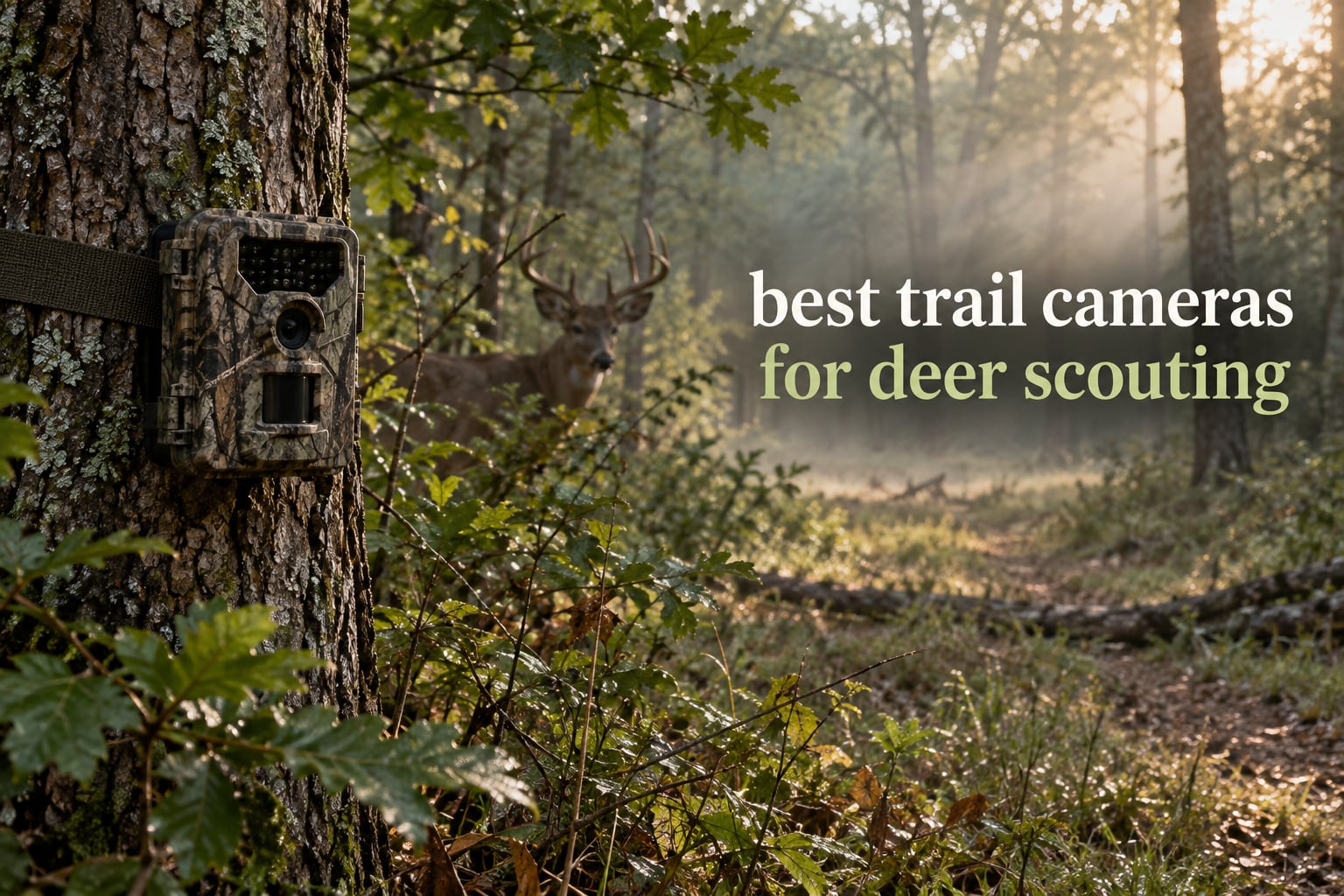
Scouting deer with a trail camera is not the same job as watching birds or securing a cabin. You need to know when a buck moves, which travel corridor he commits to, and whether that funnel is holding pressure. After spending weeks with 12 of the current crop in the field, these are the best trail cameras for deer scouting, ranked by the things that actually change how you hunt.
Three decisions narrow the field first. Do you want pictures arriving on your phone over cellular, or will you pull a card? Do you need a 940nm no-glow flash that shows no red eye at night, or will 850nm low-glow do? And how many cameras does your acreage really support? We ranked every camera below on trigger speed, detection cone, flash type, night image quality, power options, app reliability and running cost.
Forum owners also make two points worth repeating: good batteries often matter more than the camera body, and two or three cameras per location is the practical default. If you are still choosing the rest of your kit, our crossbow picks for deer hunting cover the other half of that setup.
Table of Contents
- Top 3 Picks for Best Trail Cameras for Deer Scouting in 2026
- All 12 Cameras at a Glance (October 2026)
- 1. GardePro E6 WiFi: the all-rounder with the biggest owner base
- 2. WOSPORTS G600 4K: 4K video with a 120-degree detection cone
- 3. CEYOMUR CY95: the solar unit that cuts battery swaps
- 4. SPYPOINT Flex-M Twin: cellular scouting with a free monthly allowance
- 5. iZEEKER iG200: a low-cost no-glow camera that holds up
- 6. Meidase P70: 100 foot no-glow night vision with side sensors
- 7. GardePro E5S: the non-cellular workhorse with a 0.1 second trigger
- 8. MAXDONE PH960W: adjustable solar for long deployments
- 9. VOOPEAK TC32B-2P: pan-tilt coverage rated from -40F
- 10. Moultrie Edge 2 Pro: Live Aim solves camera placement
- 11. Tactacam Reveal Ultra: GPS tracking that works with the battery out
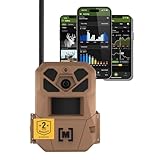
- 12. Moultrie Edge 3: AI buck detection and remote feeder control
- Do Bucks Actually Notice Trail Cameras?
- How to Choose a Trail Camera for Deer Scouting
- Frequently Asked Questions
- What is the best trail camera for deer scouting?
- What is the best trail camera for the money?
- Do Bucks avoid trail cameras?
- Which brand of trail camera is the most reliable?
- What are the most common SD card problems with trail cameras?
- What is the most common trail camera problem?
- How long do trail camera batteries last?
- Is Moultrie or Tactacam better?
- Final Verdict: Which Deer Scouting Camera Should You Buy?
Top 3 Picks for Best Trail Cameras for Deer Scouting in 2026

GardePro E6 WiFi
- 64MP stills and 1296P video
- No-glow 940nm night vision to 75 ft
- 110-degree viewing angle
- WiFi live view within about 45 ft

WOSPORTS G600 4K
- 4K video with sound
- 0.2 second trigger
- 120-degree detection cone
- On-device 2-inch color LCD

SPYPOINT Flex-M Twin
- Free plan sends up to 100 photos a month
- Cross-carrier network auto-select
- BUCK TRACKER AI species filter
- Twin pack with antennas included
All 12 Cameras at a Glance (October 2026)
| Product | Specifications | Action |
|---|---|---|
| GardePro E6 WiFi |
|
Check Latest Price |
| WOSPORTS G600 4K |
|
Check Latest Price |
 CEYOMUR CY95 Solar CEYOMUR CY95 Solar |
|
Check Latest Price |
| SPYPOINT Flex-M Twin |
|
Check Latest Price |
 iZEEKER iG200 iZEEKER iG200 |
|
Check Latest Price |
 Meidase P70 Meidase P70 |
|
Check Latest Price |
 GardePro E5S GardePro E5S |
|
Check Latest Price |
 MAXDONE PH960W MAXDONE PH960W |
|
Check Latest Price |
 VOOPEAK TC32B-2P VOOPEAK TC32B-2P |
|
Check Latest Price |
 Moultrie Edge 2 Pro Moultrie Edge 2 Pro |
|
Check Latest Price |
 Tactacam Reveal Ultra Tactacam Reveal Ultra |
|
Check Latest Price |
 Moultrie Edge 3 Moultrie Edge 3 |
|
Check Latest Price |
1. GardePro E6 WiFi: the all-rounder with the biggest owner base
GardePro E6 WiFi Trail Camera, Stable WiFi with External Antenna
64MP stills
1296P video
No-glow 940nm night vision to 75 ft
110-degree angle
Pros
- Very clear 64MP photos and 1296P video
- WiFi live view for aiming without pulling the card
- Works with little configuration
- Good night detail at 20 to 25 ft
Cons
- Rear-facing LCD makes setup awkward
- Tight battery door that some rechargeable AAs will not fit
- SD slot on the bottom can lose cards in leaves
The E6 is the pick I recommend most often, and the reason is ownership volume. At 4979 ratings it has the deepest owner base in the group, so the failure modes are documented rather than hypothetical. Owners running a dozen-plus fleet call its photo and video quality among the best they own.
For deer work the WiFi matters more than the megapixel headline. You connect within roughly 45 ft in open ground and frame the shot live instead of guessing at a strap mount, and the external antenna keeps that link stable in brushy timber.
It is not a polished piece of kit. The color screen sits inside the lid on the back of the body, the battery door is stiff, and the card slot protrudes from the bottom where leaves collect.
Owners also report app transfers stalling on batches of more than five or six files. None of that stops the camera recording; it only affects how pleasant the review process is.
Why it wins for deer scouting
A 110-degree cone with 75 ft of no-glow illumination covers a trail crossing or small clearing without lighting the woods around it.
Where it frustrates owners
Medium sensitivity still fires on leaf movement, and images lose detail when you zoom in on distant animals.
2. WOSPORTS G600 4K: 4K video with a 120-degree detection cone
WOSPORTS Trail Camera(Non-Cellular Non-WiFi) 64MP 4K 0.2S Trigger Motion Activated,Game Camera with No-Glow Night Vision 2.0”LCD 120°Wide for Outdoor Scouting Wildlife Monitoring Home Security
4K video at 30fps
0.2 second trigger
120-degree cone
No-glow 940nm to 80 ft
2-inch color LCD
Pros
- Sharp 4K video and high-resolution stills
- Fast 0.2 second trigger
- 32 no-glow IR LEDs
- On-device LCD means no card pulling to check clips
Cons
- No cellular or WiFi
- Manual focus rather than auto focus
- Push-button menus with no app support
The G600 is the value pick because it does the two things a deer scout needs most, quickly and quietly. A 0.2 second trigger across a 120-degree cone catches a deer trotting a funnel instead of the tail end of it.
Video is the differentiator. Most of its class shoots 720p or 1296p; this one records 4K at 30fps with sound through a decent optical lens, which pays off when you read movement patterns across weeks of footage.
Because it is non-cellular and non-WiFi, everything lives on the SD card. On pressured ground that is an advantage: you pull the card and the camera never lit a radio. The 2-inch color screen reviews clips in the field.
Why it suits a buck pattern study
The wide cone covers a bend where deer commit to different routes at different times of day. Owners point to trigger speed and the field LCD over pixel count.
Where it falls short
Manual focus and push-button menus feel dated beside app-driven rivals. If you want to check footage from the truck, this is the wrong tool.
3. CEYOMUR CY95: the solar unit that cuts battery swaps
CEYOMUR 4K 68MP Solar WiFi Trail Camera, Game Camera with 32GB TF Card
68MP stills and 4K video
Built-in solar with 5200mAh battery
0.1s trigger
850nm night vision
Pros
- Solar panel and internal battery reduce field battery changes
- 0.1 second trigger with 3 PIR sensors
- Night detail is clearer than most no-glow units
- 32GB card pre-installed
Cons
- 850nm flash emits a faint red glow
- WiFi range is only about 33 ft
- Needs a full 8-hour USB charge before first use
The CY95 is the pick when access is hard. A top-mounted solar panel feeding a 5200mAh internal battery means one deployment instead of four, with 4 AA cells underneath as backup.
Trigger response is 0.1 seconds across three PIR sensors and a 120-degree zone, and the 850nm LEDs push more light down the lens than a 940nm array of the same size.
The honest cost of that night quality is a faint red glow. On pressured ground or anywhere a mature buck has been educated by flash, that is a real consideration rather than a footnote.
Owners report far fewer battery trips, and the pre-installed 32GB card means it records the day you open the box.
Why it works for long scouting windows
Night detail stays sharper than most no-glow units at 65 ft, and the 2.0-inch color screen handles settings without a laptop.
Where owners complain
The app WiFi reaches roughly 33 ft and cannot view over the internet, and the internal battery wants a full overnight USB charge before the first deployment.
4. SPYPOINT Flex-M Twin: cellular scouting with a free monthly allowance
SPYPOINT Flex-M Twin, Cellular Trail Camera, Night Vision, Free Photo Plan
Cellular LTE with cross-carrier auto-select
Free plan sends up to 100 photos a month
0.5s trigger to 90 ft
Pros
- Free monthly plan with no commitment
- Camera picks the strongest network automatically
- Constant Capture records and transmits at once
- BUCK TRACKER AI filters by species
Cons
- 28MP stills and 720p video look dated
- Low-glow flash is visible at night
- IP65 water resistance trails IP66 rivals
The Flex-M twin pack is the one to watch if you want cellular scouting without a subscription hanging over you. The free plan transmits up to 100 photos a month with no commitment, and paid tiers raise the limit to 250 photos or unlimited for a few dollars more each month.
That math matters when you run three cameras. Two pushing mostly stills, with a third on unlimited video, keeps a season of pattern data affordable.
Both cameras ship with antennas and pre-activated SIM cards, and the unit auto-selects the strongest network, so there is no carrier setup in the field. BUCK TRACKER AI filters the feed by species, separating deer traffic from everything else crossing the zone.
Why it suits a first cellular season
It is one of very few cellular cameras where the free tier is genuinely usable, and the twin pack halves the number of trees you visit.
Where the reviews push back
Image quality is the weak point at 28MP and 720p, and this camera carries the highest share of one-star reviews in the group, mostly tied to failed uploads in weak signal. The flash is low-glow.
5. iZEEKER iG200: a low-cost no-glow camera that holds up
iZEEKER Trail Camera, HD Game Camera with 940nm No Glow Night Vision Motion Activated 0.2s Trigger Time, Hunting Camera No WiFi, IP66 Waterproof for Wildlife Monitoring Outdoor Security Deer Scouting
32MP stills
Video to 2K
0.2s trigger with 3-shot burst
36 no-glow 940nm LEDs
Pros
- Very capable for the money
- Fast 0.2 second trigger with burst capture
- Clamshell case clears lens condensation easily
- Front-facing screen makes aiming simple
Cons
- SD card and batteries not included
- 90-degree field of view is narrow
- 65 ft night range is short for open ground
The iG200 is the budget pick and the surprise of the set. Owners report it performing above the price bracket it sits in, with a 0.2 second trigger, 36 no-glow 940nm LEDs and a sensor handling 2K video without trouble.
Design details show real field thinking. The clamshell case opens to clear lens condensation after a wet week, and the front-facing screen lets you adjust the angle while the camera is strapped up.
Loop recording overwrites the oldest files when the card fills, so a long deployment does not stop on day nine.
The SD slot sits on the side rather than the bottom, a real improvement over rivals that lose cards in leaf litter. Illuminated icon buttons help in the dark.
Why it works as a spare or backup camera
At two or three cameras per location, most hunters need a cheap fourth unit for a secondary funnel.
Where it runs out of road
A 90-degree cone is narrow beside the 110 and 120-degree units, 65 ft of night range will not cross a wide open lane, and you buy the card and batteries separately.
6. Meidase P70: 100 foot no-glow night vision with side sensors
Meidase P70 (Non-Cellular,Non-WiFi) Trail Camera, 64MP 1296p, Game Cameras with No-Glow IR Night Vision, Motion Activated, Waterproof for Wildlife Deer Cams, Hunting
64MP and 1296p video
No-glow night vision to 100 ft
0.1s trigger with side sensors
2.4-inch display
Pros
- Very bright 100 ft no-glow night images
- 0.1 second trigger with side sensors for moving deer
- f/1.6 lens performs well in low light
- Support replies fast and honored warranty swaps
Cons
- SD card and batteries not included
- 70-degree viewing angle is narrow
- Video trigger depth at night drops to about 15 ft
The P70 is the pick when your scouting happens after dark. Thirty-six 940nm LEDs push usable night detail out to 100 feet with no visible red eye, and the f/1.6 lens keeps that detail clean on a moonless night.
Side sensors are the feature owners single out. Combined with a 0.1 second trigger, the camera captures deer mid-stride rather than after they turn, and several owners running a dozen cameras call it the best of their fleet.
Cards up to 512GB are supported and H.264 compression keeps files small enough that a month of footage fits comfortably. Power is 8 AA cells with solar panel support, and settings persist when the battery runs out.
Why it holds up on a night corridor
One hundred feet of invisible illumination matches the longest no-glow reach in this set, letting you cover a broad lane rather than one narrow trail.
Where it disappoints
The 70-degree angle is narrower than most rivals, night video trigger depth falls to roughly 15 ft, and the shutter is too slow for hard action after dark.
7. GardePro E5S: the non-cellular workhorse with a 0.1 second trigger
GardePro E5S Non-Cellular Trail Camera, 64MP Photo & 1296P HD Video
64MP and 1296P video
0.1s trigger with 3 PIR sensors
No-glow night vision to 100 ft
Non-cellular low draw
Pros
- Image quality rivals cameras costing far more
- Reported near-full lithium charge after months
- 5-minute activation delay avoids setup photos
- Settings survive a dead battery
Cons
- No cell or WiFi
- card must be retrieved by hand
- Weak night triggering on some units
- High sensitivity produces blank frames in wind
The E5S is the non-cellular answer for anyone who wants maximum scouting per battery. Owners report 95 percent charge remaining on lithium AA cells after months, and the non-cellular design is part of the reason.
Trigger speed is 0.1 seconds across three PIR sensors, with a 120-degree field of view and 100 foot no-glow night vision, which covers a wide travel corridor in one mount.
The on-off switch carries a five-minute delay before recording, so you do not burn a day of footage photographing your own ladder, and settings survive a fully depleted battery. A 1/4-20 mounting thread fits trees, posts or fence lines.
Why it stretches a deployment
With no radio drawing power the runtime advantage is substantial, and lithium chemistry handles cold far better than alkaline.
Where owners report trouble
The most common complaint is night triggering. Several owners say the card fills with daytime footage while the camera rarely fires after dusk, and high sensitivity produces blank frames in wind.
8. MAXDONE PH960W: adjustable solar for long deployments
MAXDONE Solar Trail Camera, 4K 64MP WiFi Bluetooth Night Vision Game Camera
4K and 64MP imaging
6000mAh battery with adjustable solar
0.1s trigger
32GB card included
Pros
- Adjustable solar panel angle follows the sun through the season
- 6000mAh battery with solar and Type-C charging
- Custom detection zones cut false triggers
- 32GB card pre-installed at no extra cost
Cons
- No cellular
- so no phone alerts or push notifications
- WiFi hotspot reaches about 55 ft
- Compact body is smaller than most trail cameras
The PH960W solves a problem most solar panels ignore. The split panel tilts, so you can aim it at the sun in June and re-angle it as the season turns, which owners on wooded ground call the difference between a full battery and a dead one in October.
Inside is a 6000mAh rechargeable battery with three charging paths including solar and Type-C, paired with 4K video and 64MP stills at a 0.1 second trigger. Detection zones are customizable, which is how you stop a branch swing filling the card.
The 32GB card is pre-installed, and capture modes cover time-lapse, scheduled shooting and five-shot burst.
What it does not do is transmit. It is a short-range WiFi and Bluetooth camera through the TrailCamGO app reaching about 55 ft, with no push notifications at all.
Why it fits a month-long deployment
Owner satisfaction centers on the panel and the battery rather than image quality.
Where it falls down
No cellular means no alerts and no remote review, so you still pull the card, and the body is small at under 4 inches long.
9. VOOPEAK TC32B-2P: pan-tilt coverage rated from -40F
VOOPEAK Trail Camera, 4G LTE Cellular Game Cameras with 360° Live Streaming
355-degree pan with 100-degree tilt
4W solar and 7800mAh battery
IP68 rated to -40F
0.1s PIR response
Pros
- Motorized pan and tilt covers a clearing no fixed camera can
- IP68 rating covers the widest temperature range here
- 7800mAh battery and 4W solar for unattended use
- Pre-installed SIM auto-connects to the strongest network
Cons
- Only 100MB of free data
- SD card not included
- Six IR LEDs is a low count for the stated night range
- Pan mount is awkward for a fixed trail crossing
The VOOPEAK is the only pan-tilt camera here, and that changes what you can scout. A 355-degree horizontal pan with 100 degrees of vertical tilt covers a clearing, a feeder or a road crossing from one mount, and you set the angle from the app.
It is also the one built for hard winters. The IP68 rating is specified from -40F to 140F, the widest operating range in this group, and the 4W solar panel with a 7800mAh battery is rated for up to 12 months on a charge.
Setup takes about three minutes through the app. The SIM is pre-installed, works across Verizon, AT&T and T-Mobile, and auto-connects to the strongest signal, with 2.5K live streaming and instant motion notifications on a 0.1 second PIR response.
Storage is a 256GB SD card, sold separately, or optional cloud storage. Six infrared LEDs cover a 65 foot night range.
Why it earns the cold-climate slot
Northern deer camps put cameras out in September and recover them in January. A published -40F rating removes one of the two reasons that trip usually ends early.
Where the design fights you
A panning head is wrong for a fixed trail crossing where you want a locked frame, and the free data allowance is thin.
10. Moultrie Edge 2 Pro: Live Aim solves camera placement
Moultrie Edge 2 Pro Cellular Trail Camera – 40MP, No-Glow Flash
40MP and 1440p video
Live Aim real-time preview
AI species filtering
100 ft detection range
Pros
- Live Aim shows the actual view so you can aim from the truck
- AI filters shadow and branch triggers
- 8GB built-in memory means no card to lose
- Auto-connects across four carriers with no SIM setup
Cons
- Subscription required for cellular features
- 50-degree field of view is narrow
- About 35 seconds from capture to a verified phone photo
Live Aim is the feature that makes this camera worth the subscription. It streams the camera’s real field of view to your phone, so you can dial in a 50-degree cone from the truck instead of hiking back to a tree you aimed wrong.
Moultrie Mobile A.I. identifies bucks, does, turkey and humans to strip out shadow and branch triggers, and owners credit that filtering with extending battery life.
There is 8GB of built-in memory plus cloud backup, so no card to format, lose or have stolen, and auto-connect picks the strongest of four carriers with no SIM setup.
Capture modes run Timelapse, Multi-Shot and Motion-Triggered, with 40MP stills and 1440p video with audio across a 100 foot detection range.
Why it wins on placement
A 50-degree cone is narrow, and that is the whole argument for Live Aim. Owners who leaned on it stopped second-guessing angles, and several ran it from October to February without failure.
Where the cost shows up
The subscription is required for anything cellular, including the AI filtering, and delivery runs about 35 seconds from capture to a verified photo.
11. Tactacam Reveal Ultra: GPS tracking that works with the battery out
TACTACAM Reveal Ultra Cellular Trail Camera: 4K Photo, 1080p Video, Live View, GPS Tracking-Enabled, Switchable No-Glow/Low-Glow Flash, LTE Connectivity, LCD Screen – Best Hunting, Game Camera
4K photos and 2.5K video
Switchable no-glow and low-glow flash
Active GPS theft tracking
Sub-0.5s trigger
Pros
- 4K stills and crisp 2.5K video day and night
- Holds cellular service in weak-signal areas
- GPS tracking continues with the battery removed
- Up to 9-shot burst for moving deer
Cons
- Subscription can reach roughly 25 dollars per camera per month with add-ons
- Proprietary system that will not accept a third-party SIM
- Some users describe the app as clunky and slow
The Reveal Ultra is the pick for anyone running several cameras across a spread of ground. Active GPS keeps logging location even when the camera is powered off or the battery is pulled, and a theft alert fires if the unit moves more than half a mile from its last known position.
The switchable flash is useful for deer. You get 96 feet of low-glow or 80 feet of no-glow from the same unit, so you can run no-glow on the pressured tree and low-glow on a food plot where you want reach.
Output is 4K stills and 2.5K video on a sub-0.5 second trigger with up to a 9-shot burst, with Live View streaming through the app and an upgraded antenna that helps where other cellular cameras stall.
There is 16GB of internal storage with an SD card slot, and power runs off Tactacam solar panels, the battery belt or a lithium cartridge.
Why GPS earns its place
Owners managing several cameras over a large property value knowing where a unit is, and image quality and weak-signal delivery are the other strengths.
Where the running cost bites
Add-on charges for basic actions like changing settings can push a plan well above what most hunters budget, and the camera will not accept your own SIM. GPS updates only every six hours, so it is for recovery, not live tracking.
12. Moultrie Edge 3: AI buck detection and remote feeder control
Moultrie Edge 3 Cellular Trail Camera – 40MP, 0.5s Trigger
AI buck detection
40MP stills and 1080p video
0.5s trigger to 100 ft
Live Aim and GPS mapping
Pros
- AI buck detection surfaces mature buck activity instead of every trigger
- Live Aim preview plus built-in GPS camera mapping
- Remote feeder control and feed level monitoring
- Low entry monthly plan with no contract
Cons
- 50-degree field of view demands careful aim
- Low-glow flash is more detectable than a no-glow unit
- Cellular and AI features need a paid plan
The Edge 3 is the most explicitly deer-focused camera here. AI buck detection filters the alert stream so you see mature buck activity rather than every passing doe, which is the difference between a phone full of noise and a usable pattern.
It pairs that with Live Aim for placement and built-in GPS that maps every camera location automatically, so a three-camera deployment is organised without typing coordinates.
Feeder control from the same app includes feed level monitoring, so you can check a feeder and the buck traffic around it from the cab. Local recording runs alongside alerts.
Output is 40MP stills and 1080p HD video on a 0.5 second trigger with a 100 foot detection range and low-glow infrared.
Why it fits a buck-focused season
When your goal is a single mature buck rather than general deer traffic, the filter is the feature, and remote feeder control removes a walk.
Where it constrains you
The 50-degree cone and low-glow flash both push back against pressured ground, and cellular features need a subscription.
Do Bucks Actually Notice Trail Cameras?
Most mature bucks react to your scent and your vibration long before they react to a camera body. A 940nm no-glow flash is invisible to deer at night, so the realistic risk in a scouting setup is the traffic you create walking in to pull cards, not the hardware on the tree. Owners running no-glow cameras on pressured ground report no change in deer behaviour.
Two things do make a difference. A visible low-glow red eye at short range can prompt a curious look, and cameras mounted in obvious spots on frequently walked trails invite investigation of the whole frame. Camouflage cases handle both.
How to Choose a Trail Camera for Deer Scouting
Cellular or SD card?
Cellular earns its keep when your trees are far from the truck, when you want buck alerts during work hours, or when a second hunter needs the same feed. It also means a data plan, and a phone that cannot connect sends you nothing. SD-card cameras cost nothing to run, ask less of the batteries, and are the safer choice in states with camera restrictions or on land with no signal. If you are also outfitting a truck, our backup camera picks for cars cover a different kind of viewing entirely.
No-glow or low-glow infrared?
No-glow 940nm arrays emit no visible red light, which keeps the position hidden on pressured ground. Low-glow 850nm pushes more light down the lens, so night detail is cleaner and reach longer. If you scout open country where a red dot would never be seen, take the brighter flash. If you share ground with deer that have been burned before, take the invisible one.
Trigger speed, recovery time and detection range
Trigger speed decides how many usable frames you get of a running deer. Everything here fires between 0.1 and 0.5 seconds. Detection range is the advertised figure at ideal conditions, so treat 100 feet as good for a clear corridor and much less in dense brush. A wide cone matters more than raw range when covering a bend where animals change routes.
Battery chemistry for cold deployments
Lithium AA cells hold voltage far better than alkaline in freezing conditions, and the gap widens as temperatures drop. Forum owners make the point repeatedly: good batteries often matter more than the camera itself. For a camera that sits three weeks in November, lithium is the only sensible choice.
How many cameras do you actually need?
Two or three per location is the practical default, and placement matters more than count. Strap to a live tree at 36 to 40 inches, angle slightly downward, avoid sunrise and sunset glare, clear nearby branches, and walk the approach once before settling. We covered the sit-height side in our ground blind picks for deer hunting.
Frequently Asked Questions
What is the best trail camera for deer scouting?
The GardePro E6 WiFi is the best all-round choice for deer scouting thanks to 64MP stills, no-glow 940nm night vision to 75 feet, a 110-degree viewing angle and the deepest owner base in the group at 4979 ratings. For a wider detection cone and 4K video, look at the WOSPORTS G600. For live phone alerts with a free monthly allowance, the SPYPOINT Flex-M twin pack.
What is the best trail camera for the money?
A mid-tier unit is the sweet spot, because beyond that point you are paying for resolution you rarely use in the field. The WOSPORTS G600 and the GardePro E5S both deliver 0.1 to 0.2 second triggers and no-glow 940nm night vision without a subscription. If you want cellular, budget for the data plan on top of the camera, since the plan is the real running cost.
Do Bucks avoid trail cameras?
Most mature bucks react to human scent and vibration rather than to the camera itself. A 940nm no-glow flash shows no red light at night, so the realistic risk comes from your own traffic walking in to pull cards, not from the hardware on the tree.
Which brand of trail camera is the most reliable?
GardePro stands out in this roundup, with the E6 carrying 4979 ratings at 4.0 stars and the E5S rating 4.4 across 771 ratings. For night vision specifically, Meidase draws repeated praise for 100 foot no-glow images and fast warranty service. Owners also report diminishing returns above the mid range, so reliability often comes from battery choice and mounting rather than a higher price.
What are the most common SD card problems with trail cameras?
The most frequent issue is that no card is included in the box, so the camera cannot record until you buy one. Other common problems are cards filling up mid-deployment, incompatible capacity, cards that need formatting to FAT32 before they are recognized, and failures in sustained cold. Loop recording, available on the iZEEKER iG200, overwrites old files so recording never stops silently.
What is the most common trail camera problem?
Batteries dying faster than expected in cold weather is the most common problem, driven by high trigger rates and false triggers. Lowering PIR sensitivity and clearing branches near the detection zone cuts the trigger count. Lithium AA cells rather than alkaline make the biggest difference in winter deployments.
How long do trail camera batteries last?
A non-cellular camera on lithium AA cells can run for months, and owners of the GardePro E5S report near-full charge remaining after a full season. Cellular cameras drain faster because the radio draws power on every transmission. Solar panels and large internal batteries, as on the CEYOMUR CY95 and MAXDONE PH960W, extend deployments to a season or more.
Is Moultrie or Tactacam better?
Moultrie is stronger on placement and deer-specific features, with Live Aim previews, built-in GPS mapping, AI buck detection and remote feeder control. Tactacam is stronger on connectivity hardware, with active GPS theft tracking that runs with the battery removed, a switchable no-glow and low-glow flash and an upgraded antenna for weak-signal areas. The running cost is the real difference: Tactacam plans can climb higher with add-ons.
Final Verdict: Which Deer Scouting Camera Should You Buy?
Start with the GardePro E6. It has the deepest owner base in the group, no-glow 940nm night vision, a 110-degree cone and WiFi live view for getting the angle right, and it costs nothing per month to run. The WOSPORTS G600 4K is the better buy if video resolution and a 120-degree cone matter more, and the Meidase P70 wins outright for after-dark corridor work with 100 feet of invisible illumination.
If your trees are far from the truck, the SPYPOINT Flex-M twin pack is the cheapest way into cellular scouting thanks to its free monthly allowance, while the Tactacam Reveal Ultra is the pick for anyone running several cameras over a large spread who needs to know where they are. Whichever you land on, run lithium cells, mount at 36 to 40 inches, and pull the cards on a schedule rather than at random.