

A solar power bank for hiking is a portable battery with a photovoltaic panel bonded to its shell, built-in cables or USB ports, and an IP-rated housing, sized so a phone, GPS watch, headlamp or satellite communicator can be recharged away from an outlet. The honest verdict, which almost nobody in this category will print: solar on a power bank is a top-up feature, not a power source. Charge it fully at home, then let the panel bail you out.
That is the consensus across every forum thread we read on r/backpacking, r/hiking and r/WildernessBackpacking, and it shapes how we ranked the best solar power banks for hiking in 2026. The panels on compact banks move energy at a trickle; what actually runs your electronics is the internal lithium battery. We treated the panel as a bonus and ranked these ten on the things that decide whether a hike succeeds: real usable watt-hours, grams carried, port selection, weather sealing, and how long the unit has stayed alive for the owners who bought it.
We compared all ten units side by side on the same criteria, read through thousands of buyer reviews, and cross-checked the field reports people post after real multi-day trips. If you want the wider charging picture, our guides to the best power banks for content creators and the best high-capacity power banks for photographers cover heavier non-solar options.
Table of Contents
- Top 3 Best Solar Power Bank Picks for Hiking in 2026
- All 10 Solar Power Banks Compared (October 2026)
- 1. BLAVOR 10,000mAh Solar Power Bank – Best for Day Hikes and Ultralight Carry
- 2. SOARAISE 50,000mAh Solar Power Bank – Best Overall for Long Trips
- 3. Durecopow 20,000mAh Solar Power Bank – Best Value Cable-Free Kit
- 4. SOARAISE 48,000mAh Solar Power Bank – Best for Base Camp and Car Camping
- 5. FEELLE 50,000mAh Solar Power Bank – Best for Emergency Kits and Hand-Crank Backup
- 6. Mregb 42,800mAh Solar Power Bank – Best for IP67 Sealed Trips
- 7. MINRISE 40,000mAh Solar Power Bank – Best for Multi-Day Trips with Mixed Devices
- 8. YELOMIN 38,800mAh Solar Power Bank – Best for Fast Device Top-Ups
- 9. Nuynix 49,800mAh Solar Power Bank – Best for Maximum Capacity Backup
- 10. Luvknit 20,000mAh Solar Power Bank – Budget Pick and Lightest Carry
- Are Solar Power Banks Worth It? The Honest Verdict for Hikers
- How Solar Actually Performs in the Field
- How to Size Your Power Bank for Your Trip
- What to Look for When Buying a Solar Power Bank
- Frequently Asked Questions
- Final Verdict for Hikers in 2026
Top 3 Best Solar Power Bank Picks for Hiking in 2026

BLAVOR 10000mAh Solar Power Bank
- Pocket-sized at 0.2 kg
- IPX5 sealed
- 20W USB-C and wireless charging
- Dual flashlight and carabiner

SOARAISE 50000mAh Solar Power Bank
- 50000mAh lithium-ion cell
- 22.5W PD and 15W wireless
- Built-in USB-C and Lightning cables
- Flashlight
- compass and thermometer
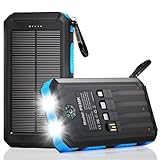
Durecopow 20000mAh Solar Power Bank
- Four built-in cables
- six-device charging
- Steady
- SOS and strobe flashlights
- Water-resistant with carabiner
All 10 Solar Power Banks Compared (October 2026)
| Product | Specifications | Action |
|---|---|---|
| BLAVOR 10000mAh Solar Power Bank |
|
Check Latest Price |
| SOARAISE 50000mAh Solar Power Bank |
|
Check Latest Price |
| Durecopow 20000mAh Solar Power Bank |
|
Check Latest Price |
 SOARAISE 48000mAh Solar Power Bank SOARAISE 48000mAh Solar Power Bank |
|
Check Latest Price |
 FEELLE 50000mAh Solar Power Bank FEELLE 50000mAh Solar Power Bank |
|
Check Latest Price |
 Mregb 42800mAh Solar Power Bank Mregb 42800mAh Solar Power Bank |
|
Check Latest Price |
 MINRISE 40000mAh Solar Power Bank MINRISE 40000mAh Solar Power Bank |
|
Check Latest Price |
 YELOMIN 38800mAh Solar Power Bank YELOMIN 38800mAh Solar Power Bank |
|
Check Latest Price |
 Nuynix 49800mAh Solar Power Bank Nuynix 49800mAh Solar Power Bank |
|
Check Latest Price |
 Luvknit 20000mAh Solar Power Bank Luvknit 20000mAh Solar Power Bank |
|
Check Latest Price |
1. BLAVOR 10,000mAh Solar Power Bank – Best for Day Hikes and Ultralight Carry
BLAVOR Solar Power Bank 10,000mAh Portable Wireless Charger for Cell Phones
10000mAh lithium-polymer
20W USB-C plus wireless pad
IPX5 sealed
0.2 kg with carabiner
Pros
- Pocketable at 0.2 kg and roughly phone-sized
- 20W USB-C output and wireless charging for three devices
- IPX5 waterproof dustproof and flame-retardant housing
- Survived a 50 mph throw with no functional damage
Cons
- Panel is a trickle top-up only
- not a real recharge path
- 10000mAh means roughly two to three phone charges
- Compass is a novelty
This is the unit I keep in the top pocket for anything under a day. At 0.2 kg it is the smallest thing in the group and it disappears in a jacket pocket, which is the point. Over 47356 reviews it holds a 4.2 rating, and the pattern in the feedback is remarkably consistent: people love the build and the lights, and they treat the solar panel as decoration rather than a charging path.
What you are actually carrying is roughly 37 watt-hours of battery. That is two to three full phone charges, or a GPS watch topped up several times over, or a headlamp recharged for a multi-day trip. The 20W USB-C output moves an iPhone 15 from flat to 65% in half an hour, so topping up while you eat lunch is realistic.
The construction is where this one separates itself. The ABS and polycarbonate shell is IPX5 rated, dustproof, shockproof and flame retardant, and one owner reported the unit surviving a 50 mph highway throw without losing function. The two super-bright flashlights are genuinely useful, and the included carabiner means you can clip it outside a pack where sun can reach it.
Wireless charging pads on a phone-sized bank are always a little alignment-frisky, so treat the pad as a bonus and the wired ports as the main event. The 5V/3A output is what most modern handsets negotiate for anyway.
When this bank is the right call
If your trip is a single day, or a two-night weekend where you are never more than a few hours from a resupply point, capacity beyond a couple of phone charges is dead weight. This covers the common case of a phone that dies, a GPS watch that needs a top-off at lunch, and a headlamp that gets recharged while you are stopped at a viewpoint.
The small footprint also makes it the easiest unit here to keep warm. In cold conditions a bank that stays in an inside pocket near body heat delivers more than a large one strapped outside a pack in the wind, and the physics of that outweigh raw capacity at altitude or in early spring.
When this bank falls short
Two or three phone charges is genuinely limiting if you carry a power-hungry device list. A phone running navigation, music and a hotspot will burn through 10,000mAh in a single long day, and a satellite communicator with an active subscription can pull a charge in a weekend of frequent check-ins.
Multiple owners also point out that the panel needs the unit lying flat in direct sun, fully stopped, to gather anything meaningful. Strap it to a shoulder strap and moving, and output drops to a level that will not register as progress on your phone.
2. SOARAISE 50,000mAh Solar Power Bank – Best Overall for Long Trips
SOARAISE 50000mAh Solar Power Bank 22.5W Wireless Portable Solar Charger
50000mAh lithium-ion
22.5W PD USB-C plus 15W wireless
2 built-in cables and 3 ports
Flashlight, compass and thermometer
Pros
- Highest average rating in the group with longevity reports past a year
- 22.5W PD takes an iPhone 17 to 70% in 30 minutes
- Two built-in cables plus wireless charging cover six devices
- 3-mode flashlight
- compass and thermometer in one kit
Cons
- Heavier and bulkier than smaller options
- Slow to refill by wall or solar
- Wireless slows with cases thicker than 3mm
This is the strongest combination of rating and capacity in the group, holding a 4.4 across 1519 reviews. It is also the one that behaved best in the long-term durability reports, with owners describing units still going strong after a year of regular use. That matters more to me than peak wattage on the spec sheet.
At 16 ounces and 6 by 3 by 1 inches it is a brick in the hand but not an unreasonable pack item. The 22.5W Power Delivery port is the fastest wired output here, and the 15W wireless pad covers Qi devices from the iPhone 8 generation onward as well as Galaxy and Pixel handsets.
Cabling is where it earns its keep. Two built-in cables plus three ports and the wireless pad means six devices can be served without you unpacking a separate cable pouch, which on a long trip saves more weight than the extra capacity ever costs you.
The extras are not filler. A three-mode flashlight, a built-in compass and a thermometer turn this into a small survival kit, and the housing is described as waterproof, shockproof and dustproof. The manufacturer also lists it as approved for air travel, which matters if you are combining a hiking trip with a flight.
Warranty coverage is 12 months, which is the shortest in this group. The three-year coverage on the BLAVOR and the FEELLE is better protection if you are planning a multi-season tool.
How it performs charging small devices
Charging a GPS watch or headlamp is the quiet reason to carry a bank this size. Those devices draw a fraction of what a phone does, and a bank that has already been topped up by the panel in the morning can quietly run a watch for days without you thinking about it.
A satellite communicator is the harder case. Transmitting drains far more than a watch, so a 50,000mAh cell buys you a long window of check-ins, but it is a top-up you plan for rather than a resource you spend freely.
What you give up for the capacity
Refilling time is the real cost. Buyers report a long wait to bring this back to full by wall outlet, and the panel is positioned by the maker as an off-grid backup rather than a primary source. Plan on charging it fully the night before, not on the trail.
Wireless charging also slows down noticeably if you leave a metal plate or a thick case on the phone, and a heavy case sitting in direct sun adds a thermal concern you do not need. Remove the case for a pad charge.
3. Durecopow 20,000mAh Solar Power Bank – Best Value Cable-Free Kit
Durecopow Solar Charger Power Bank 20,000mAh, Portable Charger, 4 Cables 3 Ports Fast Charging External Battery Pack with USB C for Cell Phones, Solar Panel Charger with Dual Flashlight for Camping
20000mAh lithium-ion
3 built-in cables plus Type-C in/out
2 USB-A outputs
Dual LED lights, carabiner and compass
Pros
- Four built-in cables remove cable weight from the pack
- Charges up to six devices at once
- Dual LEDs with steady
- SOS and strobe modes
- Drop-resistant silicone corners and covered ports
Cons
- Solar input is slow
- so wall charging is still required
- Some one-star reviews report failures within a few months
Every bank on this list eventually solves the same problem, which is that your cables are always in the wrong pocket. The Durecopow stores three output cables in the body, a Type-C, a Lightning and a Micro-USB, plus a USB-A input cable, so the charging block in your pack can stay home. At 250 g and 5.9 by 3.14 by 0.78 inches, it is a comfortable middle size.
The output configuration is unusually flexible for the class. Type-C works as both input and output, and two USB-A outputs push the total to six simultaneous devices at 5V and 2.4A. That covers a phone, a watch, earbuds and a headlamp in one stop.
The build is the point here. Silicone rubber over ABS and PC, drop-resistant corners, covered ports, and water, shock and dust resistance. The two LED lights have steady, SOS and strobe modes, and five indicator lights show remaining charge without an app.
Buyers consistently mention the carabiner and compass as included, which is standard in this category but worth confirming. The certification list covers CE, FCC and RoHS.
Why the cable storage actually saves weight
Three short built-in cables replace a full set in your pack. Once you factor in a charge cable, a Lightning cable, a Micro-USB cable and a short USB-C for a watch, the saved grams add up quickly on a longer trip, and the cables are always attached to something.
For anyone running a group, six-device output is the practical feature. Two people topping up phones and a couple of headlamps at one break saves real time at a stop where the sun is out and the panel is doing its best work.
Where the compromises sit
The 2.4A output is lower than the 3A you get on several units here, so a modern flagship phone will refill more slowly than on the 22.5W SOARAISE. Fine for an overnight top-up, slower than you would like for a dead-battery rescue.
Durability reports are mixed at the low end, with a cluster of one-star reviews describing units that stopped working within a few months. The 9900-review base is large enough that the 4.1 rating is meaningful rather than noise, but this is not a buy-it-for-a-decade tool.
4. SOARAISE 48,000mAh Solar Power Bank – Best for Base Camp and Car Camping
SOARAISE Solar Power Bank 48000mAh Wireless Portable Charger with 4 Cables
48000mAh lithium-polymer
4 solar panels plus wireless pad
4 built-in cables, 3 ports
LED camping flashlight
Pros
- Large usable capacity measured around 60 Wh
- Four built-in cables plus wireless pad serve up to seven devices
- 3A USB-C moves an iPhone 15 to 60% in 30 minutes
- Foldable panel can clip to a pack while hiking
Cons
- Advertised capacity overstates real usable energy
- Solar rarely pushes the unit past roughly half full
- Bulkier and awkward for everyday carry
If you are setting up camp and staying put for a few days, this is the bank with the most headroom. The rated capacity is 48,000mAh, but owners who measured it put the real figure nearer 60 Wh, which is a substantial battery for a car-camping or base-camp setup. The 4.2 rating across 6076 reviews is solid, and the feedback is refreshingly blunt about the gap between the label and the reality.
Four panels rather than one is the meaningful engineering difference here. The maker claims charging up to five times faster than a single panel, and while panel output is still slow, having four surfaces means you can angle the unit so at least one face catches full sun instead of guessing which side to point.
You also get four built-in cables, a USB-C, a phone cable, a USB-A and a Micro, plus a wireless pad. Combined with three ports that is up to seven devices, which covers two or three people without a cable fight.
At 6.38 by 3.43 by 1.57 inches this is a chunky object, and owners consistently describe it as awkward to carry every day. The listed battery weight of 50 g does not match the physical size, so treat the dimensions as the honest number.
The housing is described as waterproof, dustproof and shockproof, with an auto shut-off function and an LED camping flashlight. The foldable panel design lets you clip the unit to a pack when you do move.
What base camp use changes about sizing
Stationary camping changes the power math completely. When you are not moving, the panel has hours of unbroken sun to work with, and a foldable unit propped on a picnic table is a far more sensible configuration than a panel strapped to a moving shoulder.
This is also where a wireless pad earns its place, since a phone can sit on the pad at a campsite while you make coffee instead of holding a cable. The 3A USB-C port is the one to use for a faster refill, with the panel doing slow work in the background.
The honest problem with the capacity claim
This is the clearest case in the group of a headline mAh figure that does not match what you can draw out. Buyers who measured the usable energy say the number is inflated, and a capacity label that oversells by a wide margin is exactly the kind of thing that ruins a sizing calculation for a long trip.
Solar performance is the second limit. Multiple owners say the panels rarely push the unit beyond roughly half capacity, so treat a full charge at home as the starting point and the panel as insurance, not as a second battery.
5. FEELLE 50,000mAh Solar Power Bank – Best for Emergency Kits and Hand-Crank Backup
FEELLE Solar Power Bank 50000mAh Magnetic Portable Charger with Hand Crank
50000mAh lithium-polymer
15W magnetic wireless
Hand crank and compass
3-year warranty
Pros
- Hand crank gives true last-resort power when everything else fails
- Compass and backpack hook for trail carry
- 15W magnetic pad snaps into position
- 4 built-in cables and 3 ports for six devices
Cons
- Heaviest unit in the group at about 0.5 kg
- Magnetic charging drops with thick or non-magnetic cases
- Solar panel remains a supplementary source
Most panels on this list assume you have some sun. The FEELLE is the one that does not, and that is the entire reason to own it. The hand-crank generator gives you a mechanical way to push energy into the cell when a wall outlet, a full battery and direct sunlight are all unavailable, which is precisely the scenario an emergency kit is built for.
Everything else about it is built for the same mindset. A high-precision compass, a three-mode LED flashlight with steady, SOS and strobe, and a backpack hook for clipping it outside your pack all support the same use case. It carries a three-year warranty, the longest coverage in the group alongside the BLAVOR.
Capacity is rated at 50,000mAh with four built-in cables, three ports and a 15W magnetic wireless pad, which means six devices and a snap-to-align pad charge for iPhone 12 through 17 series. Buyers like the magnetic snap because it removes the alignment guesswork that spoils pad charging on other units.
Silicone corner bumpers, covered ports and dustproof, waterproof and shockproof claims give it the same weather posture as the rest of the field. The 3A USB-C output moves an iPhone to 60% in half an hour.
The redesigned solar panels include a claimed power conversion system that the maker rates at five times single-panel output. Treat that as a relative claim within the unit, not a comparison against a folding panel.
When last-resort power justifies the weight
For a vehicle kit, a go-bag or a long trip through genuinely remote terrain, a crank is worth its weight. The energy you get is modest, but you can produce it anywhere, indefinitely, with no consumables, and the cell tops up from a flat emergency phone far more gently than a cracked glass screen and a dying battery.
The compass and hook also make this a sensible pack-mate for a hiker who is already carrying navigation gear, since it duplicates a function you have and adds a power source you do not.
Why most hikers should skip it
At about 0.5 kg and 7.24 by 3.54 by 1.97 inches, this is the largest and heaviest unit here by a wide margin. Carrying a full extra pound of battery for a feature you will hopefully never use is a bad trade on a normal trip, and on a long route it competes directly with carried water.
Reviews are consistent on that point, and the same buyers who love the crank call the bulk the consistent drawback. If your trips are mostly maintained trails with resupply, pick a smaller bank and skip the crank.
6. Mregb 42,800mAh Solar Power Bank – Best for IP67 Sealed Trips
Mregb Solar Charger Power Bank 42800mAh, Portable Charger, Solar Power Bank,External Battery Pack 5V3.1A Qc 3.0 Fast Charger Built-in Super Bright Flashlight (Orange)
42800mAh lithium-polymer
IP67 waterproof and dustproof
QC 3.0 at 5V/3.1A
Flashlight rated to 100 hours
Pros
- Very high capacity packed into a standard footprint
- IP67 waterproof drop-proof and dustproof ABS shell
- Super-bright LED flashlight with up to 100 hours runtime
- Charges three devices at once with USB-C in and out
Cons
- Solar recharging is very slow and the maker calls it emergency-only
- No wireless charging despite the large capacity
- Brand is less established so long-term durability is less documented
IP67 is the rating to look for if your hiking involves persistent rain, river crossings or blowing dust. It means dust-tight and protected against immersion in water up to one metre briefly, which is a meaningful step up from the IPX4 and IPX5 units that only shrug off splashes. The Mregb housing is chemical-resistant and heat-resistant high-hardness ABS.
Inside is a 42,800mAh high-density lithium-polymer cell, which owners consistently praise for fitting that capacity into a standard bank footprint rather than a brick. The 3221 reviews at 4.2 give a reasonable read on real-world behaviour, and the summary from buyers is that the capacity-to-size ratio and the sealing are what justify the purchase.
Charging is handled by USB-C working as both input and output plus dual USB-A outputs, so three devices at once. QC 3.0 at 5V and 3.1A is a real fast-charge protocol rather than a marketing label, and overcharge and short-circuit protection are built in.
The flashlight is the sleeper feature. Rated for up to 100 hours of continuous use, it is genuinely useful for a headlamp backup, signalling a group in an emergency, or checking a headlamp that has died at an inconvenient moment.
The listed battery weight of 29 g again looks implausible against the capacity, so treat the rating as a class rather than a measurement when you weigh your pack.
What IP67 changes on a wet trip
On a coast path or in shoulder-season rain, the sealing difference is the feature that matters. Water that beads on an IPX5 housing and water that sits in a port recess behave very differently after a two-hour soak, and IP67 removes a failure mode that ends trips early.
It also lets you keep the bank in an exterior pocket or clipped outside the pack where it can catch sun, which is the only configuration that produces any real output. Sealing and solar access are the same decision.
What you give up
There is no wireless charging pad, which is a real loss if you prefer not to carry a cable. The other two 40,000mAh-class units in this group add a pad, so this is a deliberate trade toward sealing and simplicity.
Solar is explicitly framed by the maker as an emergency-only function, and reviewers agree the recharge is very slow. Also worth weighing: a newer brand with a smaller review history than the BLAVOR or Durecopow, so long-term durability is less well documented than you would like for a tool you keep for seasons.
7. MINRISE 40,000mAh Solar Power Bank – Best for Multi-Day Trips with Mixed Devices
MINRISE Solar Power Bank 40000mAh, Portable Charger PD 20W Fast Charging
40000mAh lithium-polymer
20W PD Type-C output
5 output and 4 input options
6-hour full recharge cycle
Pros
- 20W PD output takes an iPhone 15 from 15% to 65% in 30 minutes
- Three built-in output cables plus a USB-A input cable
- Flashlights reaching about 165 feet for up to 25 hours
- ABS body with anti-fall silicone corners and covered ports
Cons
- Heaviest relative to capacity at about 1.1 pounds
- Solar panel is small at 1.8W and intended for emergencies only
- Needs a 5V/2A or better adapter which is not supplied
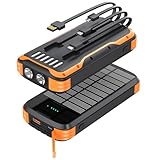
The MINRISE is the most configurable bank here, and on a multi-day trip with mixed devices that flexibility is worth more than raw capacity. It lists five output options and four input options, including solar, on a 40,000mAh lithium-polymer cell. The 20W Type-C PD output is the second-fastest wired figure in this group.
Three built-in output cables cover Type-C, iOS and Micro USB, with a built-in USB-A input cable for recharging the bank itself. In practice that means you can serve a phone, a watch and a headlamp without a cable pouch, which is the same argument as the Durecopow but with more capacity behind it.
Recharging the bank takes about six hours from a standard adapter, and owners confirm the full six-hour cycle in practice. The unit itself is described as anti-fall, dustproof and waterproof with silicone corners and covered ports.
The dual flashlights are the standout for night hiking, throwing light about 165 feet with up to 25 hours of runtime. That is enough to light a campsite or signal a group, and it doubles as a headlamp backup when your main lamp fails.
A smart protection IC manages the cell, and the housing is a straightforward orange-black ABS with reinforced corners rather than a rubberised boot.
Why weight per usable watt-hour matters more than capacity
At about 1.1 pounds for a 40,000mAh cell, this is the heaviest-for-its-capacity unit here, and users single out weight as the main drawback. The backpacking community is blunt about why that matters: every gram is a gram you did not carry water for.
That is why we rank by usable watt-hours per 100 g rather than by the mAh headline. On a loaded pack, a slightly smaller bank that fits where you can reach it beats a larger one you resent every kilometre. If your base weight is already high, step down to a smaller unit rather than shaving here.
What the panel can and cannot do
The panel is specified at 1.8W, which is the smallest in this group, and both the maker and reviewers frame it strictly as an emergency feature. Realistically that is enough to add a trickle of charge over a long lunch stop, not enough to recover a day of heavy navigation use.
One practical note: no wall adapter is included, and you need a 5V/2A or better one. If you are topping it up at a trailhead with a small power bank or a weak wall plug, the six-hour cycle will not hold.
8. YELOMIN 38,800mAh Solar Power Bank – Best for Fast Device Top-Ups
Solar Charger Power Bank 38800mAh, 22.5W USB-C Fast Charging Portable Charger with 4 Built-in Cables, External Battery Pack with Dual LED Emergency Flashlights for Camping, Hiking, Outdoor Use
38800mAh lithium-polymer
22.5W USB-C fast charging
4 built-in cables plus USB-C in/out
IP65 sealed with dual flashlights
Pros
- 22.5W USB-C fast charging delivers about 75% in 45 minutes
- Four built-in cables plus ports serve up to six devices
- Dual flashlights with steady
- SOS and strobe modes
- IP65 waterproof
- dustproof and shockproof housing
Cons
- Smallest review base here at 269 reviews
- Solar output is low and slow and limited to emergency backup
- No hand crank or compass for true off-grid emergencies
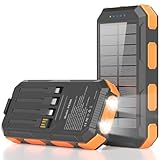
This is the newest listing in the group and the one with the highest fast-charge figure tied with the SOARAISE 50,000mAh. Twenty-two and a half watts of USB-C power delivers roughly 75% in 45 minutes, and owners rate the unit at 4.4 across 269 reviews, with a high five-star share.
Cabling is the same generous approach as the bigger units, with four built-in cables plus USB-C input and output and a USB-A output, covering up to six devices. Overcharge, over-current, short-circuit and overheat protection sit in an aviation-grade chip, which is the right place to spend that engineering.
At 6.3 by 3.07 by 1.38 inches it is a normal size for the class, and the housing is IP65 rated with dust and shock protection. A lanyard is included for clipping rather than a carabiner.
The warranty terms are worth noting: 12 months of full coverage, a 90-day free replacement window and a 60-day refund guarantee. That is a softer commitment than the three years on the BLAVOR and FEELLE.
Two LED flashlights with steady, SOS and strobe modes handle campsite and trail signalling, and the seller lists the panel as an emergency backup rather than a daily charging path.
Why fast charging matters on a short break
Most hikers top up while stopped, and stop duration is fixed by the water break, not by the phone. A 22.5W port turns a fifteen-minute stop into meaningful progress, where a 2.4A output would leave you watching the percentage crawl.
For an emergency rescue, the same wattage is the difference between a phone that boots with enough charge to navigate and one that dies again halfway down the trail. That is the strongest argument for this unit, and it costs you nothing to carry.
The honest limitation: a thin review history
269 reviews is the smallest sample here, and reviewers themselves flag that long-term durability is less well established. A 4.4 rating is encouraging, but a newer listing tells you less about how the cells behave after two seasons of thermal cycling than a 47356-review listing does.
If you are buying this as a lightweight main carry for a season of use, it is a reasonable pick on charging speed. If you are buying a permanent kit for years of trips, the warranty length and the thinner history are reasons to look at an older unit instead.
9. Nuynix 49,800mAh Solar Power Bank – Best for Maximum Capacity Backup
Nuynix 49800mAh Solar Power Bank with 15W Fast Charging & USB Charging
49800mAh lithium-polymer
15W USB-C fast charging
Rugged dust and water resistant housing
LED flashlight and carabiner
Pros
- Very high capacity
- roughly 2.5 full phone charges per fill
- 15W USB-C fast charging puts about 50% on in 30 minutes
- Carabiner included and broad device compatibility
- Water
- dust and impact resistant housing
Cons
- Solar recharging is very slow
- with some unable to fully recharge in full sun
- Wall recharge is slow and no adapter is included
- Several reports of units going dead after about three months
The Nuynix is the capacity-first option, and the number on the label is the reason to consider it. At 49,800mAh, owners report roughly two and a half full phone charges, and the compatibility list stretches from phones and tablets to earbuds, GPS units and cameras.
Charging speed is a respectable 15W over USB-C, with about 50% added in 30 minutes, and there are multiple USB ports for simultaneous device charging. Three ports in total, at 3A.
The listed weight of 4.8 ounces looks implausible next to a 49,800mAh rating, so do not use it for pack-weight planning. The dimensions of 7 by 3.4 by 1.2 inches are the more honest indicator, and they are the largest footprint in this group.
A carabiner is included, and the housing is described as rugged and resistant to water, dust and impact with a bright LED flashlight. Coverage is a 12-month limited warranty with customer support behind it.
On a dual-charging setup, USB handles daily use and solar is presented as a supplemental off-grid option, which is the honest framing and the one we would repeat.
When raw capacity solves the real problem
Capacity stops being the goal and starts being the safety margin on trips where resupply is uncertain. A fire closure, a storm that knocks out a trailhead, or a detour that adds two unplanned days all turn a marginal bank into a critical one, and 49,800mAh buys room for that.
It is also the choice if you carry a phone with a large screen, keep maps preloaded, and photograph the trip. A power-hungry phone plus a camera plus a GPS unit across a group is a genuinely different power budget from one phone and a headlamp.
Where the durability reports give me pause
The clearest weakness in the review set is a cluster of one and two-star reports describing units that went completely dead after roughly three months, along with ports loosening. That is a specific and repeatable failure pattern, and it is worth taking seriously before you rely on this for a long trip.
The slow wall recharge with no adapter included adds friction, and the solar path is slow enough that some owners report never completing a full recharge even in full sun. If you need certainty across a long trip, the Mregb or the SOARAISE with longer review histories are the safer calls.
10. Luvknit 20,000mAh Solar Power Bank – Budget Pick and Lightest Carry
Solar Power Bank 20000mAh, Portable Charger with Built-in 3 Cables (USB-C/Lightning/Micro-USB), 15W Fast Charge, Battery Pack for iPhone Samsung Android, Solar for Emergency Only, Perfect for Camping
20000mAh lithium-polymer
3 built-in cables plus wireless pad
15W steady output
3-mode flashlight, 3.2 ounces
Pros
- Lowest weight here at 3.2 ounces in a pocket-friendly size
- Three built-in cables plus USB-A output and a wireless pad
- Steady 15W output without overheating
- 3-mode flashlight with strong
- strobe and SOS settings
Cons
- 20000mAh yields only about two to three phone charges
- Solar input is very slow and meant for emergency top-ups
- Weather-resistant against splashes but not fully waterproof
- Must be wall charged 6-8 hours before first use to activate
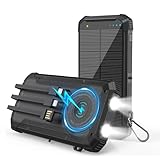
At 3.2 ounces and 5.63 by 2.91 by 0.85 inches, this is the lightest unit here by a wide margin and the one I would pack for a fast day hike where weight is the deciding factor. The 4.0 rating across 722 reviews is the lowest in the group, and the reasons for that are mostly about capacity rather than quality.
Twenty thousand milliamp-hours works out to roughly two to three full smartphone charges. That is comfortable for a day with navigation and music, and tight for anything longer. The connection options are generous for the size, with three built-in cables, a USB-A output and a wireless charging pad covering five to six devices.
Output is a steady 15W, reaching about 50% in an hour, and owners specifically note it does not overheat, which is a real concern with several small units in this category. A multi-protection chip guards against short circuits.
The flashlight has three modes, strong, strobe and SOS, toggled by holding the power button for three to five seconds, and a carabiner is included. The footprint is genuinely pocketable, which no other unit in this group manages.
One thing to know before a trip: the cell arrives in a sleep state and needs six to eight hours on a wall charger to activate. Budget that evening, not the morning of.
The case for the lightest option
Weight is the metric that decides hikes, and at under a quarter of a pound this changes how a day feels. Pairs nicely with our picks for wool socks for hiking and trekking poles when you are building a kit where every gram is counted.
It is also the sensible choice as a second, always-carried bank. A tiny unit in the lid pocket as a phone-rescue reserve costs almost nothing and covers the most common emergency on trail.
The limits you should accept up front
Two to three charges is the whole budget. If you carry a phone that spends all day on navigation, expect to be topping up daily, and expect the reserve to be gone by day two on a longer trip.
It is weather-resistant against light splashes rather than fully waterproof, so it belongs in a pocket rather than strapped to the outside of a pack in rain. The panel is explicitly an emergency-only feature, and the panel itself is the least useful of the solar options here. For trips with a real weather exposure or a multi-night plan, step up a size.
Are Solar Power Banks Worth It? The Honest Verdict for Hikers
Are solar power banks worth it for hiking? Only as a backup, and only if you charge the bank fully before you leave. Every unit in this group has a panel that produces trickle current by hiking standards, and the consistent feedback across reviews is that the panel is an emergency feature. If you expect it to recharge your phone over a day of walking, you will be disappointed.
There is a strong argument for carrying a plain high-capacity power bank and a separate folding solar panel instead, and the major review outlets cited in search results reach that same conclusion. A folding panel puts real watts on the sun and charges a plain bank far faster than a panel bonded to a bank casing ever can, because the panel gets to be large without making the battery heavy.
So who should buy an integrated unit anyway? Three groups. Anyone building a vehicle kit or go-bag wants a single object that works in an outage. Thru-hikers with long stretches without resupply want emergency top-ups without carrying extra cable. And anyone whose trip is planned around long stationary stops has a real use for a panel that keeps a bank topped up at base camp.
If your trip is a normal weekend on maintained trails, the honest answer is that a plain power bank sized to your trip is cheaper, lighter and better, and the solar version is a premium you pay for reassurance rather than function.
How Solar Actually Performs in the Field
The core limitation is physical. A panel bonded to a bank casing is measured in square inches, and small panels collect small amounts of energy. Expect a trickle measured in fractions of a phone charge over an hour of good sun, not a meaningful top-up. Multiple makers in this list now describe the panel as emergency-only in their own documentation, which is a useful honesty signal.
Position matters more than panel count. Reports from hikers describe panels working well when fully stopped in direct sun and failing completely in shade or when the unit sits flat against a pack against your back. If you mount it on a shoulder strap and keep walking, expect close to nothing. Unclip it, lay it flat in the sun and give it real time.
The other honest issue is that power banks sometimes stop accepting solar input part by partway through a charge cycle. Owners on forums describe the indicator simply quitting mid-session, which usually reflects a charge controller throttling input or shutting down at a high state of charge rather than a fault. Restarting the unit, or charging over USB before relying on the panel, is the workaround.
Cold weather is the fourth factor and one that hardly any roundup mentions. Lithium cells deliver less capacity in cold conditions, and a bank that is warm from body heat outperforms a larger bank strapped to a cold pack. Keeping the bank in an inside pocket is the single most effective cold-weather trick available.
How to Size Your Power Bank for Your Trip
Start with devices, not marketing numbers. A phone charged once a day is roughly 10 watt-hours. A GPS watch, a headlamp and a pair of earbuds together might draw 3 to 5 watt-hours a day. Add a satellite communicator and you are managing a transmitting device that can eat real capacity during a week of check-ins.
Then apply a conversion, because rated mAh does not equal usable energy. A 10,000mAh lithium-polymer cell at 3.7V holds about 37 watt-hours in theory, and you should expect 70 to 90 percent of rated capacity in real use after conversion losses, temperature and cable overhead. Measuring in watt-hours also stops the inflated mAh headlines from distorting your plan.
A one-day hike needs about 15 watt-hours of usable power, so a 10,000 to 20,000mAh unit covers it with room to spare. A three-day trip with a phone, watch and headlamp lands near 45 watt-hours, which points at the 30,000 to 40,000mAh class. A week needs roughly 100 watt-hours, and that is where the 40,000mAh and 50,000mAh units earn their weight.
For a ten-night trip, plan for two banks or a much larger capacity than you want to carry, because the 49,800mAh and 50,000mAh units still only cover around four to five heavy phone days plus smaller devices. The best solar power banks for hiking are sized this way: bank for the days you might need, panel for the days you hope you do not.
If you fly, check the watt-hour limit before you travel. Most carriers cap spare lithium batteries at 100 watt-hours for carry-on, and banks above that are not permitted in the cabin at all. Compare the watt-hour figure on the device, not the mAh number, and keep the terminals protected in the cabin.
What to Look for When Buying a Solar Power Bank
Start with sealing. IPX5 handles rain and splashes, IP65 adds dust protection, and IP67 is the one to pick for sustained rain, river crossings and dusty trails. Water ingress is the most common field failure reported by hikers, and it is the cheapest failure to design out.
Next, look at ports rather than panel count. USB-C Power Delivery and QC 3.0 determine how fast your phone refills, and those speeds matter far more day to day than a second solar panel. Built-in cables save pack weight, and a wireless pad is useful at camp when nobody wants to hold a cable.
Then weigh usable watt-hours against pack grams rather than the mAh label. A 48,000mAh bank that delivers about 60 Wh of real energy in a bulky shell is a different proposition from a 20,000mAh bank in a pocket. If you also carry navigation gear, our guides to monoculars for hiking and high-capacity power banks for photographers both reduce to the same weight-versus-capacity calculation.
Finally, check the warranty and the review history. Three years of coverage is available on some units here, and a listing with tens of thousands of reviews tells you far more about survival after two seasons than a new one with a handful. Both signals are cheap to check and hard to replace after a failure on day four of a trip.
Frequently Asked Questions
What is the best power bank for hiking?
For most hikers the BLAVOR 10,000mAh solar power bank is the best balance: 0.2 kg, IPX5 sealing, 20W USB-C output and wireless charging, with two to three full phone charges. For multi-day trips the SOARAISE 50,000mAh offers far more headroom with 22.5W PD, while the Mregb is the pick when IP67 sealing matters more than wireless charging.
What is the best power bank for thru-hiking?
Thru-hikers should size by usable watt-hours, not mAh. Budget roughly 15 watt-hours per day for a phone plus watch, headlamp and earbuds, then divide by 0.7 to 0.9 for real-world conversion loss. A three-day push lands near 45 watt-hours, a full week near 100, so a 40,000mAh to 50,000mAh bank is the realistic choice.
Are solar power banks worth it?
Only as a backup. The panels on compact banks produce trickle current and need the unit stopped in direct sun to produce anything useful. A plain high-capacity power bank paired with a separate folding solar panel charges far faster. Integrated solar banks make sense for vehicle kits, go-bags, and trips with long stationary stops.
What is the best portable power bank for hikers?
For pure portability the Luvknit 20,000mAh is the lightest at 3.2 ounces with three built-in cables and a wireless pad, though it only holds two to three phone charges and is splash-resistant rather than waterproof. For a durable everyday carry the BLAVOR at 0.2 kg is the stronger all-round answer.
Can I take a power bank on a plane?
Yes, within limits. Most airlines restrict spare lithium batteries to 100 watt-hours in carry-on luggage, and the rule is based on watt-hours rather than the mAh figure on the box. Check the label, keep the terminals protected, and do not check spare batteries in hold luggage. Banks above the limit are not permitted in the cabin at all.
Does solar charging work in the shade?
Not usefully. Output drops sharply once a panel loses direct sun, and hikers report that a panel mounted on a moving pack or under tree cover barely registers. Unclip the unit, lay it flat in open sun and give it a full stop, which is the only configuration that produces a measurable top-up.
Final Verdict for Hikers in 2026
The best solar power banks for hiking in 2026 are the ones you size honestly and treat as battery-first, panel-second. The BLAVOR 10,000mAh wins this roundup for day hikes and ultralight carry, holding up under 47356 reviews with sealing, lights and a genuinely pocketable 0.2 kg frame. The SOARAISE 50,000mAh is the pick for multi-day and thru-hike trips where 22.5W charging and a large cell earn their grams, and the Mregb 42,800mAh is the one to carry when rain, dust and river crossings are part of the route.
Charge whichever you choose fully before you leave, keep it in an inside pocket when the weather turns, and treat any solar top-up as a bonus rather than a plan. If you are still deciding, the honest alternative remains a plain high-capacity bank plus a separate folding panel, and it will serve most hikers better than any integrated panel.